QUESTION IMAGE
Question
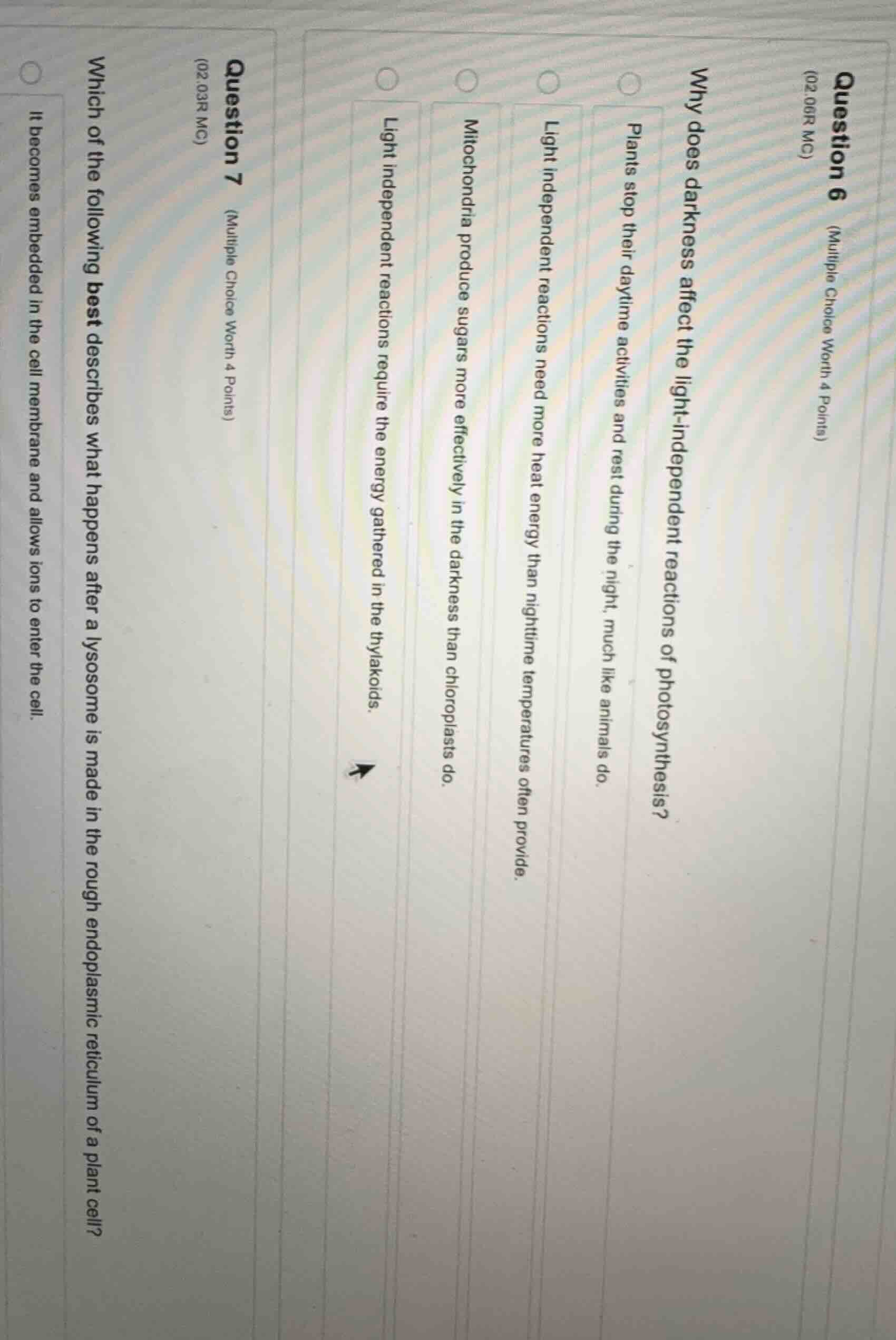
question 6 (02.06r mc) (multiple choice worth 4 points) why does darkness affect the light - independent reactions of photosynthesis? plants stop their daytime activities and rest during the night, much like animals do. light independent reactions need more heat energy than nighttime temperatures often provide. mitochondria produce sugars more effectively in the darkness than chloroplasts do. light independent reactions require the energy gathered in the thylakoids. question 7 (02.03r mc) (multiple choice worth 4 points) which of the following best describes what happens after a lysosome is made in the rough endoplasmic reticulum of a plant cell? it becomes embedded in the cell membrane and allows ions to enter the cell.
Question 6
To determine why darkness affects light - independent reactions of photosynthesis, we analyze each option:
- Option 1: Plants do not "stop activities" like animals resting; they still perform metabolic processes, so this is incorrect.
- Option 2: Light - independent reactions (Calvin cycle) do not require heat energy related to daytime/nighttime temperatures in this way, so this is incorrect.
- Option 3: Mitochondria produce ATP (energy for cell work), not sugars, and chloroplasts (not mitochondria) are for photosynthesis, so this is incorrect.
- Option 4: Light - independent reactions (Calvin cycle) use ATP and NADPH produced in the light - dependent reactions (which occur in thylakoids and need light). In darkness, the light - dependent reactions stop, so the light - independent reactions lack the energy (from thylakoid - gathered energy in light - dependent reactions) to continue effectively. So this option is correct.
Proteins made in the rough endoplasmic reticulum (rough ER) of a plant cell are processed and transported. If a protein is involved in ion transport, after processing (possibly related to lysosomal - associated processing? Or more likely, normal protein trafficking), it can become embedded in the cell membrane as an ion channel or carrier, allowing ions to enter the cell. The option "It becomes embedded in the cell membrane and allows ions to enter the cell" describes a protein (like an ion channel) that is synthesized in rough ER, processed, and then inserted into the cell membrane to facilitate ion transport.

Snap & solve any problem in the app
Get step-by-step solutions on Sovi AI
Photo-based solutions with guided steps
Explore more problems and detailed explanations
The correct option is "Light independent reactions require the energy gathered in the thylakoids."
Question 7
(Note: Since the option for Question 7 is partially visible as "It becomes embedded in the cell membrane and allows ions to enter the cell", we assume this is a question about the fate of a protein (likely a channel or carrier protein) made in rough ER and processed by lysosome? Wait, actually, proteins made in rough ER are transported to Golgi, then to lysosomes or cell membrane. If a protein is made in rough ER, sent to lysosome - related processing, and then becomes a membrane protein (like an ion channel), the option "It becomes embedded in the cell membrane and allows ions to enter the cell" makes sense for a protein that becomes an ion channel (e.g., a channel protein for ion transport). So: