QUESTION IMAGE
Question
question 1-16
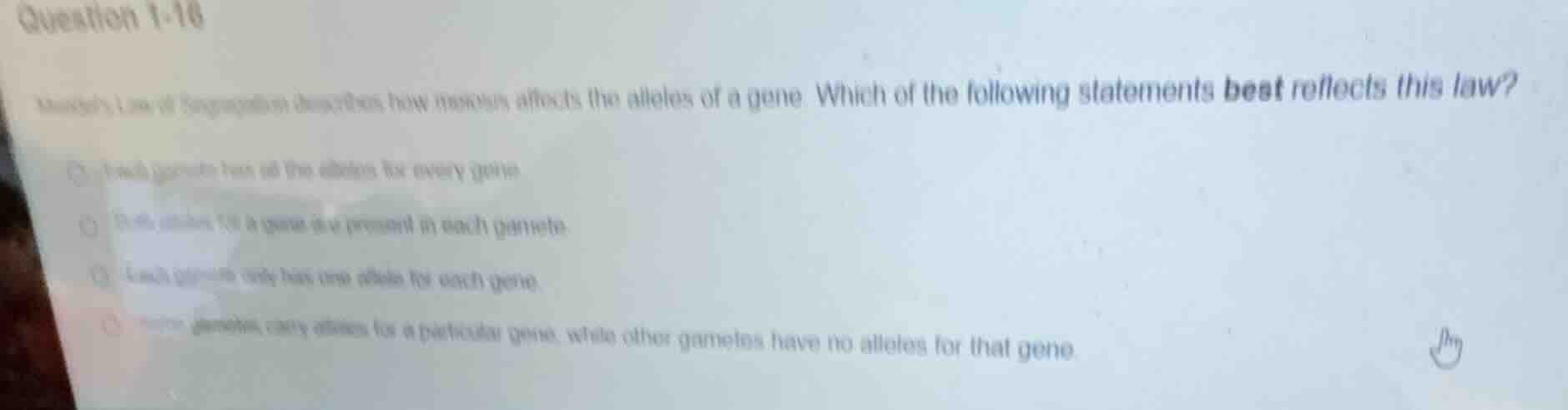
mendel’s law of segregation describes how meiosis affects the alleles of a gene. which of the following statements best reflects this law?
- each gamete has all the alleles for every gene
- both alleles for a gene are present in each gamete
- each gamete only has one allele for each gene
- some gametes carry alleles for a particular gene, while other gametes have no alleles for that gene
Mendel's Law of Segregation states that during gamete formation, the two alleles of a gene separate (segregate) so that each gamete carries only one allele for each gene. Let's analyze each option:
- Option 1: Gametes don't have all alleles for a gene; they get one allele per gene after segregation, so this is incorrect.
- Option 2: "Both alleles to a gene are present in each gamete" is wrong because segregation means alleles separate, so each gamete has one allele, not both.
- Option 3: Wait, no—wait, the correct understanding is that each gamete has one allele for each gene (since the two alleles in the parent cell segregate into different gametes). Wait, maybe there's a typo in the option? Wait, the third option says "Each gamete only has one allele for each gene"—that matches the law. Wait, let's re - check. Mendel's Law of Segregation: when gametes are formed, the two alleles of a heritable character segregate (separate) during gamete formation and end up in different gametes. So each gamete receives one allele for each gene. So the third option (assuming the option is "Each gamete only has one allele for each gene") is correct. Wait, but let's check the options again. Wait, the original options:
Wait, the user's options:
- Each gamete has all the alleles for every gene – wrong, because alleles segregate, so gametes get one allele per gene.
- Both alleles for a gene are present in each gamete – wrong, segregation means they separate, so each gamete has one.
- Each gamete only has one allele for each gene – this is correct, as per the law (the two alleles in the parent cell (like in a diploid cell) segregate into different gametes, so each gamete has one allele per gene).
- Some gametes carry alleles for a particular gene, while other gametes have no alleles for that gene – wrong, all gametes for a particular gene will have one allele (assuming normal segregation), not some with and some without.
So the correct option is the one that says "Each gamete only has one allele for each gene" (assuming that's option 3 or whatever the identifier is). Wait, but the user's options: let's see the original text. The user's options:
- First option: Each gamete has all the alleles for every gene
- Second: Both alleles for a gene are present in each gamete
- Third: Each gamete only has one allele for each gene
- Fourth: Some gametes carry alleles for a particular gene, while other gametes have no alleles for that gene
So the correct answer is the third option (assuming the third option is labeled as, say, C or whatever the identifier is. But since the user didn't label the options with letters, but in the original problem, we can assume the third option is the correct one.

Snap & solve any problem in the app
Get step-by-step solutions on Sovi AI
Photo-based solutions with guided steps
Explore more problems and detailed explanations
The statement that best reflects Mendel's Law of Segregation is "Each gamete only has one allele for each gene" (the third option among the given choices).