QUESTION IMAGE
Question
question 1-7
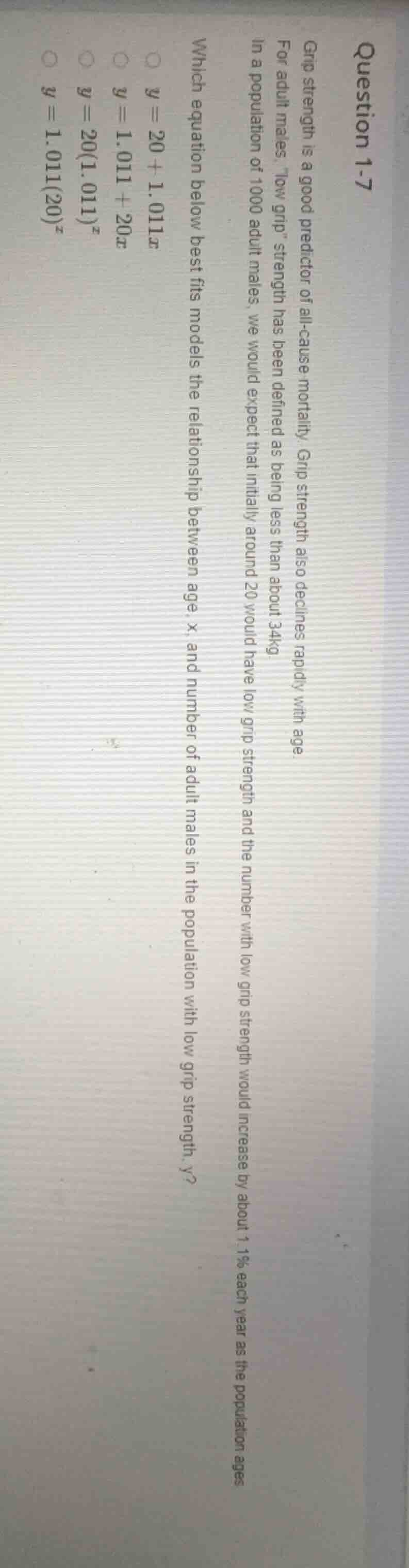
grip strength is a good predictor of all - cause mortality. grip strength also declines rapidly with age.
for adult males, “low grip” strength has been defined as being less than about 34kg.
in a population of 1000 adult males, we would expect that initially around 20 would have low grip strength and the number with low grip strength would increase by about 1.1% each year as the population ages.
which equation below best fits models the relationship between age, ( x ), and number of adult males in the population with low grip strength, ( y )?
( y = 20 + 1.011x )
( y = 1.011 + 20x )
( y = 20(1.011)^{x} )
( y = 1.011(20)^{x} )
Step1: Identify initial value
The problem states that at age $x=0$ (initial), the number of males with low grip strength is 20. This is the starting value $a$ in a growth model.
Step2: Identify growth rate
The number increases by 1.1% each year. A 1.1% growth rate means the growth factor $r = 1 + 0.011 = 1.011$.
Step3: Match to exponential model
Exponential growth models follow the form $y = a(1+r)^x$, where $a$ is the initial value, $r$ is the growth rate, and $x$ is time (age here). Substituting the values, we get $y = 20(1.011)^x$.
Step4: Eliminate other options
- Linear models ($y=20+1.011x$, $y=1.011+20x$) show constant additive growth, not the 1.1% relative growth described.
- $y=1.011(20)^x$ has an incorrect initial value and growth factor, as it would mean the initial value is 1.011, which does not match the problem.

Snap & solve any problem in the app
Get step-by-step solutions on Sovi AI
Photo-based solutions with guided steps
Explore more problems and detailed explanations
$\boldsymbol{y = 20(1.011)^x}$