QUESTION IMAGE
Question
question 5 of 10
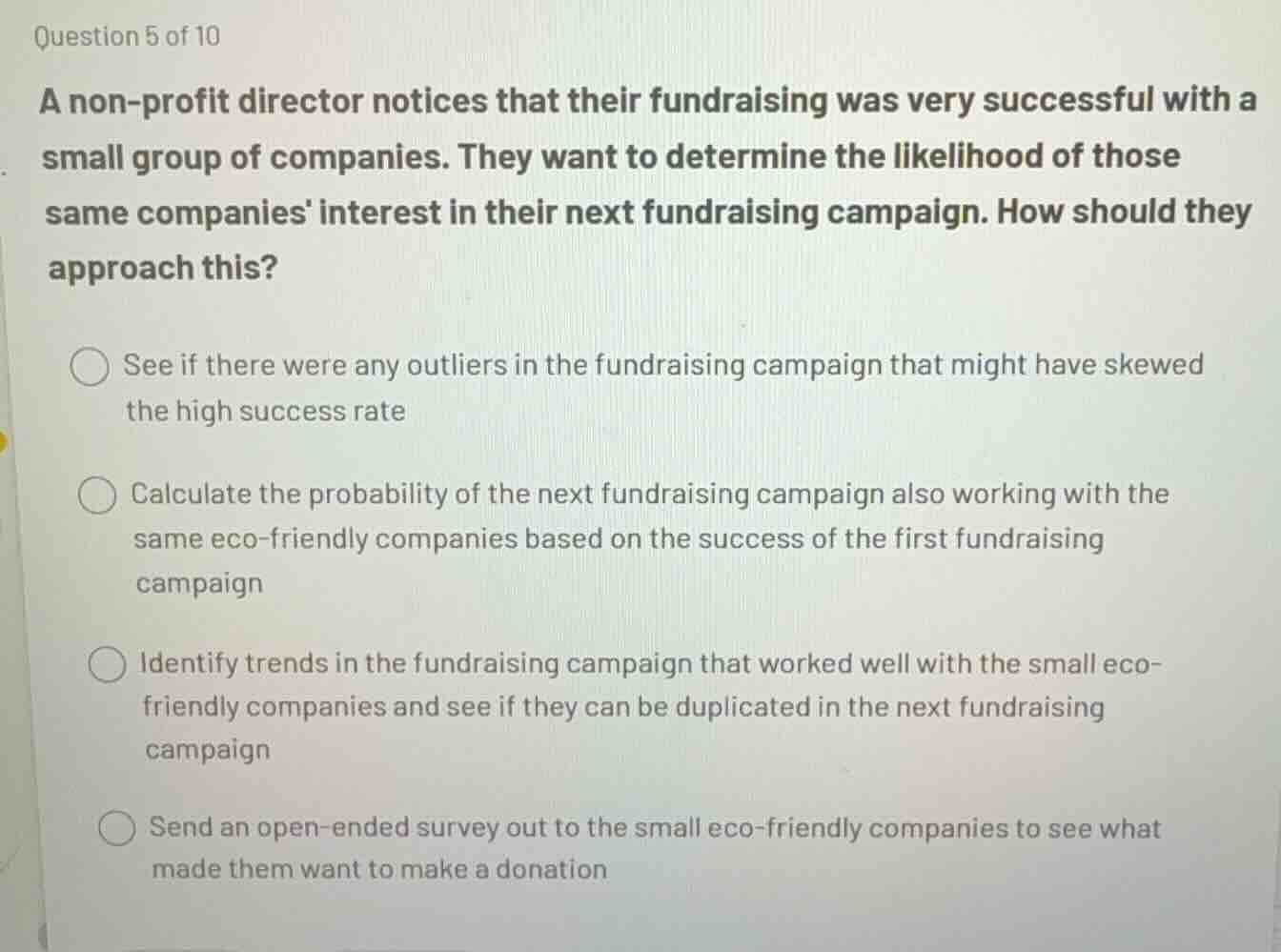
a non - profit director notices that their fundraising was very successful with a small group of companies. they want to determine the likelihood of those same companies interest in their next fundraising campaign. how should they approach this?
- see if there were any outliers in the fundraising campaign that might have skewed the high success rate
- calculate the probability of the next fundraising campaign also working with the same eco - friendly companies based on the success of the first fundraising campaign
- identify trends in the fundraising campaign that worked well with the small eco - friendly companies and see if they can be duplicated in the next fundraising campaign
- send an open - ended survey out to the small eco - friendly companies to see what made them want to make a donation
To determine the likelihood of the same companies' interest in the next fundraising campaign, the non - profit director should understand what motivated the companies to donate in the first place. Sending an open - ended survey to the small eco - friendly companies to find out what made them want to donate will provide direct insights into their interests and motivations. This information can then be used to assess the likelihood of their interest in the next campaign. Option A is about checking for outliers, which doesn't directly address the likelihood of future interest. Option B is about calculating probability, but without knowing the underlying reasons for the first campaign's success, the probability calculation may not be accurate. Option C is about identifying trends, but trends alone may not capture the specific interests of the companies as well as directly asking them through a survey.

Snap & solve any problem in the app
Get step-by-step solutions on Sovi AI
Photo-based solutions with guided steps
Explore more problems and detailed explanations
D. Send an open - ended survey out to the small eco - friendly companies to see what made them want to make a donation