QUESTION IMAGE
Question
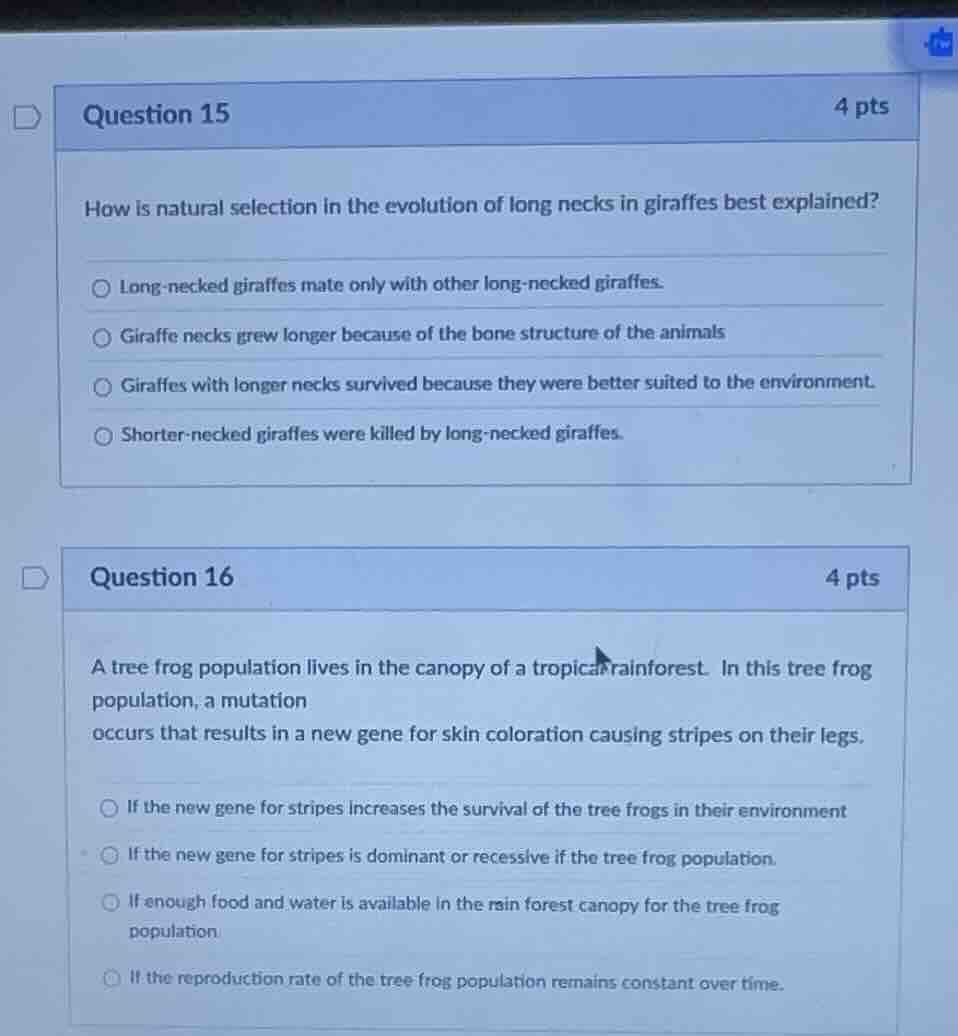
question 15
how is natural selection in the evolution of long necks in giraffes best explained?
long - necked giraffes mate only with other long - necked giraffes.
giraffe necks grew longer because of the bone structure of the animals
giraffes with longer necks survived because they were better suited to the environment.
shorter - necked giraffes were killed by long - necked giraffes.
question 16
a tree frog population lives in the canopy of a tropical rainforest. in this tree frog population, a mutation
occurs that results in a new gene for skin coloration causing stripes on their legs.
if the new gene for stripes increases the survival of the tree frogs in their environment
if the new gene for stripes is dominant or recessive if the tree frog population.
if enough food and water is available in the rain forest canopy for the tree frog
population
if the reproduction rate of the tree frog population remains constant over time.
For Question 15: Natural selection is the process where organisms with traits better suited to their environment survive and reproduce more successfully. Long-necked giraffes could access more food (taller vegetation) than shorter-necked ones, so they survived and passed on their traits.
For Question 16: A trait will become common in a population via natural selection only if it improves the organism's survival and reproductive success in its environment. Dominance/recessiveness, resource availability, or constant reproduction rate do not directly drive the spread of a new beneficial trait.

Snap & solve any problem in the app
Get step-by-step solutions on Sovi AI
Photo-based solutions with guided steps
Explore more problems and detailed explanations
Question 15: Giraffes with longer necks survived because they were better suited to the environment.
Question 16: If the new gene for stripes increases the survival of the tree frogs in their environment