QUESTION IMAGE
Question
question 15
1 pts
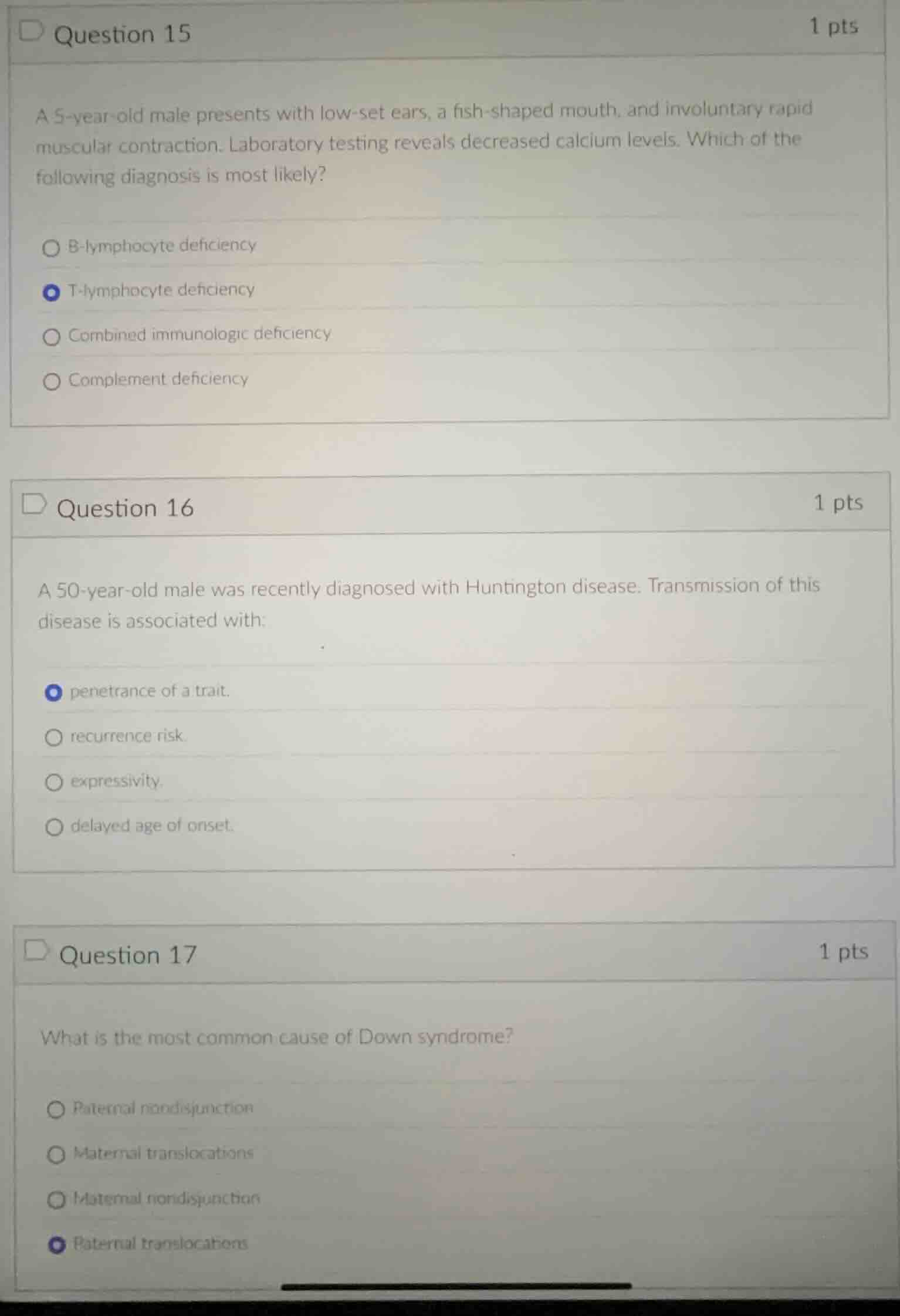
a 5-year-old male presents with low-set ears, a fish-shaped mouth, and involuntary rapid muscular contraction. laboratory testing reveals decreased calcium levels. which of the following diagnosis is most likely?
- b-lymphocyte deficiency
- t-lymphocyte deficiency
- combined immunologic deficiency
- complement deficiency
question 16
1 pts
a 50-year-old male was recently diagnosed with huntington disease. transmission of this disease is associated with:
- penetrance of a trait.
- recurrence risk.
- expressivity.
- delayed age of onset.
question 17
1 pts
what is the most common cause of down syndrome?
- paternal nondisjunction
- maternal translocations
- maternal nondisjunction
- paternal translocations
Question 15
The symptoms (low - set ears, fish - shaped mouth, involuntary rapid muscular contraction, decreased calcium) are associated with DiGeorge syndrome, which involves T - lymphocyte deficiency due to thymus hypoplasia. B - lymphocyte deficiency affects B cells (not matching symptoms), combined immunologic deficiency affects both B and T (symptoms here point to T - cell issue), and complement deficiency affects the complement system (not related to these symptoms).
Huntington disease has a delayed age of onset (symptoms appear later in life, like at 50 here). Penetrance is about how many with the gene show symptoms, recurrence risk is about family risk, and expressivity is about symptom severity variation. The key here is the late onset, so delayed age of onset is correct.
The most common cause of Down syndrome is maternal nondisjunction (trisomy 21 from mother's egg having an extra chromosome 21). Paternal nondisjunction is less common, maternal translocations and paternal translocations are less frequent causes compared to maternal nondisjunction.

Snap & solve any problem in the app
Get step-by-step solutions on Sovi AI
Photo-based solutions with guided steps
Explore more problems and detailed explanations
B. T - lymphocyte deficiency