QUESTION IMAGE
Question
question 38 of 50
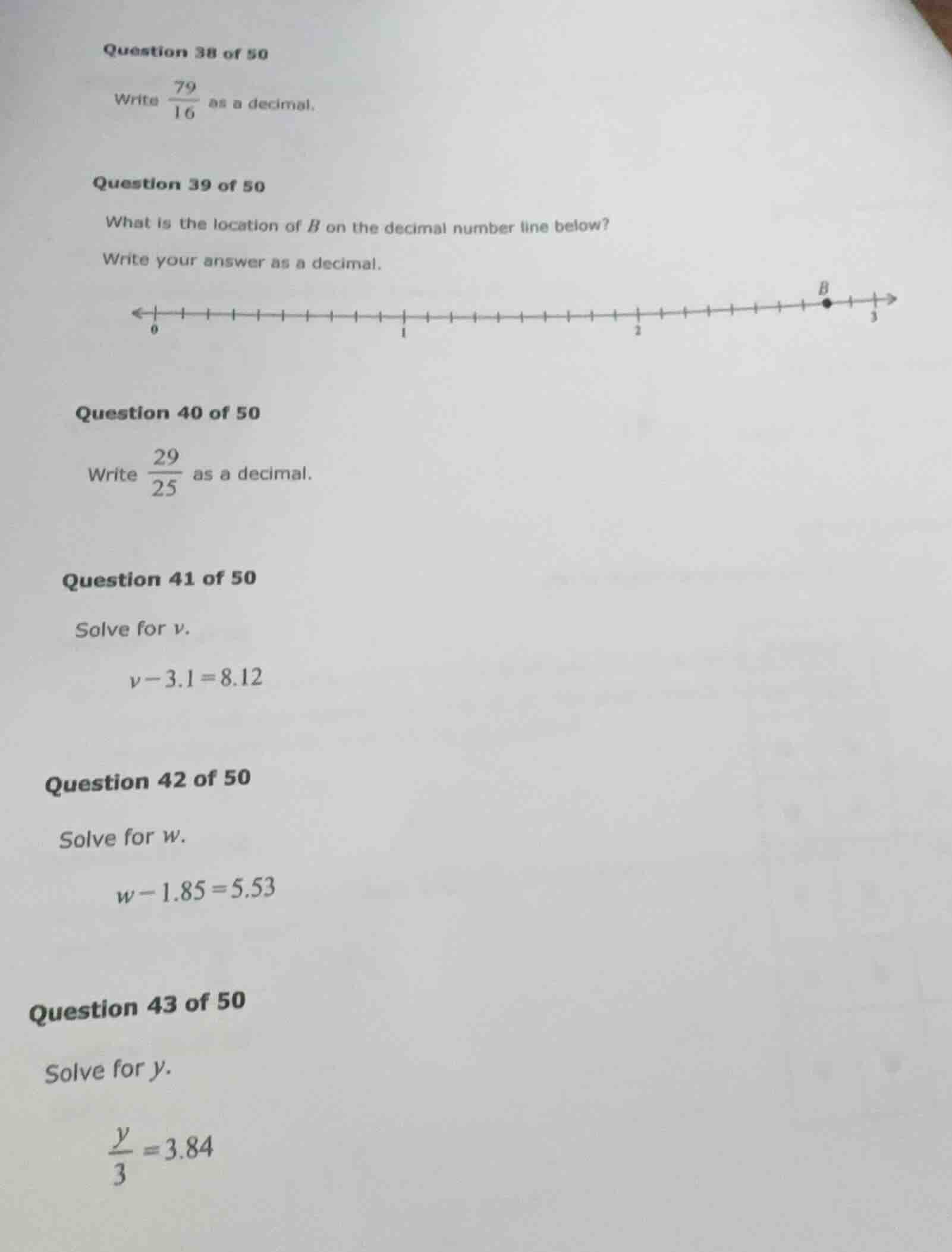
write \\(\frac{79}{16}\\) as a decimal.
question 39 of 50
what is the location of \\(b\\) on the decimal number line below?
write your answer as a decimal.
question 40 of 50
write \\(\frac{29}{25}\\) as a decimal.
question 41 of 50
solve for \\(v\\).
\\(v - 3.1 = 8.12\\)
question 42 of 50
solve for \\(w\\).
\\(w - 1.85 = 5.53\\)
question 43 of 50
solve for \\(y\\).
\\(\frac{y}{3} = 3.84\\)
Question 38
Step1: Divide 79 by 16
$79 \div 16 = 4.9375$
Step1: Determine the interval between marks
From 0 to 1, there are 10 small marks, so each mark is $0.1$. From 1 to 2, also 10 marks, each $0.1$. From 2 to 3, 10 marks, each $0.1$.
Step2: Count marks from 2 to B
From 2, moving towards 3, B is 8 marks after 2? Wait, no, let's re - examine. Wait, from 0 to 1: 10 intervals, so each interval is $1\div10 = 0.1$. From 1 to 2: 10 intervals, each 0.1. From 2 to 3: 10 intervals, each 0.1. Now, let's count the position of B. Let's see, the number line: 0, then 1, then 2, then towards 3. Let's count the number of units from 2. Let's assume that between 2 and 3, how many small ticks? Wait, maybe my initial thought was wrong. Wait, let's look at the number line: 0, then 1 (after 10 ticks from 0), then 2 (after 10 ticks from 1), then towards 3. Let's count the ticks from 2. Let's say from 2 to 3, there are 10 ticks, each 0.1. Now, B is 8 ticks before 3? Wait, no, the dot for B is 2.8? Wait, no, let's count again. Wait, 0 to 1: 10 intervals, so each is 0.1. 1 to 2: 10 intervals, each 0.1. 2 to 3: 10 intervals, each 0.1. Now, let's see the position of B. Let's count the number of intervals from 2. Let's say that from 2, moving towards 3, B is at 2 + 0.8? Wait, no, maybe the number of intervals between 0 and 1 is 10, so each interval is 0.1. Then from 1 to 2, 10 intervals, each 0.1. From 2 to 3, 10 intervals, each 0.1. Now, let's count the number of intervals from 2 to B. Let's see, the dot for B is 8 intervals after 2? Wait, no, maybe I made a mistake. Wait, let's calculate the value. Let's see, the distance from 2 to 3 is 1, divided into 10 equal parts, so each part is 0.1. Now, let's count how many parts from 2 to B. Let's assume that B is 0.8 units away from 2? No, wait, maybe the correct way is: Let's see, the number line: 0, 1, 2, then B is at 2.8? Wait, no, maybe the number of ticks between 2 and 3: let's count the number of small lines. Wait, maybe the correct answer is 2.8? Wait, no, let's do it properly. Let's find the length of each segment. From 0 to 1: there are 10 segments, so each segment is $1/10 = 0.1$. From 1 to 2: 10 segments, each 0.1. From 2 to 3: 10 segments, each 0.1. Now, let's find the position of B. Let's start from 2. Let's count the number of segments from 2 to B. Let's say that B is 8 segments after 2? Wait, no, maybe the number of segments from 2 to B is 8? Then the value is $2+ 8\times0.1=2.8$? Wait, no, maybe I miscounted. Wait, maybe the correct answer is 2.8? Wait, no, let's check again. Wait, the number line: 0, then 1 (after 10 ticks), then 2 (after 10 ticks from 1), then towards 3. Let's count the ticks from 2. Let's see, the dot for B is 8 ticks before 3? So from 2 to 3 is 1, 1 divided into 10 parts, so each part is 0.1. So 3 - 0.2 = 2.8? Yes, so B is at 2.8.
Step1: Convert the fraction to decimal by dividing 29 by 25
$29\div25 = 1.16$

Snap & solve any problem in the app
Get step-by-step solutions on Sovi AI
Photo-based solutions with guided steps
Explore more problems and detailed explanations
4.9375