QUESTION IMAGE
Question
question
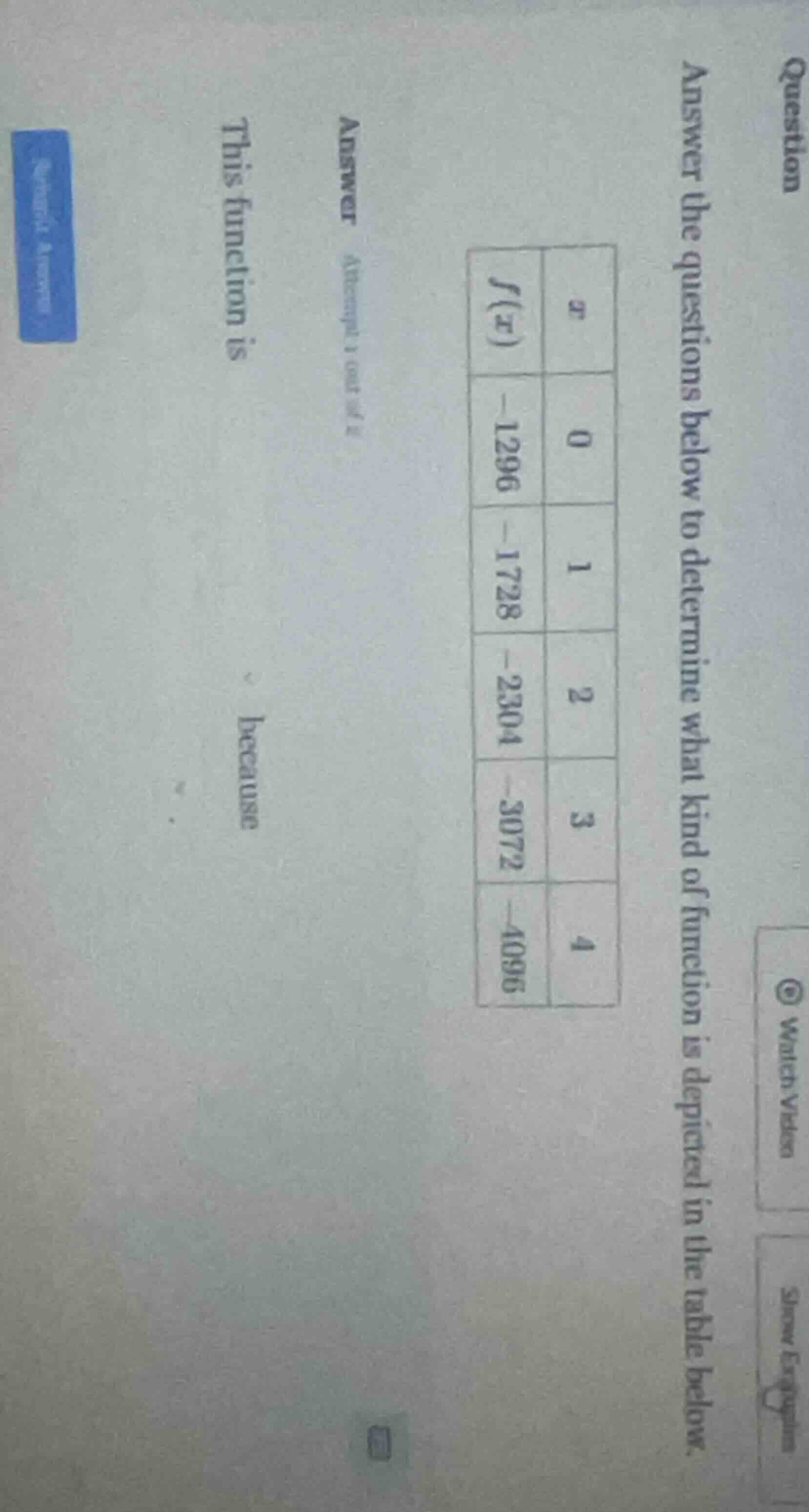
answer the questions below to determine what kind of function is depicted in the table below.
| x | f(x) |
|---|---|
| 1 | -1728 |
| 2 | -2304 |
| 3 | -3072 |
| 4 | -4096 |
answer attempt 1 out of 1
this function is
because
Step1: Calculate first differences
Find the differences between consecutive \( f(x) \) values.
For \( x = 0 \) to \( x = 1 \): \( -1728 - (-1296) = -432 \)
For \( x = 1 \) to \( x = 2 \): \( -2304 - (-1728) = -576 \)
For \( x = 2 \) to \( x = 3 \): \( -3072 - (-2304) = -768 \)
For \( x = 3 \) to \( x = 4 \): \( -4096 - (-3072) = -1024 \)
Step2: Calculate second differences
Find differences of the first differences.
\( -576 - (-432) = -144 \)
\( -768 - (-576) = -192 \)
\( -1024 - (-768) = -256 \)
Step3: Check for constant ratio (exponential)
Check if the ratio of consecutive \( f(x) \) values is constant.
\( \frac{-1728}{-1296} = \frac{4}{3} \)
\( \frac{-2304}{-1728} = \frac{4}{3} \)
\( \frac{-3072}{-2304} = \frac{4}{3} \)
\( \frac{-4096}{-3072} = \frac{4}{3} \)

Snap & solve any problem in the app
Get step-by-step solutions on Sovi AI
Photo-based solutions with guided steps
Explore more problems and detailed explanations
This function is \(\boldsymbol{\text{exponential}}\) because the ratio of consecutive \( f(x) \) values is constant (\(\frac{4}{3}\)), indicating exponential growth/decay.