QUESTION IMAGE
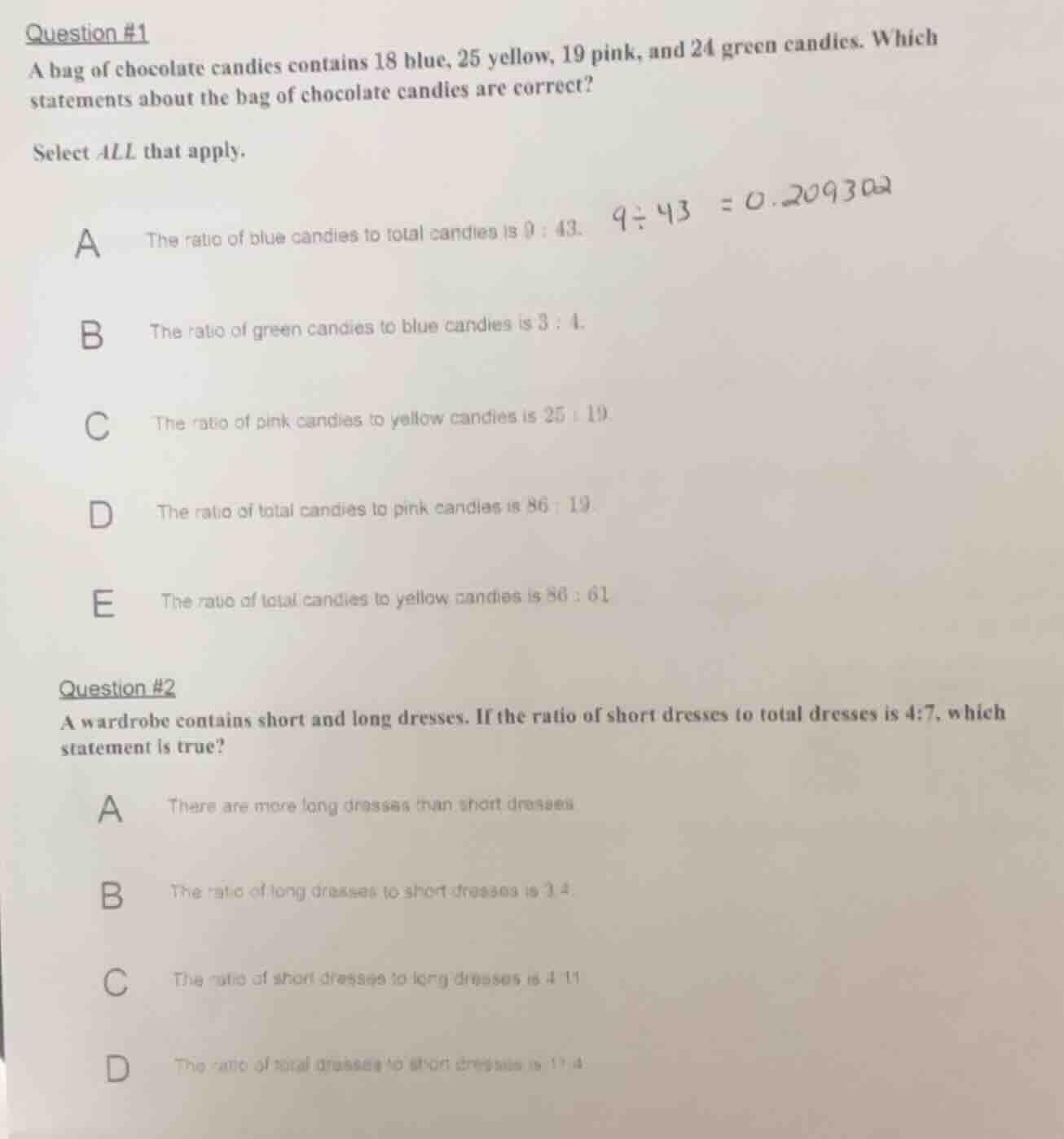
Question
question #1
a bag of chocolate candies contains 18 blue, 25 yellow, 19 pink, and 24 green candies. which statements about the bag of chocolate candies are correct?
select all that apply.
a the ratio of blue candies to total candies is 9 : 43.
9÷43 = 0.209302
b the ratio of green candies to blue candies is 3 : 4.
c the ratio of pink candies to yellow candies is 25 : 19.
d the ratio of total candies to pink candies is 86 : 19
e the ratio of total candies to yellow candies is 86 : 61
question #2
a wardrobe contains short and long dresses. if the ratio of short dresses to total dresses is 4:7, which statement is true?
a there are more long dresses than short dresses
b the ratio of long dresses to short dresses is 3:4.
c the ratio of short dresses to long dresses is 4:11
d the ratio of total dresses to short dresses is 11:4
Question #1
First, we calculate the total number of candies. The number of blue candies is 18, yellow is 25, pink is 19, and green is 24. So the total number of candies is \(18 + 25 + 19 + 24 = 86\).
Step 1: Analyze Option A
The number of blue candies is 18, and the total number of candies is 86. The ratio of blue candies to total candies is \(18:86\), which simplifies to \(9:43\) (dividing both numbers by 2). So Option A is correct.
Step 2: Analyze Option B
The number of green candies is 24, and the number of blue candies is 18. The ratio of green candies to blue candies is \(24:18\), which simplifies to \(4:3\) (dividing both numbers by 6), not \(3:4\). So Option B is incorrect.
Step 3: Analyze Option C
The number of pink candies is 19, and the number of yellow candies is 25. The ratio of pink candies to yellow candies is \(19:25\), not \(25:19\). So Option C is incorrect.
Step 4: Analyze Option D
The total number of candies is 86, and the number of pink candies is 19. The ratio of total candies to pink candies is \(86:19\). So Option D is correct.
Step 5: Analyze Option E
The total number of candies is 86, and the number of yellow candies is 25. The ratio of total candies to yellow candies is \(86:25\), not \(86:61\). So Option E is incorrect.
Given that the ratio of short dresses to total dresses is \(4:7\). Let the number of short dresses be \(4x\) and the total number of dresses be \(7x\). Then the number of long dresses is \(7x - 4x = 3x\).
Step 1: Analyze Option A
The number of short dresses is \(4x\) and the number of long dresses is \(3x\). Since \(4x>3x\) (for \(x>0\)), there are more short dresses than long dresses. So Option A is incorrect.
Step 2: Analyze Option B
The number of long dresses is \(3x\) and the number of short dresses is \(4x\). The ratio of long dresses to short dresses is \(3x:4x = 3:4\). So Option B is correct.
Step 3: Analyze Option C
The number of short dresses is \(4x\) and the number of long dresses is \(3x\). The ratio of short dresses to long dresses is \(4x:3x = 4:3\), not \(4:11\). So Option C is incorrect.
Step 4: Analyze Option D
The total number of dresses is \(7x\) and the number of short dresses is \(4x\). The ratio of total dresses to short dresses is \(7x:4x = 7:4\), not \(11:4\). So Option D is incorrect.

Snap & solve any problem in the app
Get step-by-step solutions on Sovi AI
Photo-based solutions with guided steps
Explore more problems and detailed explanations
A, D