QUESTION IMAGE
Question
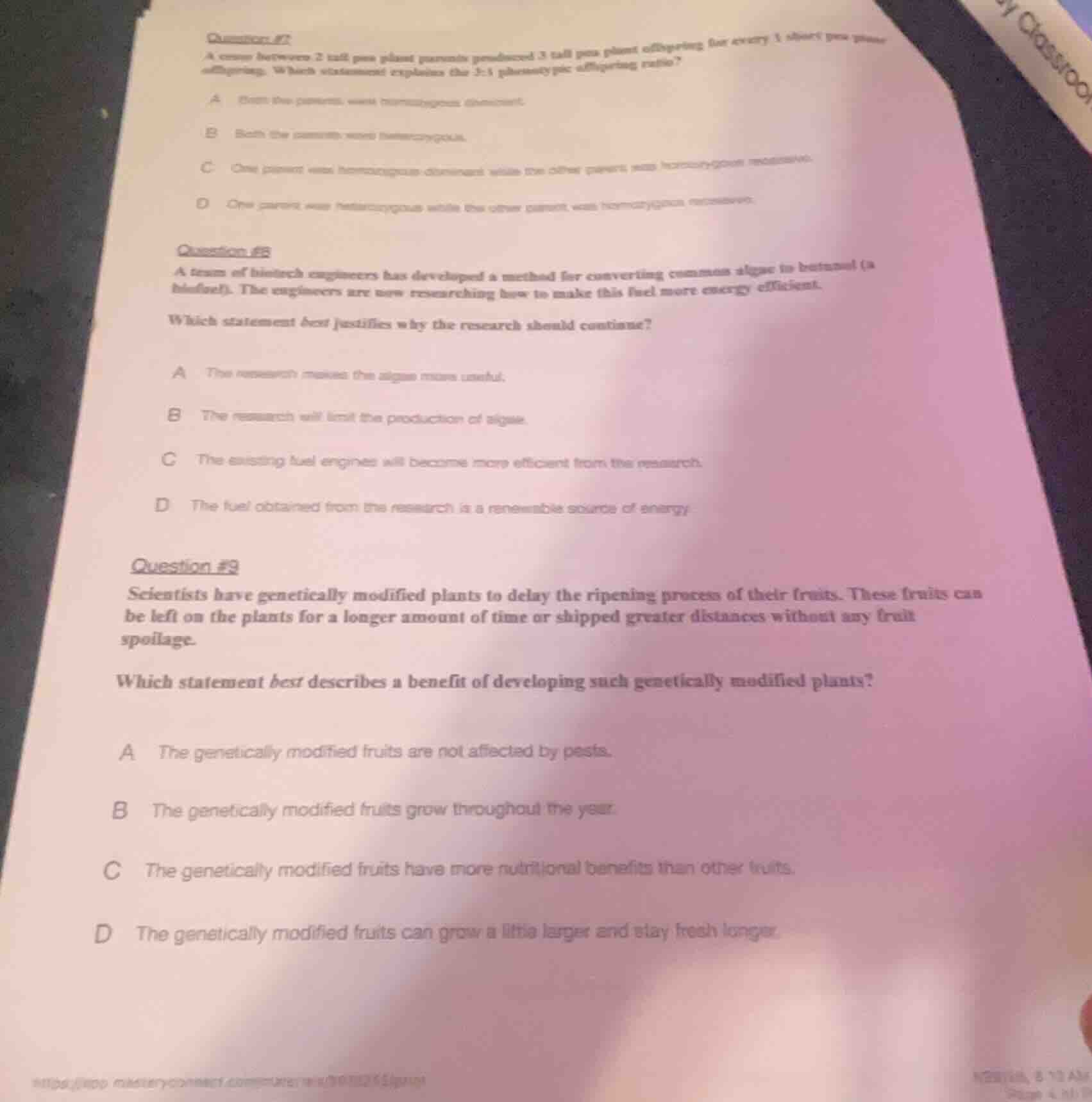
question #7: a cross between 2 tall pea plant parents produced 3 tall pea plant offspring for every 1 short pea plant offspring. which statement explains the 3:1 phenotypic offspring ratio? a both the parents were homozygous dominant. b both the parents were heterozygous. c one parent was homozygous dominant while the other parent was homozygous recessive. d one parent was heterozygous while the other parent was homozygous recessive. question #8: a team of biotech engineers has developed a method for converting common algae to butanol (a biofuel). the engineers are now researching how to make this fuel more energy efficient. which statement best justifies why the research should continue? a the research makes the algae more useful. b the research will limit the production of algae. c the existing fuel engines will become more efficient from the research. d the fuel obtained from the research is a renewable source of energy. question #9: scientists have genetically modified plants to delay the ripening process of their fruits. these fruits can be left on the plants for a longer amount of time or shipped greater distances without any fruit spoilage. which statement best describes a benefit of developing such genetically modified plants? a the genetically modified fruits are not affected by pests. b the genetically modified fruits grow throughout the year. c the genetically modified fruits have more nutritional benefits than other fruits. d the genetically modified fruits can grow a little larger and stay fresh longer.
Question #7
To determine the correct statement for the 3:1 phenotypic ratio in pea plants, we recall Mendelian genetics. A 3:1 ratio in offspring from two parents typically occurs when both parents are heterozygous (e.g., Tt × Tt, where T is dominant for tall and t is recessive for short). Let's analyze each option:
- Option A: If both parents were homozygous dominant (TT × TT), all offspring would be TT (tall), so no 3:1 ratio. Eliminate A.
- Option B: If both parents are heterozygous (Tt × Tt), the Punnett square gives genotypes TT, Tt, Tt, tt. Phenotypes: 3 tall (TT, Tt, Tt) and 1 short (tt), which is a 3:1 ratio. This matches.
- Option C: If one parent is homozygous dominant (TT) and the other is homozygous recessive (tt), offspring would be Tt (all tall), no 3:1 ratio. Eliminate C.
- Option D: If one parent is heterozygous (Tt) and the other is homozygous recessive (tt), offspring would be Tt and tt (1:1 ratio). Eliminate D.
We need to find the best justification for continuing the research on converting algae to biofuel (butanol) to make it more energy - efficient. Let's analyze each option:
- Option A: The research is about making the fuel (butanol) more energy - efficient, not making the algae more useful. The algae is the raw material, and the focus is on the fuel. Eliminate A.
- Option B: The research is about improving the fuel, not limiting algae production. Limiting algae production would not be a reason to continue research on fuel efficiency. Eliminate B.
- Option C: The research is about the fuel (butanol) being more energy - efficient, not about making existing fuel engines more efficient. The two are different concepts. Eliminate C.
- Option D: Butanol from algae is a renewable energy source (since algae can be regrown). Making a renewable fuel more energy - efficient is a strong reason to continue research, as it can help in sustainable energy production.
We need to find the best benefit of genetically modified plants that delay fruit ripening. Let's analyze each option:
- Option A: The modification is about ripening, not pest resistance. There's no information suggesting the fruits are not affected by pests. Eliminate A.
- Option B: The ripening - delay modification doesn't imply the fruits grow throughout the year. Growing throughout the year is related to factors like climate and plant variety, not ripening - delay. Eliminate B.
- Option C: The ripening - delay modification doesn't provide any information about increased nutritional benefits. The focus is on ripening and spoilage. Eliminate C.
- Option D: The plants are modified to delay ripening, so the fruits can stay on the plant longer or be shipped further without spoilage (stay fresh longer). Also, if the ripening process is controlled, it may allow for better growth (and potentially larger size) before ripening. This option aligns with the given benefits of the modification.

Snap & solve any problem in the app
Get step-by-step solutions on Sovi AI
Photo-based solutions with guided steps
Explore more problems and detailed explanations
B. Both the parents were heterozygous.