QUESTION IMAGE
Question
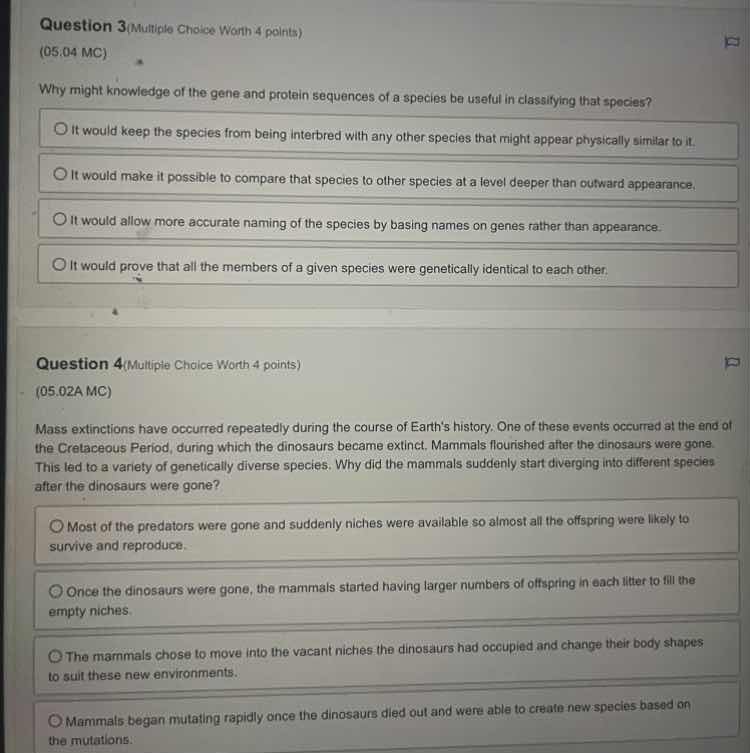
question 3 (multiple choice worth 4 points)
(05.04 mc)
why might knowledge of the gene and protein sequences of a species be useful in classifying that species?
- it would keep the species from being interbred with any other species that might appear physically similar to it.
- it would make it possible to compare that species to other species at a level deeper than outward appearance.
- it would allow more accurate naming of the species by basing names on genes rather than appearance.
- it would prove that all the members of a given species were genetically identical to each other.
question 4 (multiple choice worth 4 points)
(05.02a mc)
mass extinctions have occurred repeatedly during the course of earths history. one of these events occurred at the end of the cretaceous period, during which the dinosaurs became extinct. mammals flourished after the dinosaurs were gone. this led to a variety of genetically diverse species. why did the mammals suddenly start diverging into different species after the dinosaurs were gone?
- most of the predators were gone and suddenly niches were available so almost all the offspring were likely to survive and reproduce.
- once the dinosaurs were gone, the mammals started having larger numbers of offspring in each litter to fill the empty niches.
- the mammals chose to move into the vacant niches the dinosaurs had occupied and change their body shapes to suit these new environments.
- mammals began mutating rapidly once the dinosaurs died out and were able to create new species based on the mutations.
Question 3
- Option 1: Preventing interbreeding isn't the purpose of using gene/protein sequences for classification. Eliminate.
- Option 2: Gene and protein sequences reflect evolutionary relationships, allowing comparison beyond physical appearance. This makes sense for classification.
- Option 3: Naming species is based on taxonomic rules, not just genes. Eliminate.
- Option 4: Members of a species have genetic variation, not identical genes. Eliminate.
- Option 1: After dinosaurs (predators for many mammals) went extinct, ecological niches opened. With reduced predation, offspring survival/reproduction chances increased, leading to diversification. This aligns with adaptive radiation.
- Option 2: Mammals don't suddenly increase litter size to fill niches; reproduction strategies are more complex. Eliminate.
- Option 3: Mammals don't "choose" to change body shapes; evolution is driven by natural selection, not conscious choice. Eliminate.
- Option 4: Mutation rate doesn't suddenly spike; diversification is due to niche availability and natural selection, not rapid mutation. Eliminate.

Snap & solve any problem in the app
Get step-by-step solutions on Sovi AI
Photo-based solutions with guided steps
Explore more problems and detailed explanations
B. It would make it possible to compare that species to other species at a level deeper than outward appearance.