QUESTION IMAGE
Question
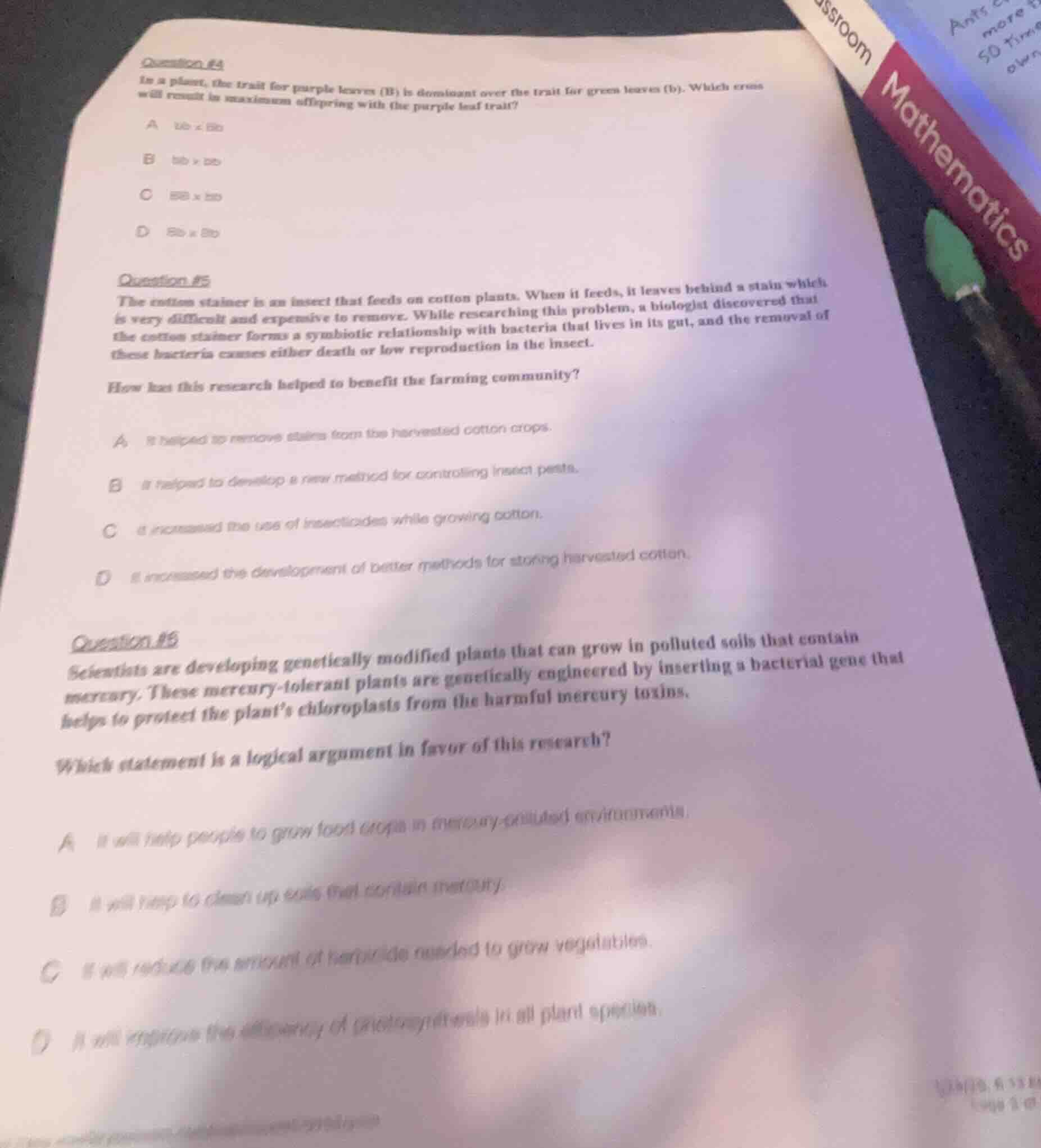
question #4
in a plant, the trait for purple leaves (b) is dominant over the trait for green leaves (b). which cross will result in maximum offspring with the purple leaf trait?
a bb × bb
b bb × bb
c bb × bb
d bb × bb
question #5
the cotton stainer is an insect that feeds on cotton plants. when it feeds, it leaves behind a stain which is very difficult and expensive to remove. while researching this problem, a biologist discovered that the cotton stainer forms a symbiotic relationship with bacteria that lives in its gut, and the removal of these bacteria causes either death or low reproduction in the insect.
how has this research helped to benefit the farming community?
a it helped to remove stains from the harvested cotton crops.
b it helped to develop a new method for controlling insect pests.
c it increased the use of insecticides while growing cotton.
d it increased the development of better methods for storing harvested cotton.
question #6
scientists are developing genetically modified plants that can grow in polluted soils that contain mercury. these mercury - tolerant plants are genetically engineered by inserting a bacterial gene that helps to protect the plant’s chloroplasts from the harmful mercury toxins.
which statement is a logical argument in favor of this research?
a it will help people to grow food crops in mercury - polluted environments.
b it will help to clean up soils that contain mercury.
c it will reduce the amount of herbicide needed to grow vegetables.
d it will increase the efficiency of photosynthesis in all plant species.
Question #4
Step1: Analyze each cross
- For cross A: \( Bb \times Bb \). Using Punnett square, the genotypes are \( BB, Bb, Bb, bb \). So purple ( \( BB, Bb \)) ratio is \( \frac{3}{4} \).
- For cross B: \( Bb \times bb \). Genotypes: \( Bb, Bb, bb, bb \). Purple ratio is \( \frac{2}{4}=\frac{1}{2} \).
- For cross C: \( BB \times bb \). Genotypes: \( Bb, Bb, Bb, Bb \). Purple ratio is \( 1 \) (all \( Bb \)).
- For cross D: \( Bb \times Bb \) (same as A, maybe typo? But C gives all purple - related? Wait, wait, \( BB \times bb \): all offspring are \( Bb \), which is purple. Wait, original options: let's re - check. Wait, the dominant is \( B \) (purple), recessive \( b \) (green). So \( BB \) and \( Bb \) are purple.
- Cross A: \( Bb\times Bb \): 3/4 purple.
- Cross B: \( Bb\times bb \): 2/4 purple.
- Cross C: \( BB\times bb \): all 4/4 (100%) purple (since all offspring are \( Bb \), which has purple trait as \( B \) is dominant).
- Cross D: If it's \( Bb\times Bb \) (same as A), but if it's a typo, but as per given, C is \( BB\times bb \), which gives all offspring with \( Bb \) (purple). So cross C gives maximum purple offspring.
- Option A: The research is about the insect's symbiotic bacteria, not removing stains from cotton. Eliminate A.
- Option B: Since removing the bacteria from the insect causes death or low reproduction, this can be used to control the insect pest (cotton stainer). This is a new method (targeting the symbiotic bacteria) for pest control.
- Option C: The research doesn't mention increasing insecticide use. Eliminate C.
- Option D: The research is about the insect, not storage methods for cotton. Eliminate D.
- Option A: The plants are for polluted soils with mercury, not for food crops in mercury - polluted areas (they are mercury - tolerant, not for food production context here). Eliminate A.
- Option B: If plants can grow in mercury - polluted soils, they can absorb mercury (phytoremediation concept), helping to clean up such soils. This is a logical argument for the research.
- Option C: The research is about mercury - tolerant plants, not herbicides. Eliminate C.
- Option D: The research is about a specific genetic modification for mercury tolerance, not about photosynthesis efficiency in all plants. Eliminate D.

Snap & solve any problem in the app
Get step-by-step solutions on Sovi AI
Photo-based solutions with guided steps
Explore more problems and detailed explanations
C. \( BB \times bb \)