QUESTION IMAGE
Question
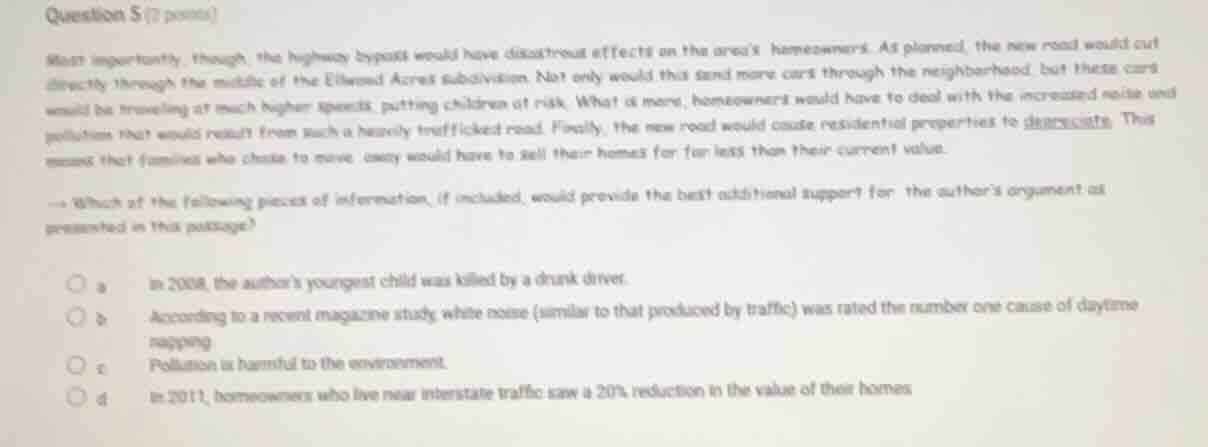
question 5 (7 points) most importantly, though, the highway bypass would have disastrous effects on the areas homeowners. as planned, the new road would cut directly through the middle of the ellwood acres subdivision. not only would this send more cars through the neighborhood, but these cars would be traveling at much higher speeds, putting children at risk. what is more, homeowners would have to deal with the increased noise and pollution that would result from such a heavily trafficked road. finally, the new road would cause residential properties to depreciate. this means that families who choose to move away would have to sell their homes for far less than their current value. -- which of the following pieces of information, if included, would provide the best additional support for the author’s argument as presented in this passage? a in 2008, the author’s youngest child was killed by a drunk driver. b according to a recent magazine study white noise (similar to that produced by traffic) was rated the number one cause of daytime napping c pollution is harmful to the environment. d in 2011, homeowners who live near interstate traffic saw a 20% reduction in the value of their homes
The author's argument focuses on the negative impacts of the highway bypass on homeowners, including property devaluation (homeowners having to sell for less). Option d provides specific data (20% reduction in home value for those near interstate traffic in 2011) that directly supports the claim about property devaluation. Option a is personal and not general support. Option b's focus on daytime napping is not relevant to the author's main points (risk to children, noise/pollution, property devaluation). Option c is too general about pollution and doesn't address the specific impacts on homeowners or property value.

Snap & solve any problem in the app
Get step-by-step solutions on Sovi AI
Photo-based solutions with guided steps
Explore more problems and detailed explanations
d. In 2011, homeowners who live near interstate traffic saw a 20% reduction in the value of their homes