QUESTION IMAGE
Question
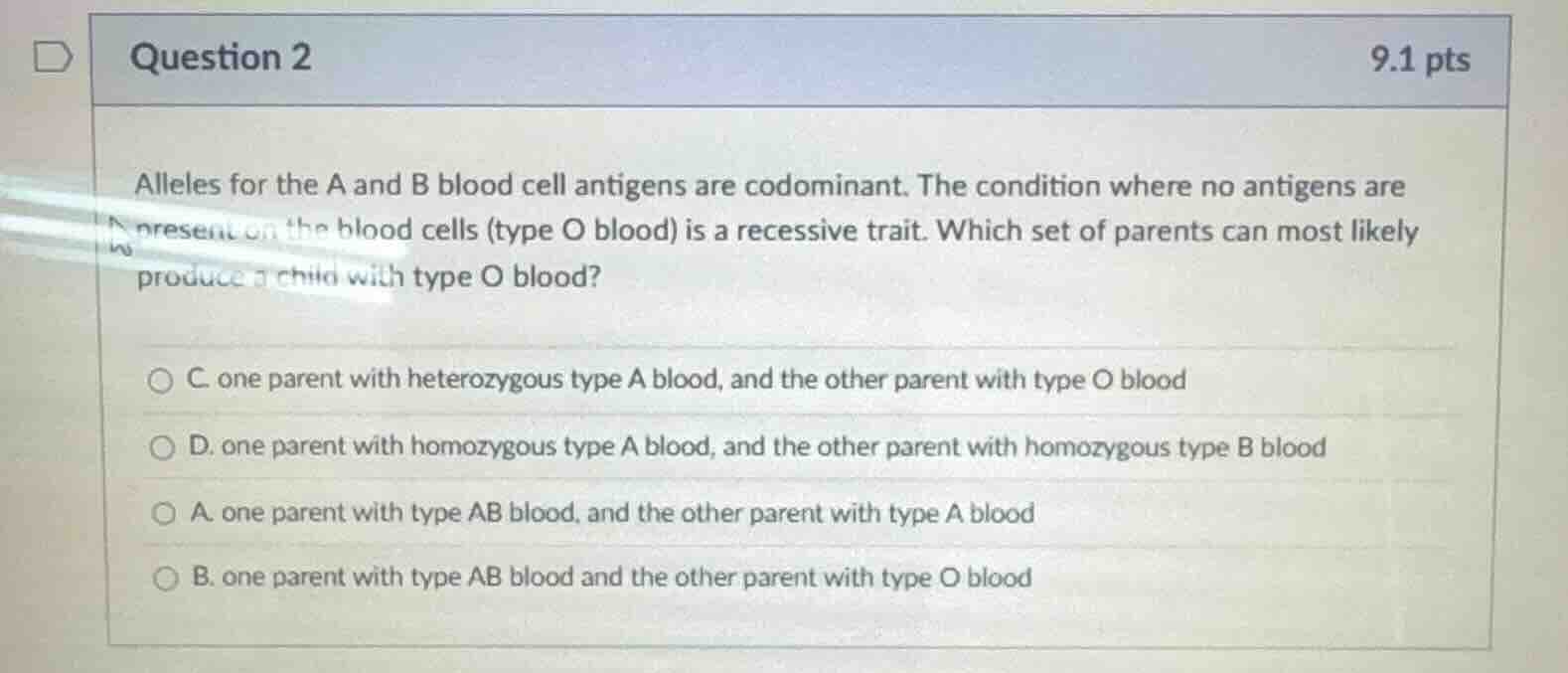
question 2 9.1 pts alleles for the a and b blood cell antigens are codominant. the condition where no antigens are present on the blood cells (type o blood) is a recessive trait. which set of parents can most likely produce a child with type o blood? c one parent with heterozygous type a blood, and the other parent with type o blood d. one parent with homozygous type a blood, and the other parent with homozygous type b blood a. one parent with type ab blood, and the other parent with type a blood b. one parent with type ab blood and the other parent with type o blood
To determine which parents can have a child with type O blood (genotype \( ii \)), we analyze each option:
- Option A: Parent with AB (\( I^A I^B \)) and parent with A (either \( I^A I^A \) or \( I^A i \)). The AB parent can only pass \( I^A \) or \( I^B \), so no \( i \) allele to form \( ii \).
- Option B: Parent with AB (\( I^A I^B \)) and parent with O (\( ii \)). AB parent passes \( I^A \) or \( I^B \), so child’s genotype is \( I^A i \) or \( I^B i \) (not \( ii \)).
- Option C: Heterozygous A (\( I^A i \)) and O (\( ii \)). The heterozygous A parent can pass \( i \), and the O parent always passes \( i \). So there’s a 50% chance of \( ii \) (type O).
- Option D: Homozygous A (\( I^A I^A \)) and homozygous B (\( I^B I^B \)). All children will be \( I^A I^B \) (type AB), no \( ii \) possible.

Snap & solve any problem in the app
Get step-by-step solutions on Sovi AI
Photo-based solutions with guided steps
Explore more problems and detailed explanations
C. one parent with heterozygous type A blood, and the other parent with type O blood