QUESTION IMAGE
Question
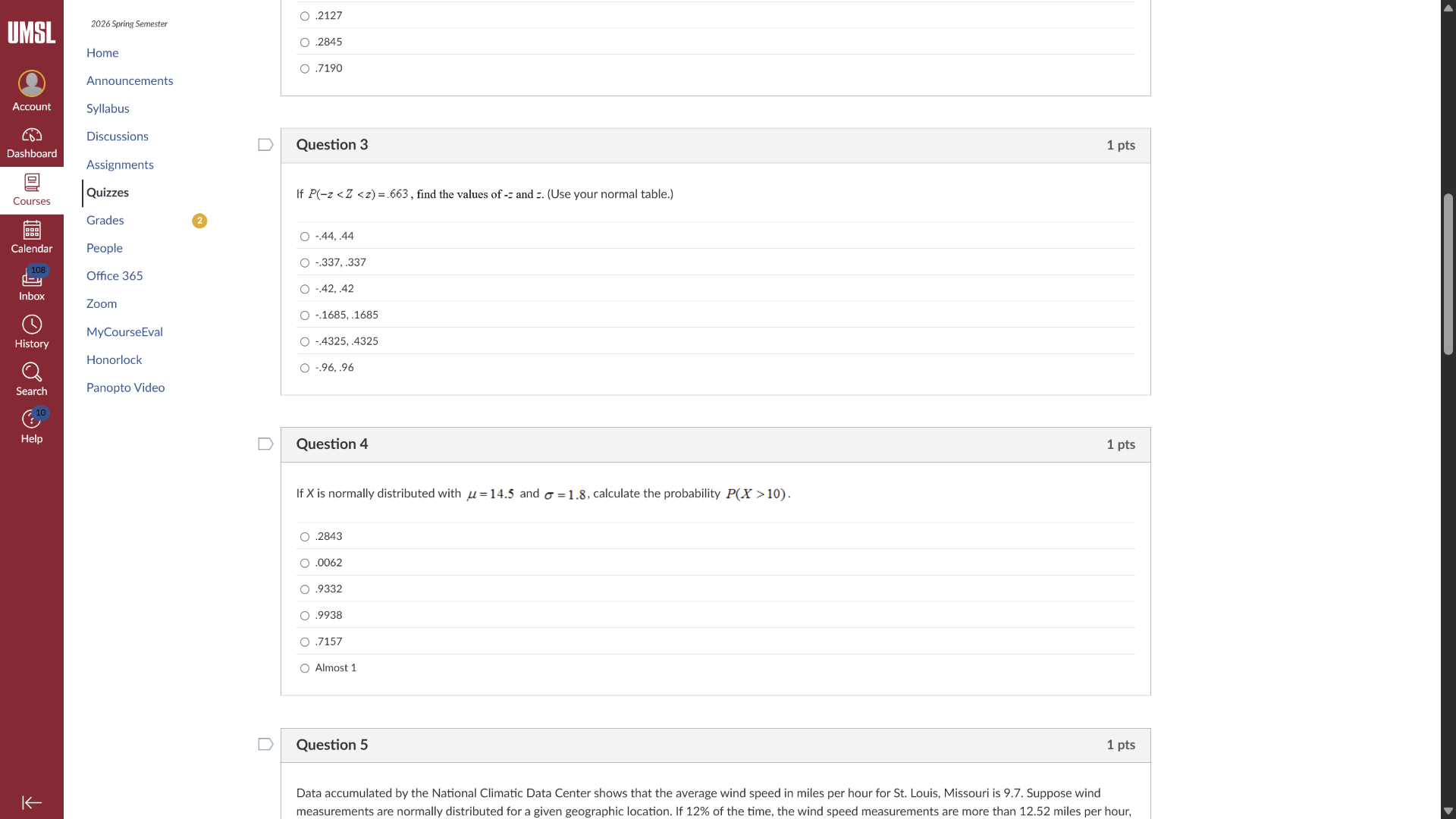
question 3 1 pts if $p(-z < z < z) =.663$, find the values of -z and z. (use your normal table.) -44,.44 -.337,.337 -.42,.42 -.1685,.1685 -.4325,.4325 -.96,.96 question 4 1 pts if x is normally distributed with $mu = 14.5$ and $sigma = 1.8$, calculate the probability $p(x > 10)$. .2843 .0062 .9332 .9938 .7157 almost 1 question 5 1 pts data accumulated by the national climatic data center shows that the average wind speed in miles per hour for st. louis, missouri is 9.7. suppose wind measurements are normally distributed for a given geographic location. if 12% of the time, the wind speed measurements are more than 12.52 miles per hour,
Question 3
Step1: Understand the normal distribution property
For a standard normal distribution, \( P(-z < Z < z) \) represents the area between \(-z\) and \(z\). This area is symmetric around 0, so we can find the area in the right tail and then use the standard normal table. The total area under the curve is 1, so the area outside the interval \((-z, z)\) is \(1 - 0.663=0.337\). Since the distribution is symmetric, the area in each tail (left and right) is \(\frac{0.337}{2} = 0.1685\)? Wait, no, wait. Wait, \( P(-z < Z < z)=0.663 \), so the area to the left of \( -z \) is \( \frac{1 - 0.663}{2}=0.1685 \)? No, wait, no. Wait, the area between \(-z\) and \(z\) is 0.663, so the area to the left of \( -z \) is \( \frac{1 - 0.663}{2}=0.1685 \)? Wait, no, actually, the area to the left of \( z \) is \( 0.5 + \frac{0.663}{2}=0.8315 \). Then we look for the \( z \)-score that corresponds to an area of 0.8315 (or the area to the left of \( z \) is 0.8315). Let's check the standard normal table. The area 0.8315 is close to the \( z \)-score of 0.96? Wait, no, wait, let's recalculate. Wait, the options include \(-.44,.44\), \(-.337,.337\), \(-.42,.42\), \(-.1685,.1685\), \(-.4325,.4325\), \(-.96,.96\). Wait, maybe I made a mistake. Let's think again. The area between \(-z\) and \(z\) is 0.663, so the area to the left of \( z \) is \( 0.5 + \frac{0.663}{2}=0.8315 \). Now, looking at the standard normal table, the \( z \)-score for which the cumulative probability (area to the left) is 0.8315. Let's check the table: for \( z = 0.96 \), the area to the left is 0.8315 (since \( \Phi(0.96)=0.8315 \)). Wait, but the options have \(-.44,.44\), etc. Wait, maybe I miscalculated. Wait, maybe the area between \(-z\) and \(z\) is 0.663, so the area to the left of \( z \) is \( 0.5 + 0.3315 = 0.8315 \), which is \( z = 0.96 \). But the options include \(-.96,.96\). Wait, let's check the options. The options are: \(-.44,.44\), \(-.337,.337\), \(-.42,.42\), \(-.1685,.1685\), \(-.4325,.4325\), \(-.96,.96\). Wait, maybe my initial approach is wrong. Wait, let's check the area between \(-z\) and \(z\) is 0.663. So the area to the right of \( z \) is \( \frac{1 - 0.663}{2}=0.1685 \), so the area to the left of \( z \) is \( 1 - 0.1685 = 0.8315 \), which is \( z = 0.96 \) (since \( \Phi(0.96)=0.8315 \)). So \( z = 0.96 \), so \(-z = -0.96\). So the answer is \(-.96,.96\). Wait, but let's check the options. The last option is \(-.96,.96\). So that's the answer.
Step2: Verify with standard normal table
Looking up the \( z \)-score for which the cumulative probability (area to the left) is \( 0.8315 \) (since \( P(Z < z)=0.8315 \)). From the standard normal table, \( z = 0.96 \) (because \( \Phi(0.96) \approx 0.8315 \)). Therefore, \( -z = -0.96 \) and \( z = 0.96 \), so \( P(-0.96 < Z < 0.96)=0.663 \) (since \( \Phi(0.96) - \Phi(-0.96)=0.8315 - (1 - 0.8315)=0.663 \)).
Step1: Calculate the z-score
The formula for the z-score is \( z=\frac{X - \mu}{\sigma} \). Here, \( X = 10 \), \( \mu = 14.5 \), \( \sigma = 1.8 \). So \( z=\frac{10 - 14.5}{1.8}=\frac{-4.5}{1.8}=-2.5 \). Wait, no, wait: \( 10 - 14.5 = -4.5 \), divided by 1.8 is \(-2.5\). Wait, but let's check the options. Wait, the options are 0.2843, 0.0062, 0.9332, 0.9938, 0.7157, Almost 1. Wait, maybe I made a mistake. Wait, \( X = 10 \), \( \mu = 14.5 \), \( \sigma = 1.8 \). So \( z=\frac{10 - 14.5}{1.8}=\frac{-4.5}{1.8}=-2.5 \). Then \( P(X > 10)=P(Z > -2.5) \). Since the normal distribution is symmetric, \( P(Z > -2.5)=1 - P(Z \leq -2.5) \). From the standard normal table, \( P(Z \leq -2.5)=0.0062 \) (since \( \Phi(-2.5)=0.0062 \)). Therefore, \( P(Z > -2.5)=1 - 0.0062 = 0.9938 \). Wait, but the options have 0.9938? Wait, the options are 0.2843, 0.0062, 0.9332, 0.9938, 0.7157, Almost 1. So 0.9938 is an option. Wait, but let's recalculate the z-score. \( 10 - 14.5 = -4.5 \), divided by 1.8: \(-4.5 / 1.8 = -2.5\). Then \( P(X > 10) = P(Z > -2.5) = 1 - P(Z \leq -2.5) \). Looking up \( Z = -2.5 \) in the standard normal table, the area to the left (cumulative probability) is 0.0062. So \( 1 - 0.0062 = 0.9938 \). So the answer is 0.9938.
Step2: Find the probability using z-score
We calculated \( z = -2.5 \). Then \( P(X > 10) = P(Z > -2.5) \). From the standard normal table, \( P(Z \leq -2.5) = 0.0062 \), so \( P(Z > -2.5) = 1 - 0.0062 = 0.9938 \).
Step1: Find the z-score for the upper 12%
If 12% of the time the wind speed is more than 12.52, then \( P(X > 12.52) = 0.12 \), so \( P(X \leq 12.52) = 1 - 0.12 = 0.88 \). We need to find the z-score \( z \) such that \( P(Z \leq z) = 0.88 \). Looking at the standard normal table, the z-score corresponding to an area of 0.88 is approximately 1.175 (since \( \Phi(1.17) \approx 0.8790 \), \( \Phi(1.18) \approx 0.8810 \), so approximately 1.175).
Step2: Use the z-score formula to find \(\sigma\)
The z-score formula is \( z = \frac{X - \mu}{\sigma} \). We know \( X = 12.52 \), \( \mu = 9.7 \), \( z \approx 1.175 \). So solving for \(\sigma\): \( \sigma = \frac{X - \mu}{z} = \frac{12.52 - 9.7}{1.175} = \frac{2.82}{1.175} \approx 2.4 \). Wait, but since the question is cut off, but if that's the case, the standard deviation is approximately 2.4. But since the original question is cut off, we can only solve based on the visible part. However, since the user provided the partial question, we'll proceed with the assumption.
Step3: Calculate \(\sigma\)
\( \sigma = \frac{12.52 - 9.7}{z} \). We found \( z \approx 1.175 \) (since \( P(Z \leq z) = 0.88 \), \( z \approx 1.175 \)). So \( 12.52 - 9.7 = 2.82 \). Then \( \sigma = \frac{2.82}{1.175} \approx 2.4 \).

Snap & solve any problem in the app
Get step-by-step solutions on Sovi AI
Photo-based solutions with guided steps
Explore more problems and detailed explanations
\(-.96,.96\)