QUESTION IMAGE
Question
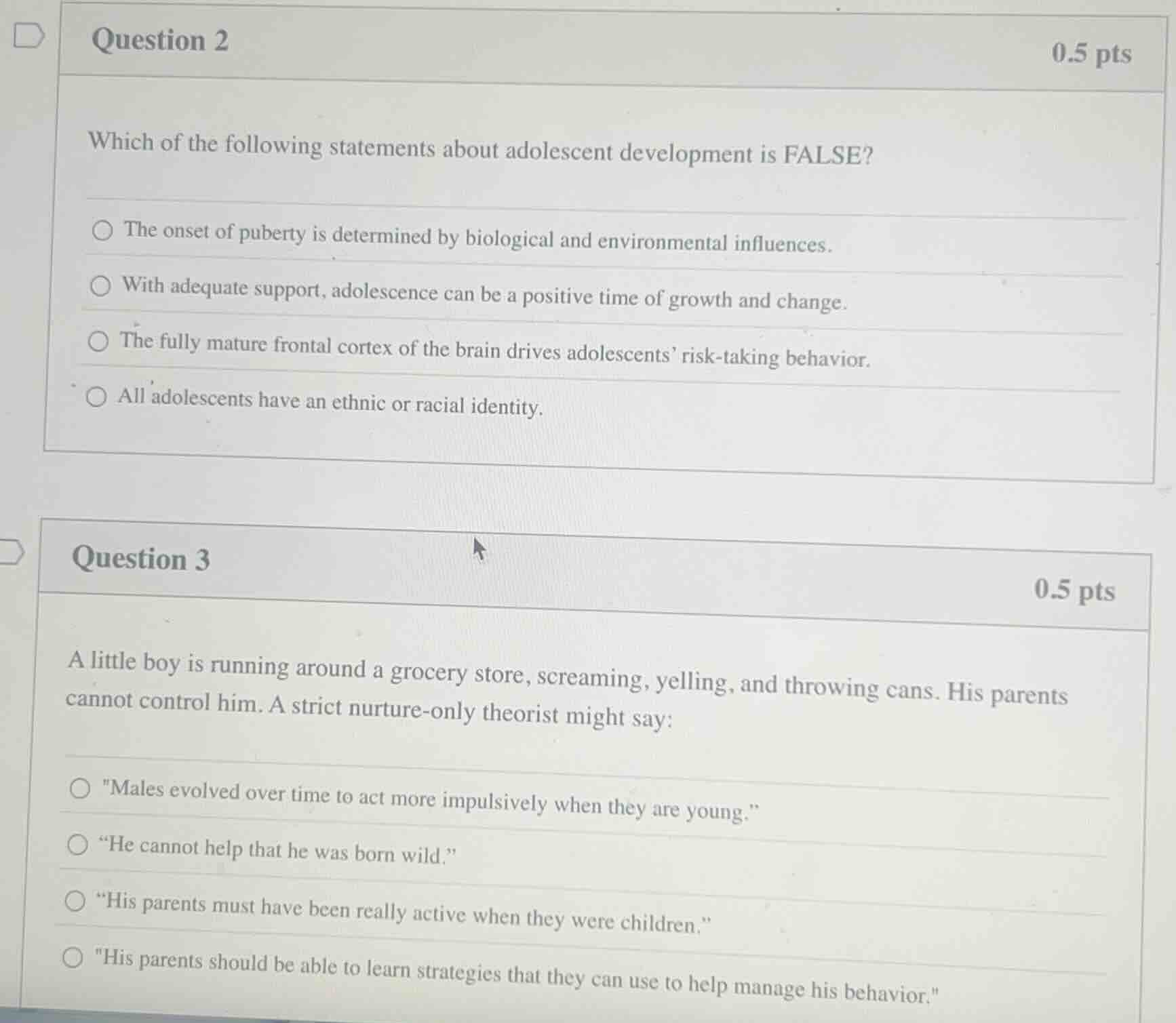
question 2
0.5 pts
which of the following statements about adolescent development is false?
the onset of puberty is determined by biological and environmental influences.
with adequate support, adolescence can be a positive time of growth and change.
the fully mature frontal cortex of the brain drives adolescents’ risk - taking behavior.
all adolescents have an ethnic or racial identity.
question 3
0.5 pts
a little boy is running around a grocery store, screaming, yelling, and throwing cans. his parents cannot control him. a strict nurture - only theorist might say:
\males evolved over time to act more impulsively when they are young.\
“he cannot help that he was born wild.”
“his parents must have been really active when they were children.”
\his parents should be able to learn strategies that they can use to help manage his behavior.\
For Question 2:
- Puberty onset is influenced by both biology (genetics) and environment (nutrition, stress), so the first statement is true.
- Adequate support (family, community) fosters positive adolescent growth, so the second statement is true.
- The frontal cortex (responsible for impulse control) is NOT fully mature in adolescents; this immaturity is linked to risk-taking, making the third statement false.
- All adolescents develop an ethnic/racial identity as part of social development, so the fourth statement is true.
For Question 3:
- A strict nurture-only theorist believes behavior is shaped entirely by environment and learned experiences, not biology/genetics.
- The first three options reference evolutionary, innate, or inherited traits (nature-focused), while the last option focuses on learned parental strategies (nurture-focused).

Snap & solve any problem in the app
Get step-by-step solutions on Sovi AI
Photo-based solutions with guided steps
Explore more problems and detailed explanations
Question 2: The fully mature frontal cortex of the brain drives adolescents’ risk-taking behavior.
Question 3: "His parents should be able to learn strategies that they can use to help manage his behavior."