QUESTION IMAGE
Question
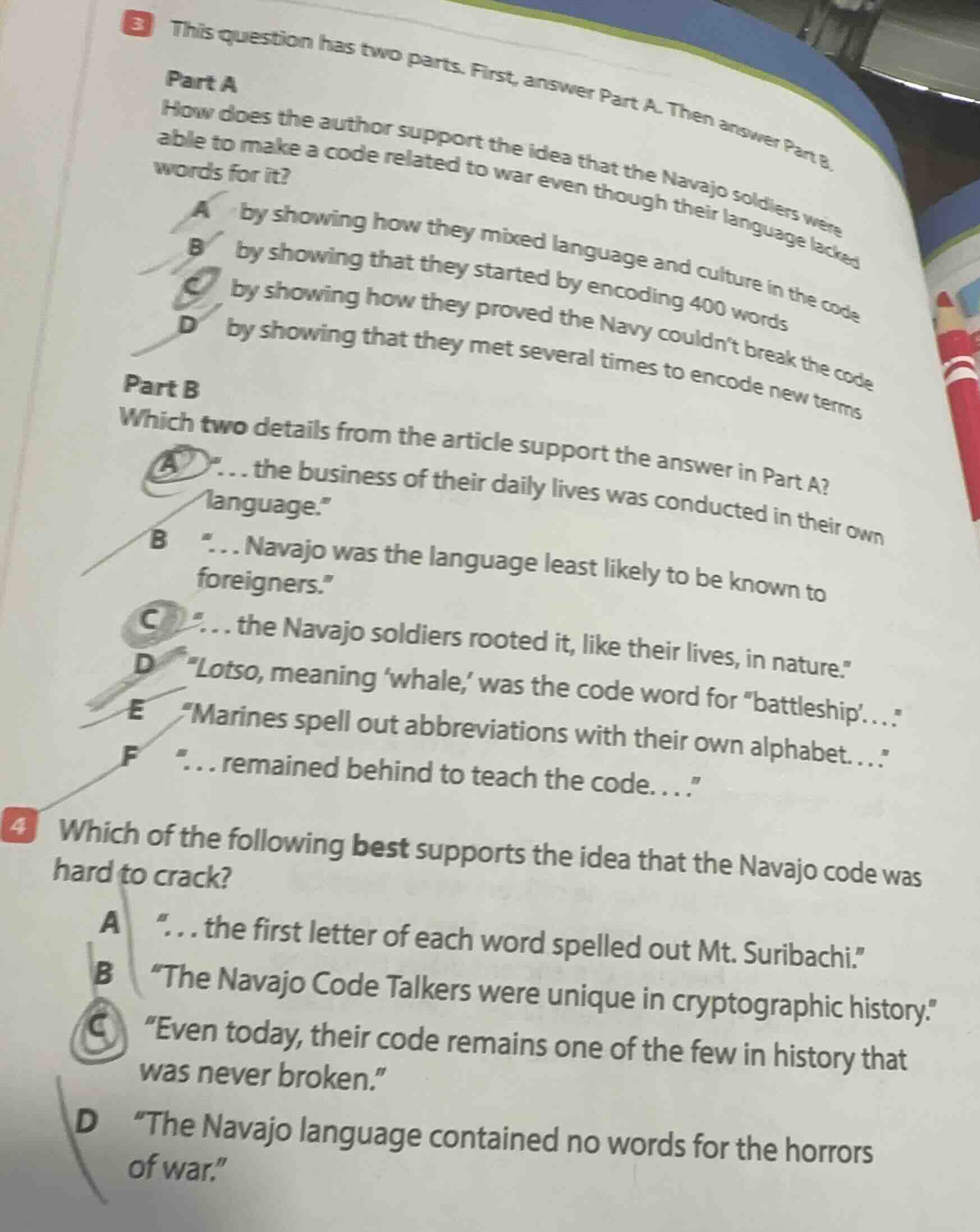
3 this question has two parts. first, answer part a. then answer part b. part a how does the author support the idea that the navajo soldiers were able to make a code related to war even though their language lacked words for it? a by showing how they mixed language and culture in the code b by showing that they started by encoding 400 words c by showing how they proved the navy couldn’t break the code d by showing that they met several times to encode new terms part b which two details from the article support the answer in part a? a “... the business of their daily lives was conducted in their own language.” b “... navajo was the language least likely to be known to foreigners.” c “... the navajo soldiers rooted it, like their lives, in nature.” d “lotso, meaning ‘whale,’ was the code word for ‘battleship’....” e “marines spell out abbreviations with their own alphabet....” f “... remained behind to teach the code....” 4 which of the following best supports the idea that the navajo code was hard to crack? a “... the first letter of each word spelled out mt. suribachi.” b “the navajo code talkers were unique in cryptographic history.” c “even today, their code remains one of the few in history that was never broken.” d “the navajo language contained no words for the horrors of war.”
Part A
To solve Part A, we analyze each option:
- Option A: Mixing language and culture in the code would help create war - related code even without existing words, as they can draw from cultural and linguistic elements.
- Option B: Just encoding 400 words doesn't explain how they made war - related code without war words.
- Option C: Proving the Navy couldn't break the code is about code security, not creation.
- Option D: Meeting to encode new terms is about updating, not initial creation of war - related code.
We need details that support the idea of mixing language and culture in the code (from Part A's answer):
- Option C: "the Navajo soldiers rooted it, like their lives, in nature" shows cultural (rooted in nature, part of their life/culture) and linguistic mixing.
- Option D: "Lotso, meaning ‘whale,’ was the code word for ‘battleship’" shows using a Navajo word (linguistic) for a war - related term, mixing language and culture (whale is part of their natural/cultural context, used for a warship).
Options A, B, E, F don't relate to mixing language and culture for creating war - related code.
To find the option that supports the Navajo code being hard to crack:
- Option A: Describes spelling out a name, not code security.
- Option B: Says they were unique in cryptographic history, but not directly about being hard to crack.
- Option C: "Even today, their code remains one of the few in history that was never broken" directly shows it was hard to crack as it was never broken.
- Option D: Talks about lack of war words, not code security.

Snap & solve any problem in the app
Get step-by-step solutions on Sovi AI
Photo-based solutions with guided steps
Explore more problems and detailed explanations
A. by showing how they mixed language and culture in the code