QUESTION IMAGE
Question
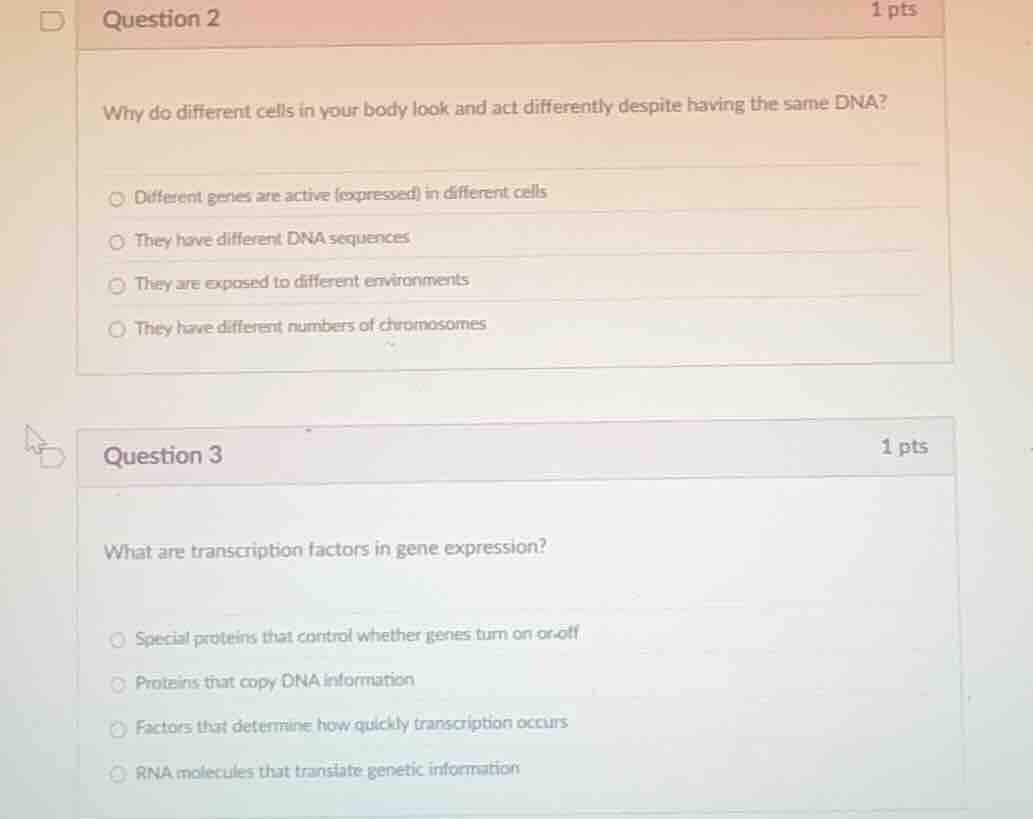
question 2
why do different cells in your body look and act differently despite having the same dna?
- different genes are active (expressed) in different cells
- they have different dna sequences
- they are exposed to different environments
- they have different numbers of chromosomes
question 3
what are transcription factors in gene expression?
- special proteins that control whether genes turn on or off
- proteins that copy dna information
- factors that determine how quickly transcription occurs
- rna molecules that translate genetic information
For Question 2: All body cells share identical DNA. Cell specialization arises from selective gene expression, where only specific genes are activated in each cell type to produce proteins that define its structure and function. The other options are incorrect: all somatic cells have the same DNA sequence and chromosome number, while environmental exposure is not the core reason for inherent cell differences.
For Question 3: Transcription factors are regulatory proteins that bind to specific DNA sequences to either promote or inhibit the transcription of genes, effectively controlling whether genes are turned on or off. The other options describe different molecules: proteins that copy DNA are DNA polymerases, factors controlling transcription speed are not the core definition of transcription factors, and RNA molecules that translate genetic information are transfer RNA or ribosomal RNA.

Snap & solve any problem in the app
Get step-by-step solutions on Sovi AI
Photo-based solutions with guided steps
Explore more problems and detailed explanations
Question 2: Different genes are active (expressed) in different cells
Question 3: Special proteins that control whether genes turn on or off