QUESTION IMAGE
Question
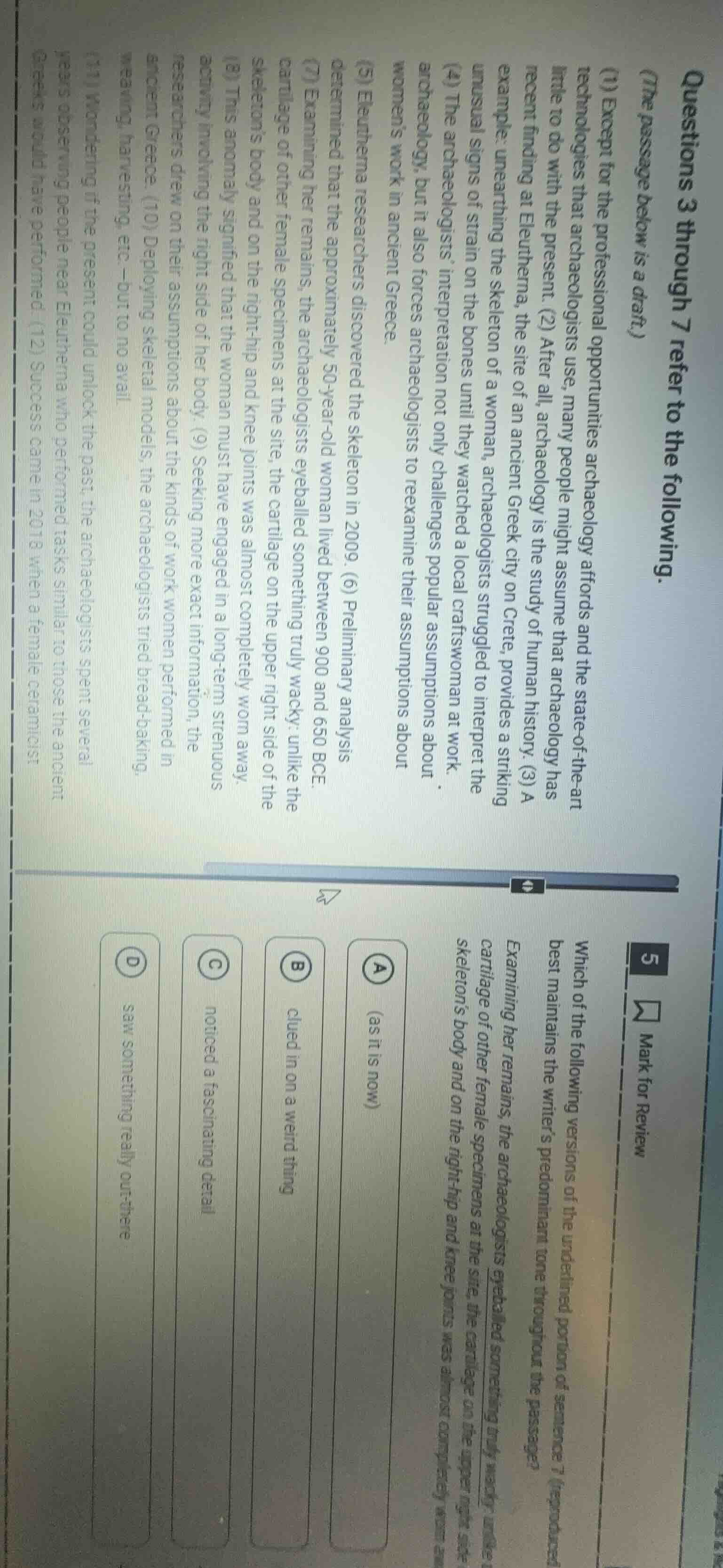
questions 3 through 7 refer to the following.(the passage below is a draft.)(1) except for the professional opportunities archaeology affords and the state-of-the-art technologies that archaeologists use, many people might assume that archaeology has little to do with the present. (2) after all, archaeology is the study of human history. (3) a recent finding at eleutherna, the site of an ancient greek city on crete, provides a striking example: unearthing the skeleton of a woman, archaeologists struggled to interpret the unusual signs of strain on the bones until they watched a local craftswoman at work.(4) the archaeologists interpretation not only challenges popular assumptions about archaeology, but it also forces archaeologists to reexamine their assumptions about womens work in ancient greece.(5) eleutherna researchers discovered the skeleton in 2009. (6) preliminary analysis determined that the approximately 50-year-old woman lived between 900 and 650 bce.(7) examining her remains, the archaeologists eyeballed something truly wacky: unlike the cartilage of other female specimens at the site, the cartilage on the upper right side of the skeletons body and on the right-hip and knee joints was almost completely worn away.(8) this anomaly signified that the woman must have engaged in a long-term strenuous activity involving the right side of her body. (9) seeking more exact information, the researchers drew on their assumptions about the kinds of work women performed in ancient greece. (10) deploying skeletal models, the archaeologists tried bread-baking, weaving, harvesting, etc.—but to no avail.(11) wondering if the present could unlock the past, the archaeologists spent several years observing people near eleutherna who performed tasks similar to those the ancient greeks would have performed. (12) success came in 2018 when a female ceramicist5 mark for reviewwhich of the following versions of the underlined portion of sentence 7 (reproduced below) best maintains the writers predominant tone throughout the passage?examining her remains, the archaeologists eyeballed something truly wacky: unlike the cartilage of other female specimens at the site, the cartilage on the upper right side of the skeletons body and on the right-hip and knee joints was almost completely worn awaya (as it is now)b clued in on a weird thingc noticed a fascinating detaild saw something really out-there
The passage uses a casual, accessible tone with informal phrasing like "truly wacky" and "unusual signs of strain" to discuss archaeological findings. Option D matches this tone: "saw something really out-there" is informal and aligns with the passage's conversational style, while the other options are either too formal (C), awkwardly phrased (B), or the original "eyeballed" is overly colloquial for the context of professional archaeologists' observation.

Snap & solve any problem in the app
Get step-by-step solutions on Sovi AI
Photo-based solutions with guided steps
Explore more problems and detailed explanations
D. saw something really out-there