QUESTION IMAGE
Question
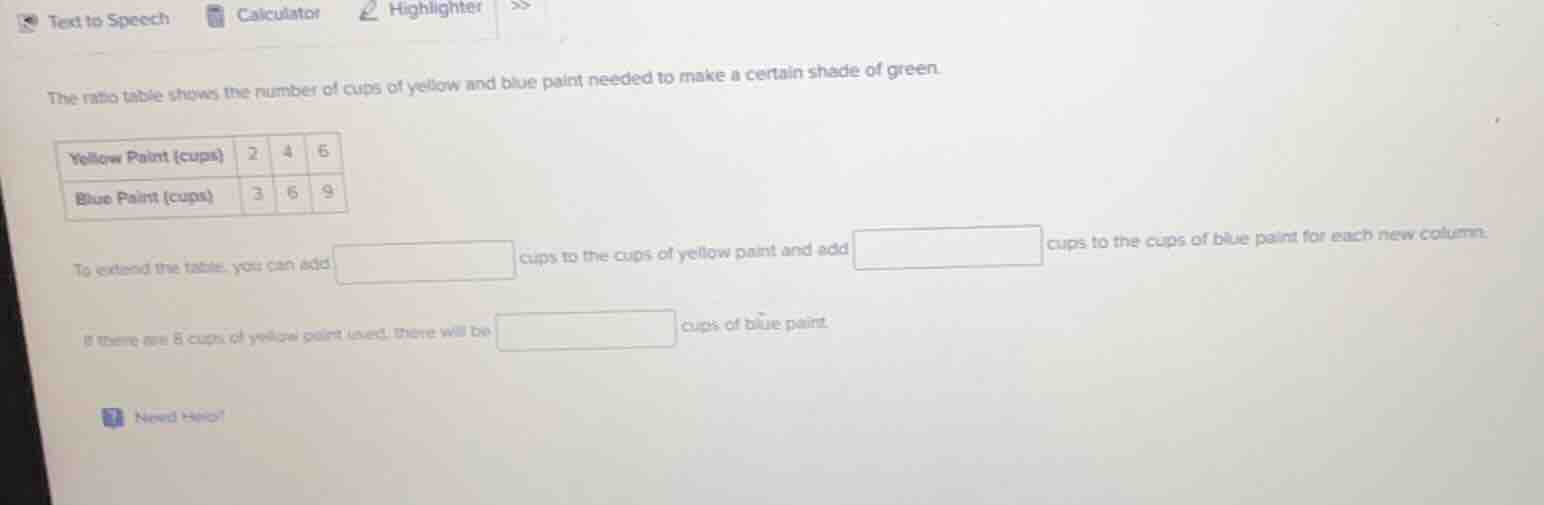
the ratio table shows the number of cups of yellow and blue paint needed to make a certain shade of green.
yellow paint (cups) 2 4 6
blue paint (cups) 3 6 9
to extend the table, you can add cups to the cups of yellow paint and add cups to the cups of blue paint for each new column.
if there are 8 cups of yellow paint used, there will be cups of blue paint.
Step1: Find the common difference for yellow paint
Looking at the yellow paint values: \(4 - 2 = 2\), \(6 - 4 = 2\). So the common difference is 2.
Step2: Find the common difference for blue paint
Looking at the blue paint values: \(6 - 3 = 3\), \(9 - 6 = 3\). So the common difference is 3.
Step3: Find the ratio of yellow to blue paint
The ratio of yellow to blue paint is \(\frac{2}{3}\) (from \(2:3\), \(4:6\) which simplifies to \(2:3\), \(6:9\) which simplifies to \(2:3\)).
Step4: Calculate blue paint for 8 cups of yellow paint
Let \(x\) be the cups of blue paint. Using the ratio \(\frac{2}{3}=\frac{8}{x}\), cross - multiply: \(2x = 8\times3\), \(2x=24\), then \(x = \frac{24}{2}=12\).

Snap & solve any problem in the app
Get step-by-step solutions on Sovi AI
Photo-based solutions with guided steps
Explore more problems and detailed explanations
To extend the table, you can add \(\boldsymbol{2}\) cups to the cups of yellow paint and add \(\boldsymbol{3}\) cups to the cups of blue paint for each new column.
If there are 8 cups of yellow paint used, there will be \(\boldsymbol{12}\) cups of blue paint.