QUESTION IMAGE
Question
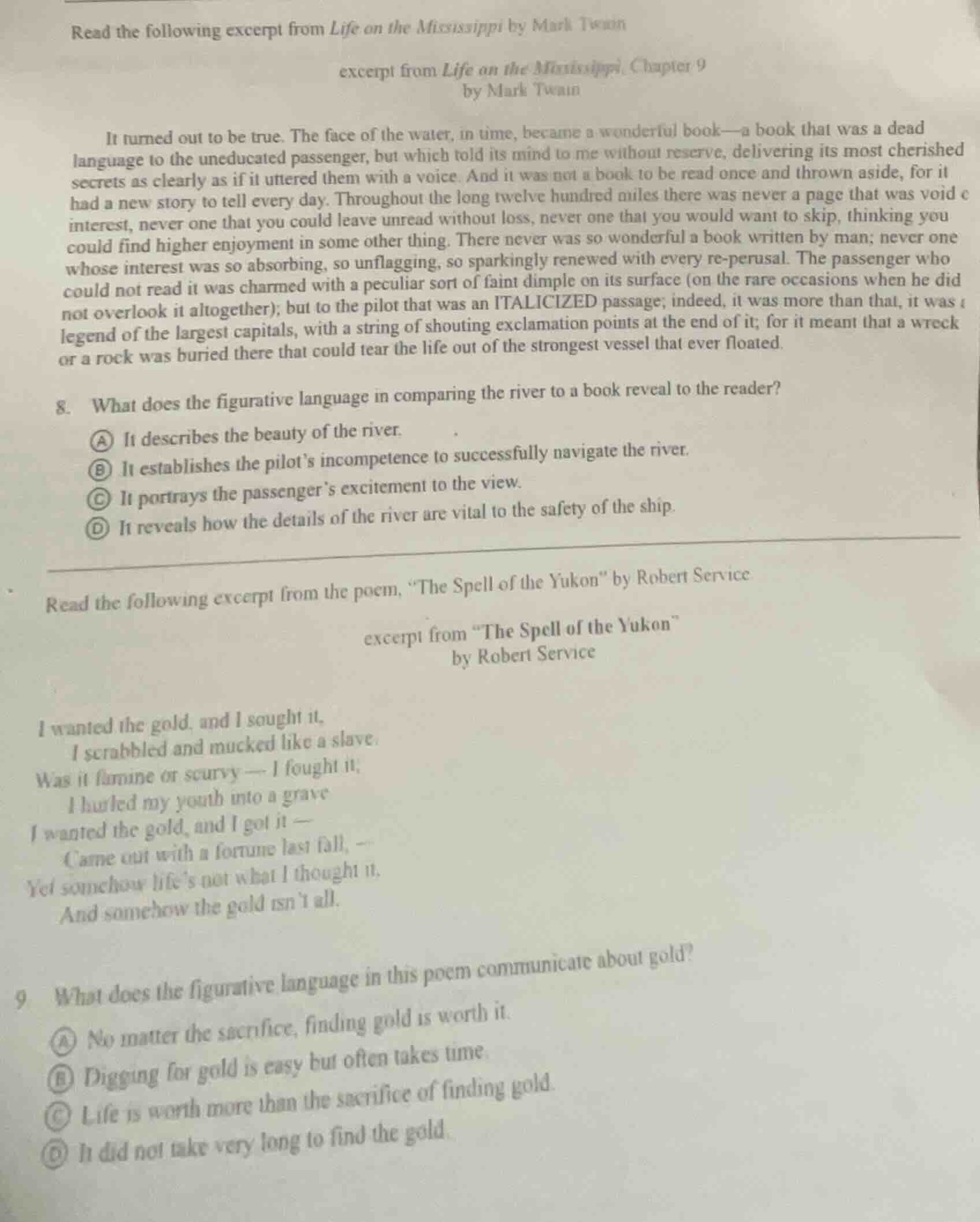
read the following excerpt from life on the mississippi by mark twain
excerpt from life on the mississippi, chapter 9
by mark twain
it turned out to be true. the face of the water, in time, became a wonderful book—a book that was a dead
language to the uneducated passenger, but which told its mind to me without reserve, delivering its most cherished
secrets as clearly as if it uttered them with a voice. and it was not a book to be read once and thrown aside, for it
had a new story to tell every day. throughout the long twelve hundred miles there was never a page that was void c
interest, never one that you could leave unread without loss, never one that you would want to skip, thinking you
could find higher enjoyment in some other thing. there never was so wonderful a book written by man; never one
whose interest was so absorbing, so unflagging, so sparkingly renewed with every re - perusal. the passenger who
could not read it was charmed with a peculiar sort of faint dimple on its surface (on the rare occasions when he did
not overlook it altogether); but to the pilot that was an italicized passage; indeed, it was more than that, it was t
legend of the largest capitals, with a string of shouting exclamation points at the end of it; for it meant that a wreck
or a rock was buried there that could tear the life out of the strongest vessel that ever floated.
- what does the figurative language in comparing the river to a book reveal to the reader?
① it describes the beauty of the river.
② it establishes the pilot’s incompetence to successfully navigate the river.
③ it portrays the passenger’s excitement to the view.
④ it reveals how the details of the river are vital to the safety of the ship.
read the following excerpt from the poem, “the spell of the yukon” by robert service
excerpt from “the spell of the yukon”
by robert service
i wanted the gold, and i sought it,
i scrabbled and mucked like a slave.
was it famine or scurvy — i fought it,
i hurled my youth into a grave
i wanted the gold, and i got it —
came out with a fortune last fall, —
yet somehow life’s not what i thought it,
and somehow the gold isn’t all.
9 what does the figurative language in this poem communicate about gold?
① no matter the sacrifice, finding gold is worth it.
② digging for gold is easy but often takes time.
③ life is worth more than the sacrifice of finding gold.
④ it did not take very long to find the gold.
For Question 8:
The metaphor compares the river to a book. Uneducated passengers only see surface details, but pilots read critical "text"—like dimples that signal hidden wrecks/rocks threatening the ship's safety. Options A, B, C are incorrect: the focus is not beauty, pilot incompetence, or passenger excitement, but life-or-death river details for navigation.
For Question 9:
The poem uses figurative language like "hurled my youth into a grave" to show the great sacrifice for gold. The final lines "Yet somehow life's not what I thought it, And somehow the gold isn't all" reveal gold fails to fulfill expectations, so life's value outweighs the sacrifice for gold. Options A, B, D are incorrect: the poem rejects gold being worth the sacrifice, states mining was hard, and notes it took enough time to lose youth.

Snap & solve any problem in the app
Get step-by-step solutions on Sovi AI
Photo-based solutions with guided steps
Explore more problems and detailed explanations
- D. It reveals how the details of the river are vital to the safety of the ship.
- C. Life is worth more than the sacrifice of finding gold.