QUESTION IMAGE
Question
read the passage. then answer the question below.
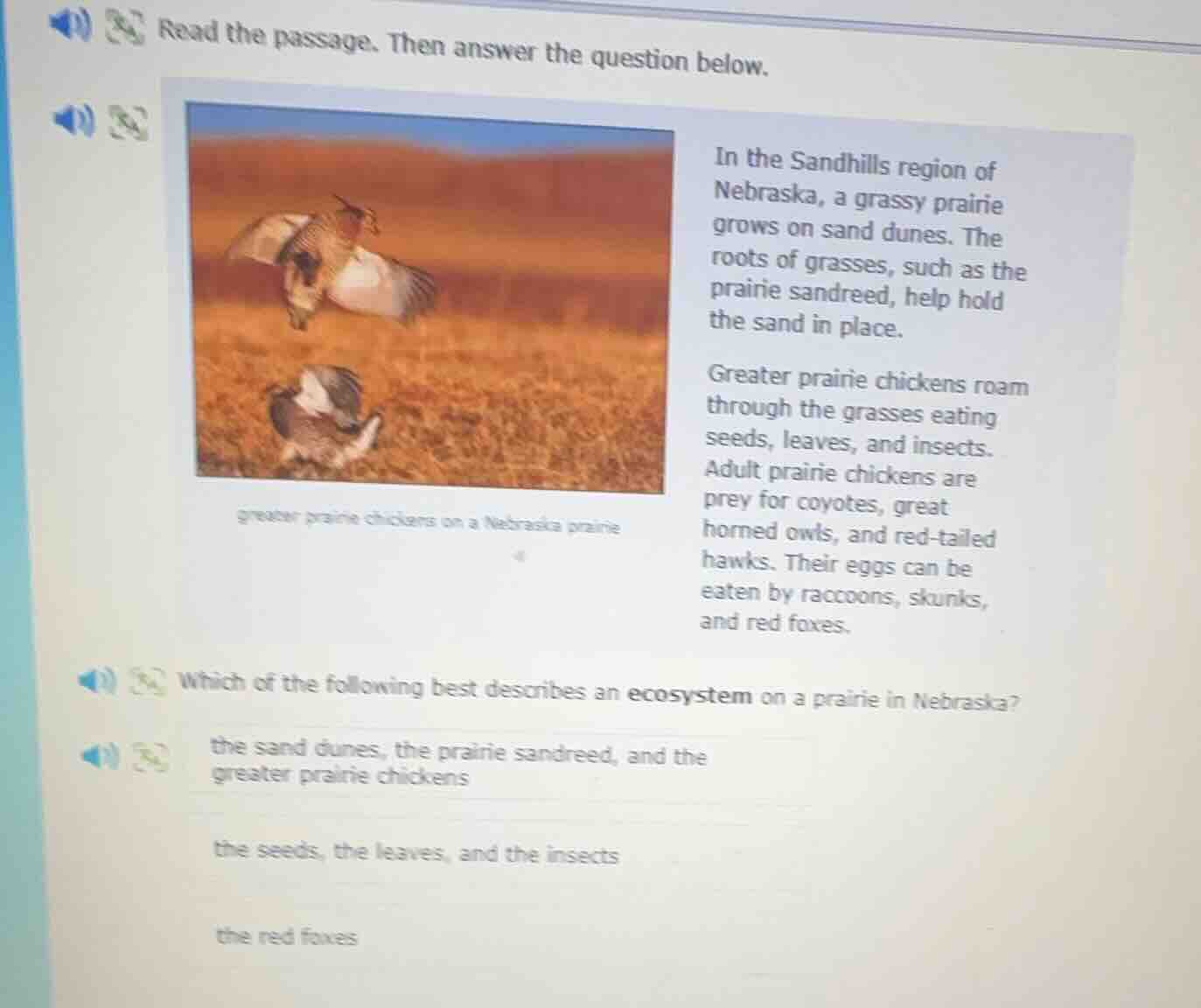
image: greater prairie chickens on a nebraska prairie
in the sandhills region of nebraska, a grassy prairie grows on sand dunes. the roots of grasses, such as the prairie sandreed, help hold the sand in place.
greater prairie chickens roam through the grasses eating seeds, leaves, and insects. adult prairie chickens are prey for coyotes, great horned owls, and red - tailed hawks. their eggs can be eaten by raccoons, skunks, and red foxes.
which of the following best describes an ecosystem on a prairie in nebraska?
- the sand dunes, the prairie sandreed, and the greater prairie chickens
- the seeds, the leaves, and the insects
- the red foxes
An ecosystem includes all living (biotic) and non - living (abiotic) components in a particular area. The sand dunes are non - living (abiotic), the prairie sandreed is a living (biotic, plant) component, and the greater prairie chickens are living (biotic, animal) components. The other options: the second option has only biotic components (seeds, leaves, insects) and misses abiotic and other biotic components; the third option has only one biotic component (red foxes) and misses most of the ecosystem components.

Snap & solve any problem in the app
Get step-by-step solutions on Sovi AI
Photo-based solutions with guided steps
Explore more problems and detailed explanations
the sand dunes, the prairie sandreed, and the greater prairie chickens