QUESTION IMAGE
Question
read the passage. then answer the question below.
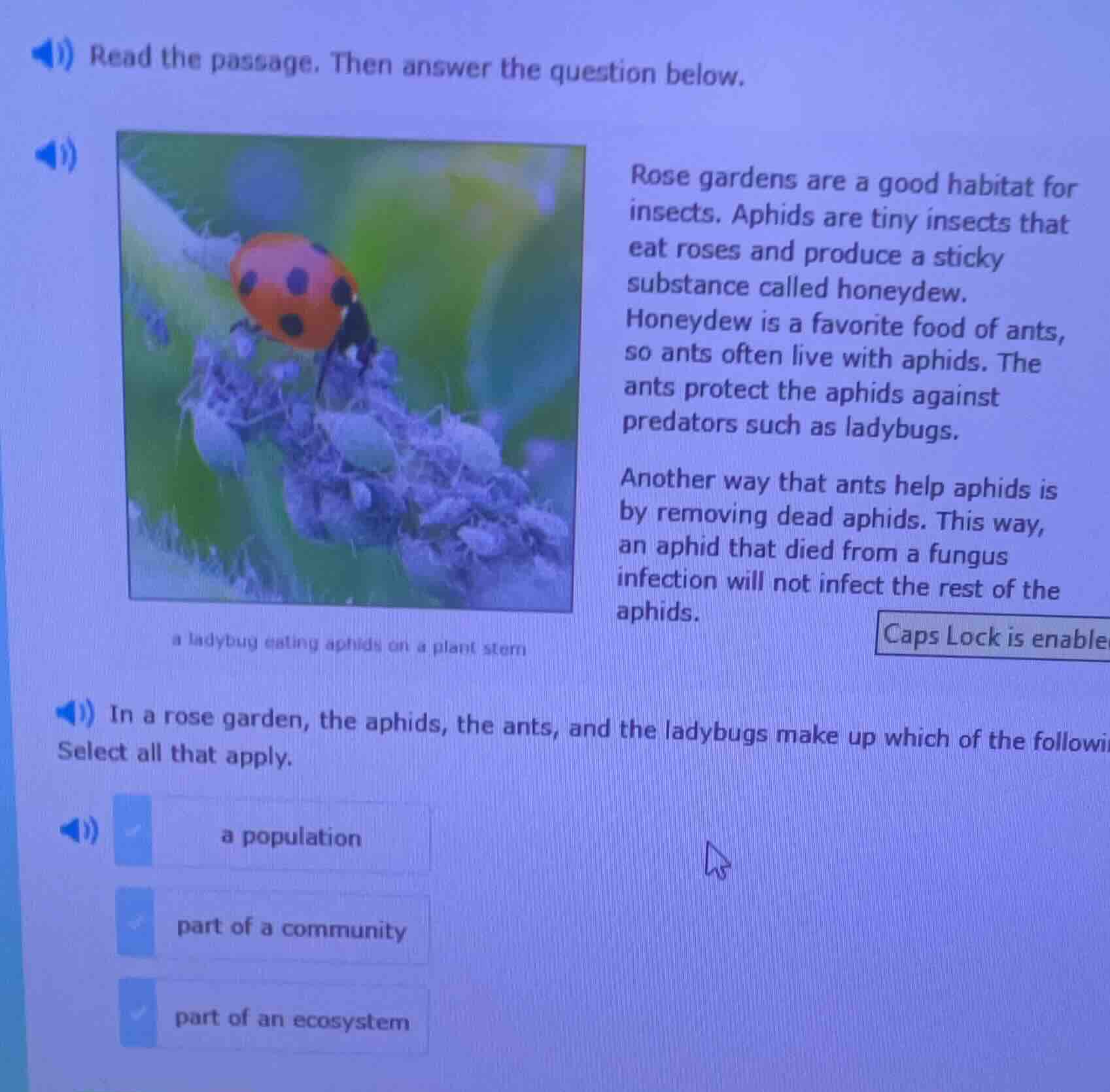
rose gardens are a good habitat for insects. aphids are tiny insects that eat roses and produce a sticky substance called honeydew. honeydew is a favorite food of ants, so ants often live with aphids. the ants protect the aphids against predators such as ladybugs.
another way that ants help aphids is by removing dead aphids. this way, an aphid that died from a fungus infection will not infect the rest of the aphids.
in a rose garden, the aphids, the ants, and the ladybugs make up which of the followi
select all that apply.
a population
part of a community
part of an ecosystem
- Population: A population is a group of individuals of the same species. Aphids, ants, and ladybugs are different species, so they don't form a single population. But if we consider each species separately (e.g., all aphids in the garden are a population, all ants are a population, all ladybugs are a population), but the question is about the three groups together. Wait, maybe the initial thought was wrong. Wait, no—actually, the options: "a population"—if we take each species, but the question is about aphids, ants, ladybugs together. Wait, no, maybe the user's options: the first option is "a population"—but since they are different species, together they are not a population. But the other two: "part of a community" (a community is all living organisms in an area, so these species are part of the community in the rose garden) and "part of an ecosystem" (an ecosystem includes living (biotic) and non - living (abiotic) components; these organisms are biotic components, so part of the ecosystem). Wait, but the first option: maybe the question's options—let's re - evaluate.
Wait, the passage is about the interactions between aphids, ants, and ladybugs in a rose garden.
- Population: A population is a group of the same species. Aphids, ants, and ladybugs are different species. So together, they are not a single population. But if we consider that maybe the question's "a population" is incorrect, but the other two:
- Part of a community: A community is all the different populations (of different species) in a given area. So aphids, ants, and ladybugs (each is a population) are part of the community of the rose garden.
- Part of an ecosystem: An ecosystem includes all biotic (living) and abiotic (non - living, like soil, water, sunlight in the garden) components. The aphids, ants, and ladybugs are biotic components, so they are part of the ecosystem.
Wait, but the first option "a population"—maybe the question has a trick. Wait, maybe the original options' checkmarks—maybe the user's initial selection was wrong, but according to the concepts:
- "a population": Incorrect (different species).
- "part of a community": Correct (they are different species in the same area, part of the community).
- "part of an ecosystem": Correct (they are biotic parts of the ecosystem which includes abiotic factors too).
But maybe the question's options—let's answer based on ecological concepts.

Snap & solve any problem in the app
Get step-by-step solutions on Sovi AI
Photo-based solutions with guided steps
Explore more problems and detailed explanations
- part of a community
- part of an ecosystem
(Note: "a population" is incorrect because a population consists of individuals of the same species, and aphids, ants, and ladybugs are different species. However, if the question considers each species as a population, but the question is about the three groups together, "a population" is incorrect. "Part of a community" is correct as a community includes all populations in an area, and these three are different populations. "Part of an ecosystem" is correct as an ecosystem includes biotic (these organisms) and abiotic components.)