QUESTION IMAGE
Question
read the passage. then answer the question below.
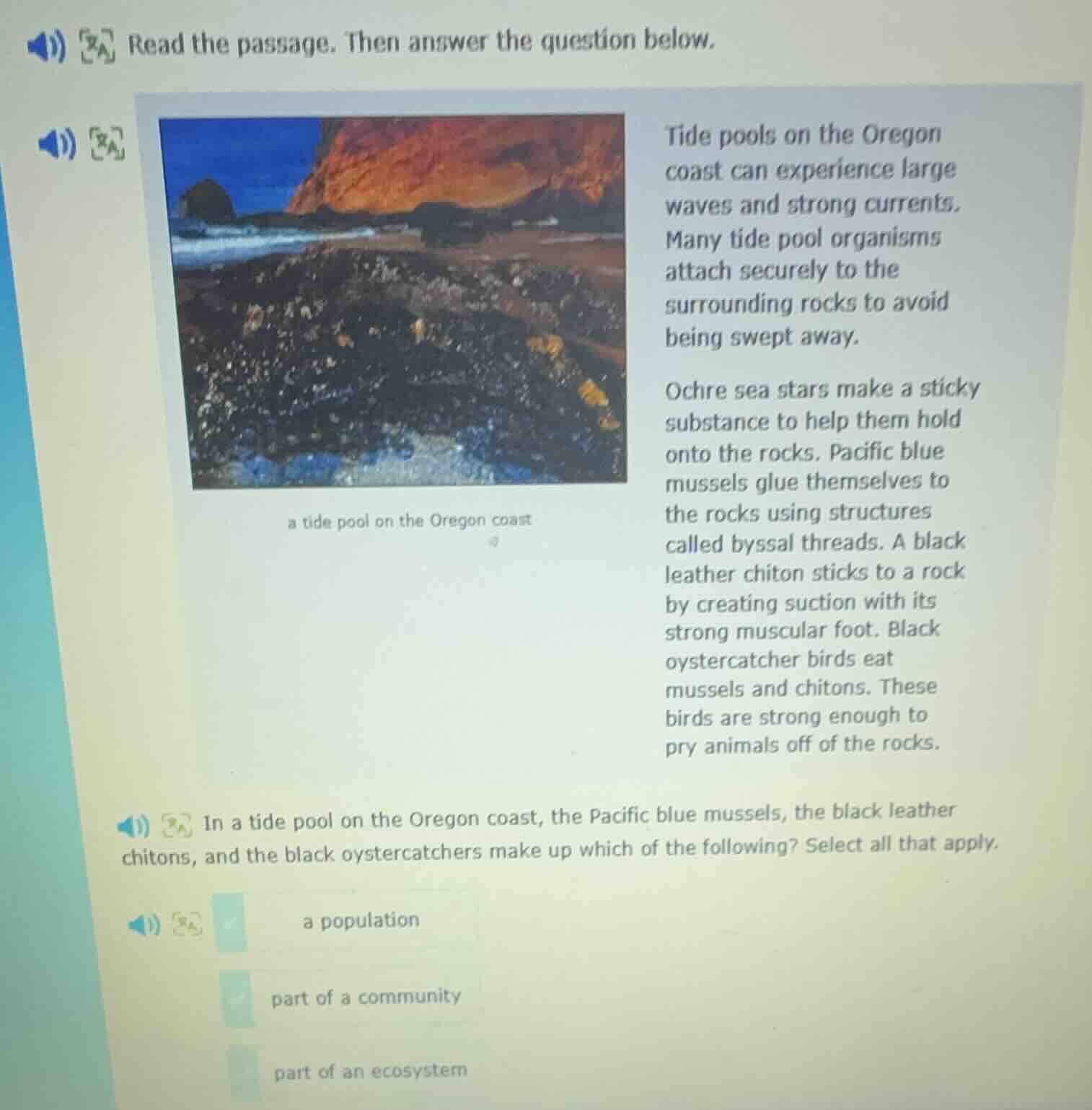
tide pools on the oregon coast can experience large waves and strong currents. many tide pool organisms attach securely to the surrounding rocks to avoid being swept away.
ochre sea stars make a sticky substance to help them hold onto the rocks. pacific blue mussels glue themselves to the rocks using structures called byssal threads. a black leather chiton sticks to a rock by creating suction with its strong muscular foot. black oystercatcher birds eat mussels and chitons. these birds are strong enough to pry animals off of the rocks.
in a tide pool on the oregon coast, the pacific blue mussels, the black leather chitons, and the black oystercatchers make up which of the following? select all that apply.
a population
part of a community
part of an ecosystem
- For "a population": A population is a group of individuals of the same species. Here, Pacific blue mussels, black leather chitons, and black oystercatchers are different species, so they don't form a single population.
- For "part of a community": A community consists of all the different populations (species) in a particular area. Since these three are different species living in the tide pool (a particular area), they are part of the community of the tide pool.
- For "part of an ecosystem": An ecosystem includes all the living (biotic) components (like these species) and the non - living (abiotic) components (like the rocks, water, waves in the tide pool). So these organisms, along with the abiotic factors of the tide pool, form an ecosystem, and thus they are part of an ecosystem.

Snap & solve any problem in the app
Get step-by-step solutions on Sovi AI
Photo-based solutions with guided steps
Explore more problems and detailed explanations
B. part of a community
C. part of an ecosystem