QUESTION IMAGE
Question
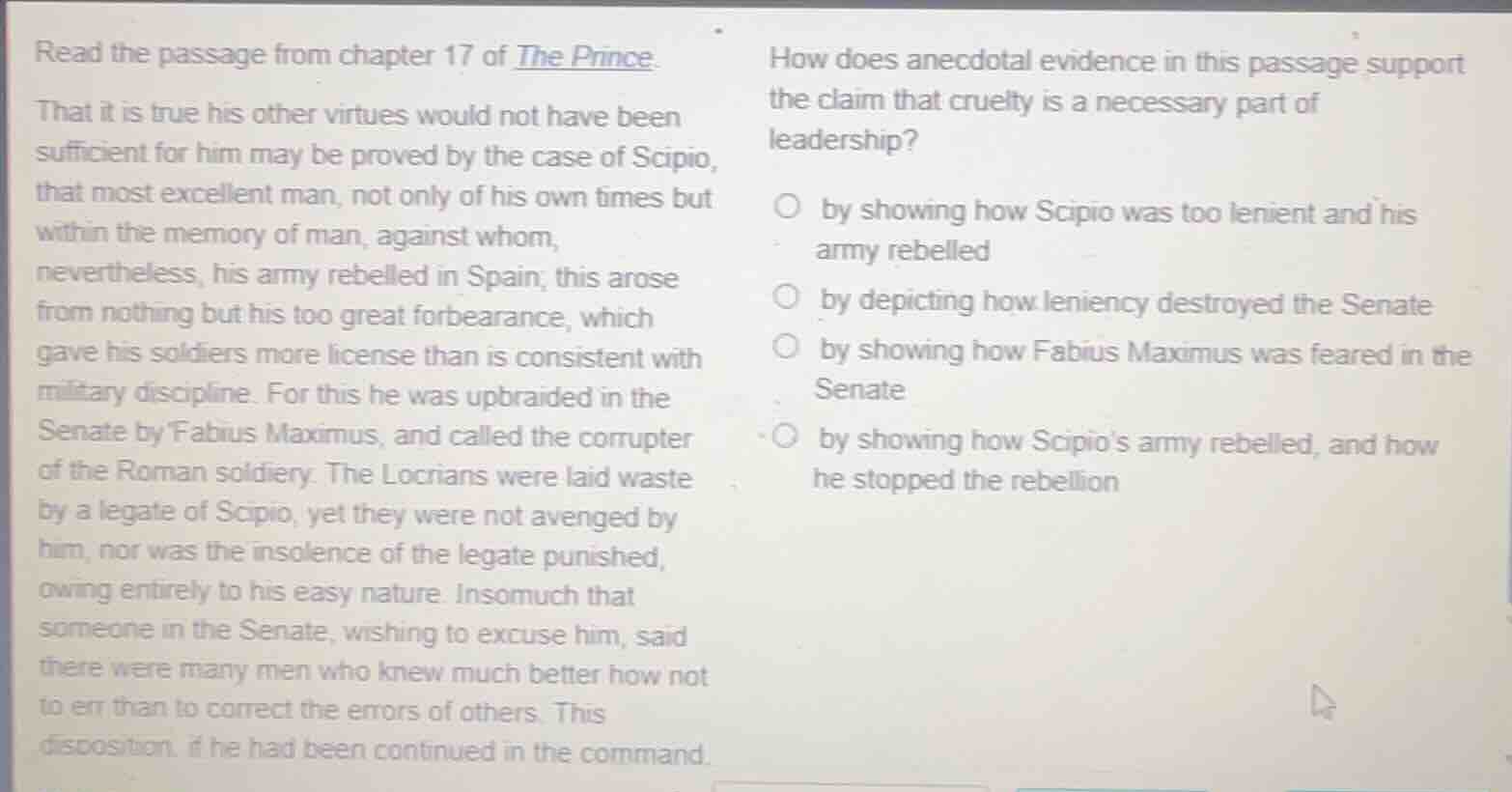
read the passage from chapter 17 of the prince. that it is true his other virtues would not have been sufficient for him may be proved by the case of scipio, that most excellent man, not only of his own times but within the memory of man, against whom, nevertheless, his army rebelled in spain; this arose from nothing but his too great forbearance, which gave his soldiers more license than is consistent with military discipline. for this he was upbraided in the senate by fabius maximus, and called the corrupter of the roman soldiery. the locrians were laid waste by a legate of scipio, yet they were not avenged by him, nor was the insolence of the legate punished, owing entirely to his easy nature. insomuch that someone in the senate, wishing to excuse him, said there were many men who knew much better how not to err than to correct the errors of others. this disposition, if he had been continued in the command. how does anecdotal evidence in this passage support the claim that cruelty is a necessary part of leadership? by showing how scipio was too lenient and his army rebelled by depicting how leniency destroyed the senate by showing how fabius maximus was feared in the senate by showing how scipio’s army rebelled, and how he stopped the rebellion
The passage uses Scipio's story as anecdotal evidence. Scipio's excessive leniency (lack of cruelty) led to his army rebelling in Spain, which directly illustrates that without the use of necessary cruelty (strict discipline), leadership can break down. The other options are incorrect: the passage does not link leniency to destroying the Senate, focus on Fabius Maximus being feared, or mention Scipio stopping the rebellion.

Snap & solve any problem in the app
Get step-by-step solutions on Sovi AI
Photo-based solutions with guided steps
Explore more problems and detailed explanations
A. by showing how Scipio was too lenient and his army rebelled