QUESTION IMAGE
Question
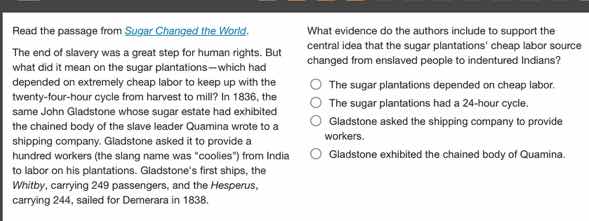
read the passage from sugar changed the world. the end of slavery was a great step for human rights. but what did it mean on the sugar plantations - which had depended on an extremely cheap labor to keep up with the twenty - four - hour cycle from harvest to mill? in 1836, the same john gladstone whose sugar estate had exhibited a chained body of the slave leader quamina wrote to a shipping company. gladstone asked it to provide a hundred workers (the slang name was \coolies\) from india to labor on his plantations. gladstones first ships, the whitby, carrying 249 passengers, and the hesperus, carrying 244, sailed for demerara in 1838. what evidence do the authors include to support the central idea that the sugar plantations cheap labor source changed from enslaved people to indentured indians? \bigcirc the sugar plantations depended on cheap labor. \bigcirc the sugar plantations had a 24 - hour cycle. \bigcirc gladstone asked the shipping company to provide workers. \bigcirc gladstone exhibited the chained body of quamina.
To support the central idea that the labor source changed from enslaved to indentured Indians, we analyze each option:
- Option 1: Just stating dependence on cheap labor doesn't show the change. Eliminate.
- Option 2: A 24 - hour cycle doesn't relate to the labor source change. Eliminate.
- Option 3: Gladstone (who had a sugar estate) asking the shipping company for "coolies" (indentured Indians) to labor on his plantations shows the shift from enslaved people to indentured Indians. This is relevant.
- Option 4: Exhibiting the chained body of Quamina (an enslaved person) shows the old (enslaved) labor source, not the new (indentured Indian) one. Eliminate.

Snap & solve any problem in the app
Get step-by-step solutions on Sovi AI
Photo-based solutions with guided steps
Explore more problems and detailed explanations
C. Gladstone asked the shipping company to provide workers.