QUESTION IMAGE
Question
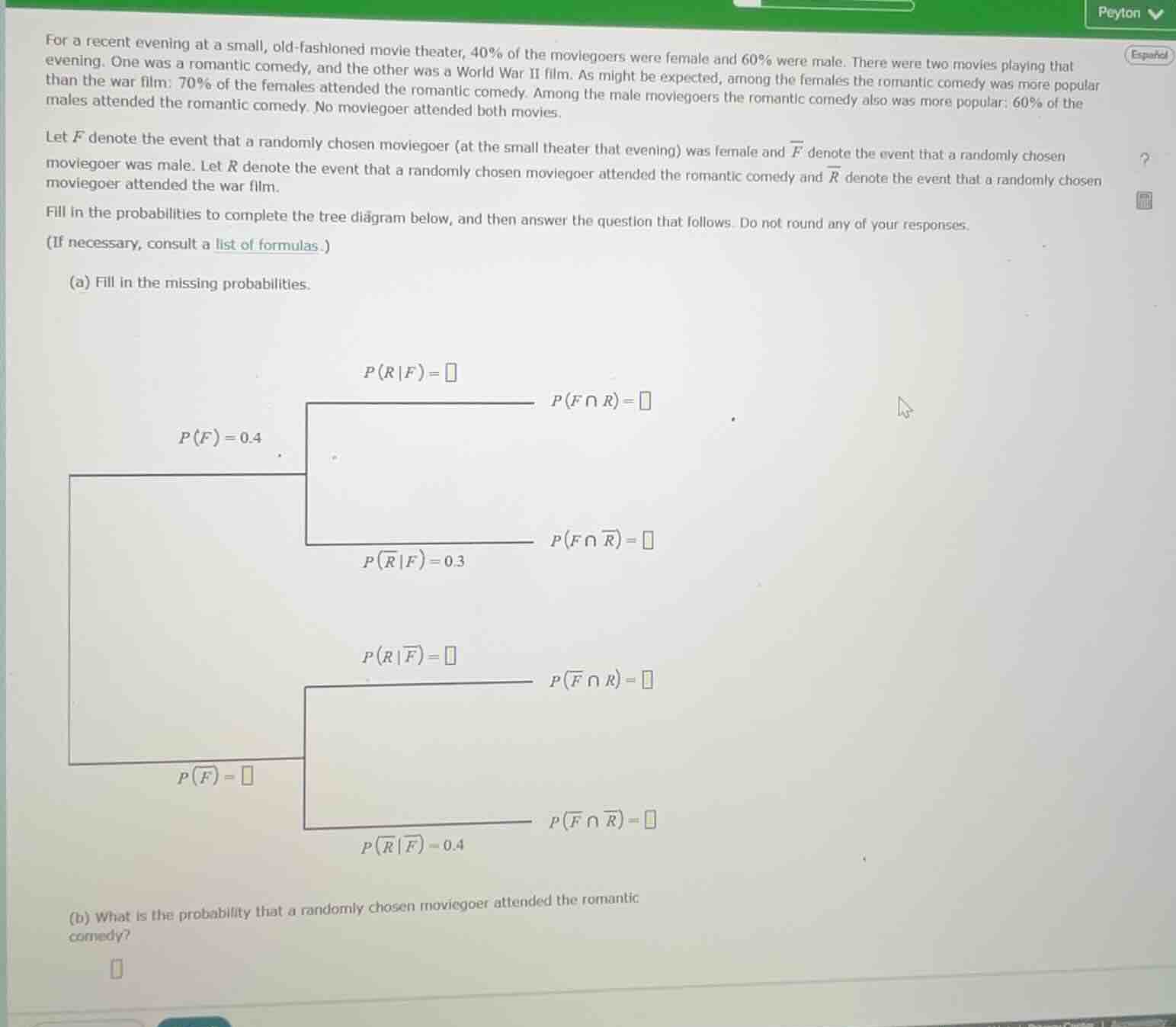
for a recent evening at a small, old - fashioned movie theater, 40% of the moviegoers were female and 60% were male. there were two movies playing that evening. one was a romantic comedy, and the other was a world war ii film. as might be expected, among the females the romantic comedy was more popular than the war film: 70% of the females attended the romantic comedy. among the male moviegoers the romantic comedy also was more popular: 60% of the males attended the romantic comedy. no moviegoer attended both movies.\
let $f$ denote the event that a randomly chosen moviegoer (at the small theater that evening) was female and $\overline{f}$ denote the event that a randomly chosen moviegoer was male. let $r$ denote the event that a randomly chosen moviegoer attended the romantic comedy and $\overline{r}$ denote the event that a randomly chosen moviegoer attended the war film.\
fill in the probabilities to complete the tree diagram below, and then answer the question that follows. do not round any of your responses.\
(if necessary, consult a list of formulas.)\
(a) fill in the missing probabilities.\
\\\
\\\
(b) what is the probability that a randomly chosen moviegoer attended the romantic comedy?\
\\(\square\\)
Part (a)
Step 1: Find \( P(R|F) \)
We know that for a given event \( F \), the sum of the conditional probabilities of \( R \) and \( \overline{R} \) given \( F \) should be 1. So \( P(R|F)+P(\overline{R}|F) = 1 \). We are given \( P(\overline{R}|F)=0.3 \), so \( P(R|F)=1 - 0.3 = 0.7 \).
Step 2: Find \( P(F\cap R) \)
The formula for the intersection of two events is \( P(A\cap B)=P(A)\times P(B|A) \). Here, \( A = F \) and \( B = R \), so \( P(F\cap R)=P(F)\times P(R|F) \). We know \( P(F) = 0.4 \) and \( P(R|F)=0.7 \), so \( P(F\cap R)=0.4\times0.7 = 0.28 \).
Step 3: Find \( P(F\cap \overline{R}) \)
Using the formula \( P(A\cap B)=P(A)\times P(B|A) \) with \( A = F \) and \( B=\overline{R} \), we have \( P(F\cap \overline{R})=P(F)\times P(\overline{R}|F) \). Substituting \( P(F) = 0.4 \) and \( P(\overline{R}|F)=0.3 \), we get \( P(F\cap \overline{R})=0.4\times0.3 = 0.12 \).
Step 4: Find \( P(\overline{F}) \)
Since \( F \) and \( \overline{F} \) are complementary events, \( P(F)+P(\overline{F}) = 1 \). We know \( P(F) = 0.4 \), so \( P(\overline{F})=1 - 0.4 = 0.6 \).
Step 5: Find \( P(R|\overline{F}) \)
We know that for a given event \( \overline{F} \), the sum of the conditional probabilities of \( R \) and \( \overline{R} \) given \( \overline{F} \) should be 1. So \( P(R|\overline{F})+P(\overline{R}|\overline{F}) = 1 \). We are given \( P(\overline{R}|\overline{F}) = 0.4 \), so \( P(R|\overline{F})=1 - 0.4 = 0.6 \).
Step 6: Find \( P(\overline{F}\cap R) \)
Using the formula \( P(A\cap B)=P(A)\times P(B|A) \) with \( A=\overline{F} \) and \( B = R \), we have \( P(\overline{F}\cap R)=P(\overline{F})\times P(R|\overline{F}) \). Substituting \( P(\overline{F}) = 0.6 \) and \( P(R|\overline{F})=0.6 \), we get \( P(\overline{F}\cap R)=0.6\times0.6 = 0.36 \).
Step 7: Find \( P(\overline{F}\cap \overline{R}) \)
Using the formula \( P(A\cap B)=P(A)\times P(B|A) \) with \( A=\overline{F} \) and \( B=\overline{R} \), we have \( P(\overline{F}\cap \overline{R})=P(\overline{F})\times P(\overline{R}|\overline{F}) \). Substituting \( P(\overline{F}) = 0.6 \) and \( P(\overline{R}|\overline{F}) = 0.4 \), we get \( P(\overline{F}\cap \overline{R})=0.6\times0.4 = 0.24 \).
Part (b)
To find the probability that a randomly chosen moviegoer attended the romantic comedy, we use the law of total probability. The event \( R \) can occur in two ways: either the moviegoer is female and attended \( R \) (i.e., \( F\cap R \)) or the moviegoer is male and attended \( R \) (i.e., \( \overline{F}\cap R \)). So \( P(R)=P(F\cap R)+P(\overline{F}\cap R) \). We found \( P(F\cap R)=0.28 \) and \( P(\overline{F}\cap R)=0.36 \). So \( P(R)=0.28 + 0.36 = 0.64 \).
Final Answers for (a)
- \( P(R|F)=\boldsymbol{0.7} \)
- \( P(F\cap R)=\boldsymbol{0.28} \)
- \( P(F\cap \overline{R})=\boldsymbol{0.12} \)
- \( P(\overline{F})=\boldsymbol{0.6} \)
- \( P(R|\overline{F})=\boldsymbol{0.6} \)
- \( P(\overline{F}\cap R)=\boldsymbol{0.36} \)
- \( P(\overline{F}\cap \overline{R})=\boldsymbol{0.24} \)
Final Answer for (b)
\( P(R)=\boldsymbol{0.64} \)

Snap & solve any problem in the app
Get step-by-step solutions on Sovi AI
Photo-based solutions with guided steps
Explore more problems and detailed explanations
Part (a)
Step 1: Find \( P(R|F) \)
We know that for a given event \( F \), the sum of the conditional probabilities of \( R \) and \( \overline{R} \) given \( F \) should be 1. So \( P(R|F)+P(\overline{R}|F) = 1 \). We are given \( P(\overline{R}|F)=0.3 \), so \( P(R|F)=1 - 0.3 = 0.7 \).
Step 2: Find \( P(F\cap R) \)
The formula for the intersection of two events is \( P(A\cap B)=P(A)\times P(B|A) \). Here, \( A = F \) and \( B = R \), so \( P(F\cap R)=P(F)\times P(R|F) \). We know \( P(F) = 0.4 \) and \( P(R|F)=0.7 \), so \( P(F\cap R)=0.4\times0.7 = 0.28 \).
Step 3: Find \( P(F\cap \overline{R}) \)
Using the formula \( P(A\cap B)=P(A)\times P(B|A) \) with \( A = F \) and \( B=\overline{R} \), we have \( P(F\cap \overline{R})=P(F)\times P(\overline{R}|F) \). Substituting \( P(F) = 0.4 \) and \( P(\overline{R}|F)=0.3 \), we get \( P(F\cap \overline{R})=0.4\times0.3 = 0.12 \).
Step 4: Find \( P(\overline{F}) \)
Since \( F \) and \( \overline{F} \) are complementary events, \( P(F)+P(\overline{F}) = 1 \). We know \( P(F) = 0.4 \), so \( P(\overline{F})=1 - 0.4 = 0.6 \).
Step 5: Find \( P(R|\overline{F}) \)
We know that for a given event \( \overline{F} \), the sum of the conditional probabilities of \( R \) and \( \overline{R} \) given \( \overline{F} \) should be 1. So \( P(R|\overline{F})+P(\overline{R}|\overline{F}) = 1 \). We are given \( P(\overline{R}|\overline{F}) = 0.4 \), so \( P(R|\overline{F})=1 - 0.4 = 0.6 \).
Step 6: Find \( P(\overline{F}\cap R) \)
Using the formula \( P(A\cap B)=P(A)\times P(B|A) \) with \( A=\overline{F} \) and \( B = R \), we have \( P(\overline{F}\cap R)=P(\overline{F})\times P(R|\overline{F}) \). Substituting \( P(\overline{F}) = 0.6 \) and \( P(R|\overline{F})=0.6 \), we get \( P(\overline{F}\cap R)=0.6\times0.6 = 0.36 \).
Step 7: Find \( P(\overline{F}\cap \overline{R}) \)
Using the formula \( P(A\cap B)=P(A)\times P(B|A) \) with \( A=\overline{F} \) and \( B=\overline{R} \), we have \( P(\overline{F}\cap \overline{R})=P(\overline{F})\times P(\overline{R}|\overline{F}) \). Substituting \( P(\overline{F}) = 0.6 \) and \( P(\overline{R}|\overline{F}) = 0.4 \), we get \( P(\overline{F}\cap \overline{R})=0.6\times0.4 = 0.24 \).
Part (b)
To find the probability that a randomly chosen moviegoer attended the romantic comedy, we use the law of total probability. The event \( R \) can occur in two ways: either the moviegoer is female and attended \( R \) (i.e., \( F\cap R \)) or the moviegoer is male and attended \( R \) (i.e., \( \overline{F}\cap R \)). So \( P(R)=P(F\cap R)+P(\overline{F}\cap R) \). We found \( P(F\cap R)=0.28 \) and \( P(\overline{F}\cap R)=0.36 \). So \( P(R)=0.28 + 0.36 = 0.64 \).
Final Answers for (a)
- \( P(R|F)=\boldsymbol{0.7} \)
- \( P(F\cap R)=\boldsymbol{0.28} \)
- \( P(F\cap \overline{R})=\boldsymbol{0.12} \)
- \( P(\overline{F})=\boldsymbol{0.6} \)
- \( P(R|\overline{F})=\boldsymbol{0.6} \)
- \( P(\overline{F}\cap R)=\boldsymbol{0.36} \)
- \( P(\overline{F}\cap \overline{R})=\boldsymbol{0.24} \)
Final Answer for (b)
\( P(R)=\boldsymbol{0.64} \)