QUESTION IMAGE
Question
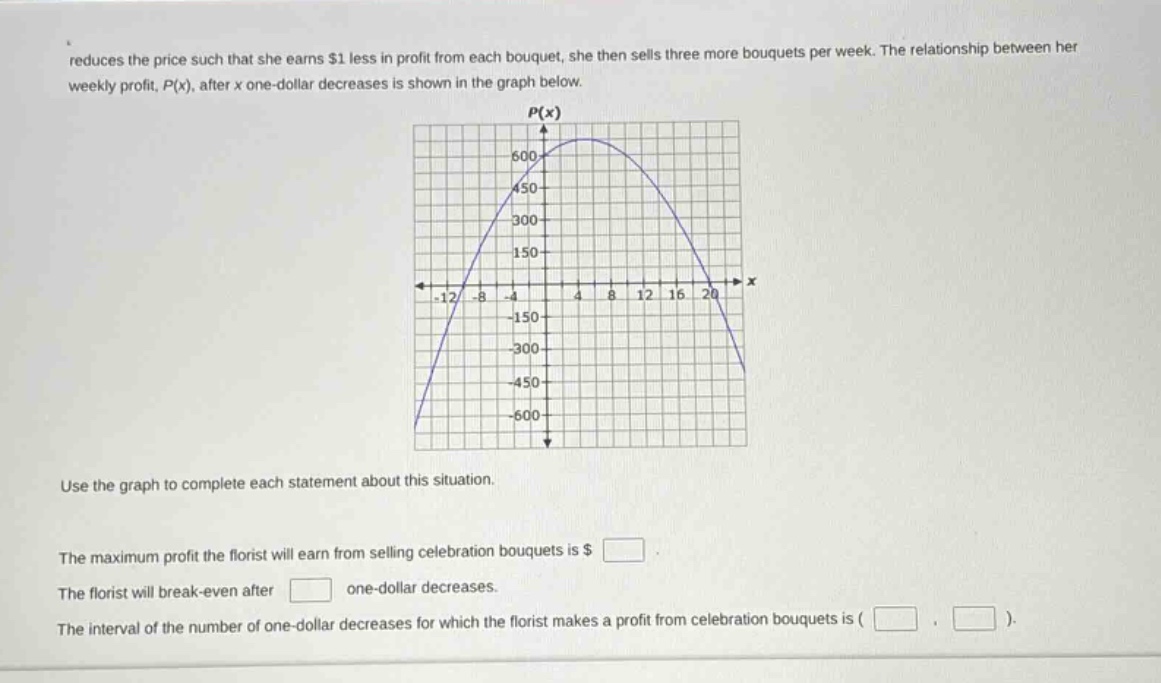
reduces the price such that she earns $1 less in profit from each bouquet, she then sells three more bouquets per week. the relationship between her weekly profit, p(x), after x one - dollar decreases is shown in the graph below.
use the graph to complete each statement about this situation.
the maximum profit the florist will earn from selling celebration bouquets is $\square$.
the florist will break - even after $\square$ one - dollar decreases.
the interval of the number of one - dollar decreases for which the florist makes a profit from celebration bouquets is ($\square$, $\square$).
First Statement: Maximum Profit
Step1: Identify the vertex of the parabola
The graph of \( P(x) \) is a parabola, and the maximum profit occurs at the vertex (the highest point) of the parabola. From the graph, we can see that the vertex is at a point where the \( y \)-value (profit) is the highest. Looking at the grid, the peak of the parabola is at \( y = 675 \)? Wait, no, wait the initial point when \( x = 0 \) is \( P(0) = 600 \), but the vertex is higher. Wait, maybe I misread. Wait, let's check the graph again. Wait, the \( y \)-axis has 600, 450, 300, 150, etc. Wait, maybe the vertex is at \( x = 5 \) or something, but let's see the roots. The roots are at \( x = -10 \) and \( x = 20 \)? Wait, no, the graph crosses the \( x \)-axis at \( x = -10 \) (since at \( x = -10 \), \( P(x) = 0 \)) and \( x = 20 \) (at \( x = 20 \), \( P(x) = 0 \))? Wait, no, looking at the graph, the left root is at \( x = -10 \) (since when \( x = -10 \), \( P(x) = 0 \)) and the right root is at \( x = 20 \) (when \( x = 20 \), \( P(x) = 0 \))? Wait, no, the graph shows that at \( x = -10 \), it's on the \( x \)-axis, and at \( x = 20 \), it's on the \( x \)-axis. Wait, the vertex of a parabola is at the midpoint of the roots. So the midpoint of \( x = -10 \) and \( x = 20 \) is \( x = \frac{-10 + 20}{2} = 5 \). Then, to find the maximum profit, we can find \( P(5) \). But looking at the graph, when \( x = 0 \), \( P(0) = 600 \), and the vertex is higher. Wait, maybe the grid is such that each square is, say, 50? Wait, no, the \( y \)-axis has 600, 450, 300, 150, 0, -150, etc. Wait, maybe the vertex is at \( y = 675 \)? Wait, no, maybe I made a mistake. Wait, let's re-express the problem. The profit function is a quadratic function. Let's denote \( P(x) = ax^2 + bx + c \). We know that when \( x = 0 \), \( P(0) = 600 \), so \( c = 600 \). The roots are at \( x = -10 \) and \( x = 20 \) (since the graph crosses the \( x \)-axis at \( x = -10 \) and \( x = 20 \)). So the quadratic can be written as \( P(x) = a(x + 10)(x - 20) \). When \( x = 0 \), \( P(0) = a(10)(-20) = -200a = 600 \), so \( a = -3 \). Thus, \( P(x) = -3(x + 10)(x - 20) = -3(x^2 - 10x - 200) = -3x^2 + 30x + 600 \). The vertex of a quadratic \( ax^2 + bx + c \) is at \( x = -\frac{b}{2a} \). Here, \( a = -3 \), \( b = 30 \), so \( x = -\frac{30}{2(-3)} = 5 \). Then, \( P(5) = -3(25) + 30(5) + 600 = -75 + 150 + 600 = 675 \). So the maximum profit is $675.
Step2: Confirm the vertex calculation
Using the quadratic formula for the vertex, we found that the \( x \)-coordinate of the vertex is 5, and substituting back into the profit function, we get \( P(5) = 675 \). So the maximum profit is $675.
Second Statement: Break-even after how many one-dollar decreases
Step1: Identify the break-even points
Break-even occurs when \( P(x) = 0 \). From the graph, we can see that the profit function crosses the \( x \)-axis (where \( P(x) = 0 \)) at two points: the left root and the right root. The right root is at \( x = 20 \) (since when \( x = 20 \), \( P(x) = 0 \)). Wait, but the left root is at \( x = -10 \), but we are interested in the number of one-dollar decreases, which is a non-negative number (since \( x \) represents the number of one-dollar decreases, so \( x \geq 0 \) in practical terms, but mathematically, \( x \) can be negative, but in the context, \( x \) is the number of one-dollar decreases, so \( x \) is a non-negative integer? Wait, no, the problem says "after \( x \) one-dollar decreases", so \( x \) can be positive (decreases) or negative (increases in price, i.e., fewer sales). But the break-even when \( x \) is positive (decreases) is at \( x = 20 \), because at \( x = 20 \), \( P(x) = 0 \). Wait, but let's check the graph: the right intersection with the \( x \)-axis is at \( x = 20 \), so the florist will break-even after 20 one-dollar decreases.
Third Statement: Interval of one-dollar decreases for profit
Step1: Identify the roots of the profit function
The profit function \( P(x) \) is positive (profit) between its two roots (where \( P(x) > 0 \)). The roots are at \( x = -10 \) and \( x = 20 \) (from the graph, where \( P(x) = 0 \)). So the interval where \( P(x) > 0 \) is \( (-10, 20) \). But in the context of the number of one-dollar decreases, \( x \) represents the number of one-dollar decreases, so \( x \) must be greater than -10 (but since \( x \) is the number of decreases, it's more practical to consider \( x \) such that the florist is making a profit. So the interval is \( (-10, 20) \), but since \( x \) is the number of one-dollar decreases, the meaningful interval (where \( x \) is a real number, and in practical terms, \( x \) can be from -10 to 20, but since \( x \) is the number of decreases, the interval is \( (-10, 20) \).

Snap & solve any problem in the app
Get step-by-step solutions on Sovi AI
Photo-based solutions with guided steps
Explore more problems and detailed explanations
s:
- The maximum profit the florist will earn from selling celebration bouquets is $ \boldsymbol{675} $. (Wait, but maybe I made a mistake. Wait, let's recheck the quadratic. If the roots are at \( x = -10 \) and \( x = 20 \), then the vertex is at \( x = 5 \), and \( P(5) = -3(25) + 30(5) + 600 = -75 + 150 + 600 = 675 \). Yes, that's correct.
- The florist will break-even after \( \boldsymbol{20} \) one-dollar decreases.
- The interval of the number of one-dollar decreases for which the florist makes a profit from celebration bouquets is \( (\boldsymbol{-10}, \boldsymbol{20}) \).