QUESTION IMAGE
Question
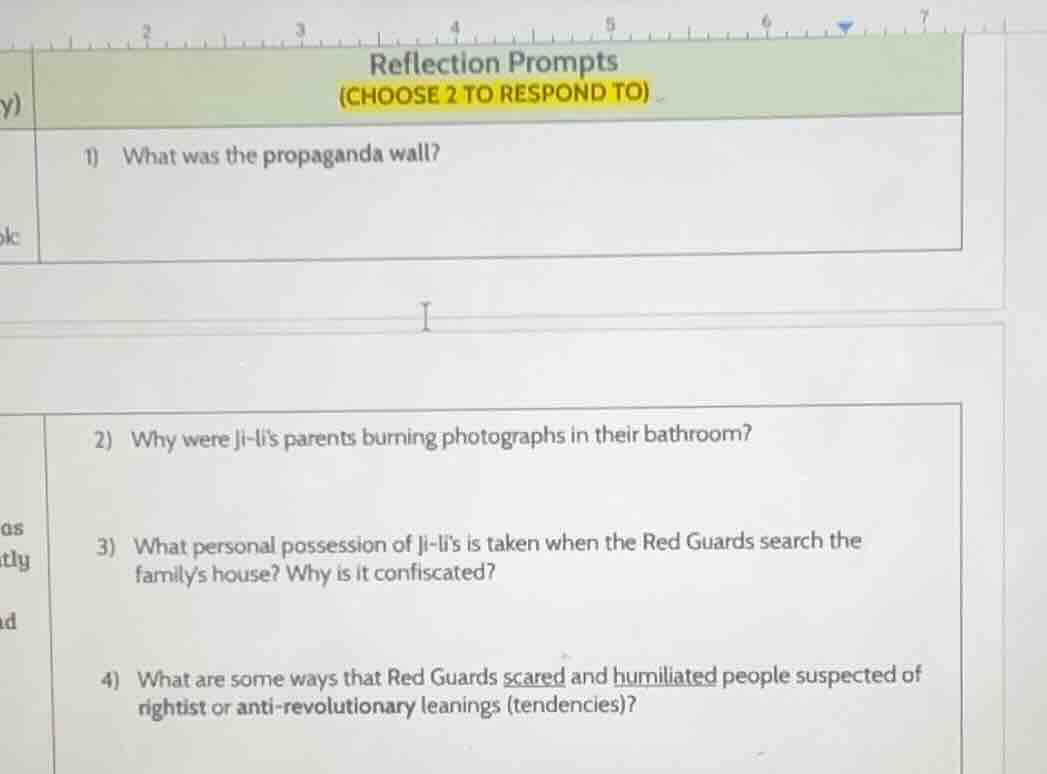
reflection prompts (choose 2 to respond to)
- what was the propaganda wall?
- why were ji-li’s parents burning photographs in their bathroom?
- what personal possession of ji-li’s is taken when the red guards search the family’s house? why is it confiscated?
- what are some ways that red guards scared and humiliated people suspected of rightist or anti - revolutionary leanings (tendencies)?
To answer these reflection prompts, we assume they are related to the novel Red Scarf Girl by Ji - li Jiang, which is set during the Cultural Revolution in China. Here are the answers to each prompt:
Prompt 1: What was the propaganda wall?
In the context of the Cultural Revolution (as depicted in Red Scarf Girl), the propaganda wall was a public space (usually a large wall in a community or near important buildings) where revolutionary slogans, posters, and announcements were displayed. These walls were used to spread Maoist ideology, promote the goals of the Cultural Revolution, and denounce "enemies of the revolution" such as "rightists" or those with "anti - revolutionary" tendencies. They were a key tool for the Communist Party to control the narrative and mobilize the masses.
During the Cultural Revolution, having certain types of photographs (such as those of family members with "undesirable" backgrounds, or photographs that didn't conform to the revolutionary aesthetic or ideology) could be dangerous. Ji - li's family had a "bad" class background (her grandfather was a landlord). Burning the photographs was an attempt to destroy evidence that could be used against them. The bathroom was likely chosen because it had a source of heat (from the water heater or stove - like fixtures for heating water) and also because it was a more private space where they could try to do this without being easily seen. If the Red Guards (the revolutionary youth groups) found these photographs, they could use them as a pretext to accuse the family of being anti - revolutionary or having ties to the "old society" (the pre - Communist, "feudal" or "bourgeois" society).
Ji - li's violin is taken. The violin was seen as a symbol of the "old culture" (associated with bourgeois or feudal - era art forms) and not in line with the revolutionary, proletarian art that was promoted during the Cultural Revolution. Also, given Ji - li's family's "bad" class background, any item that could be associated with "bourgeois" tastes or the "old society" was a target for the Red Guards, who were tasked with destroying elements of the "old culture" and purging those with "bad" class backgrounds. The violin, as a Western - style musical instrument, was considered a part of the "decadent" old culture that the Cultural Revolution sought to eliminate.

Snap & solve any problem in the app
Get step-by-step solutions on Sovi AI
Photo-based solutions with guided steps
Explore more problems and detailed explanations
The propaganda wall was a public wall (often in communities or near key buildings) used to display revolutionary slogans, posters, and announcements to spread Maoist ideology, promote Cultural Revolution goals, and denounce "enemies of the revolution" during China's Cultural Revolution.