QUESTION IMAGE
Question
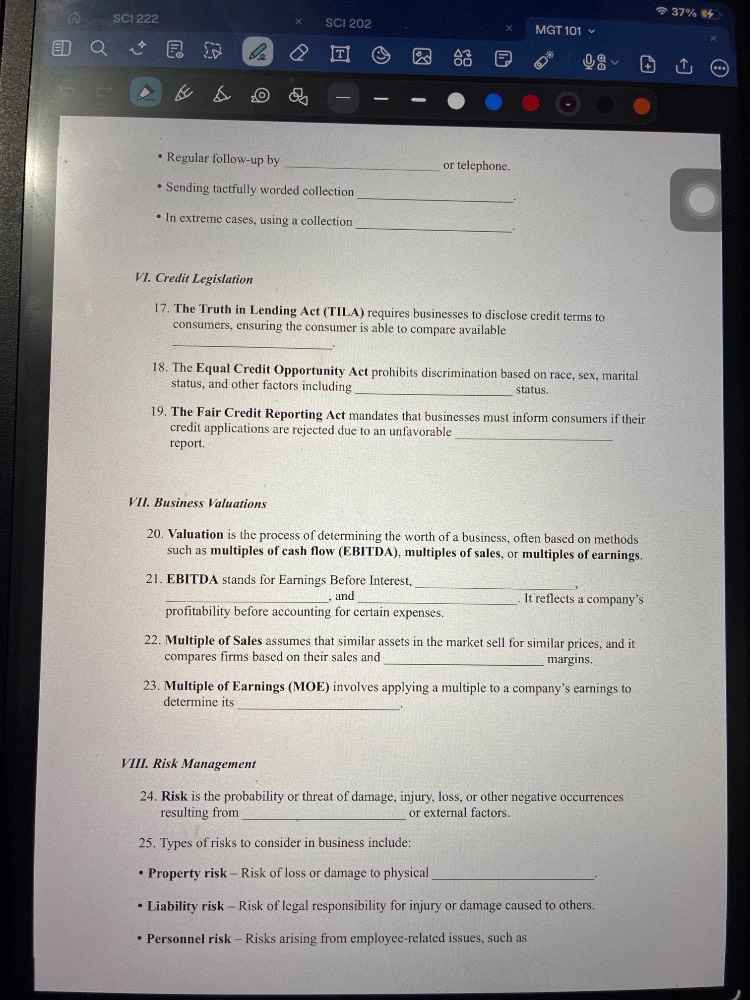
- regular follow - up by ____________ or telephone.
- sending tactfully worded collection ____________.
- in extreme cases, using a collection ____________.
vi. credit legislation
- the truth in lending act (tila) requires businesses to disclose credit terms to consumers, ensuring the consumer is able to compare available ____________.
- the equal credit opportunity act prohibits discrimination based on race, sex, marital status, and other factors including ____________ status.
- the fair credit reporting act mandates that businesses must inform consumers if their credit applications are rejected due to an unfavorable ____________ report.
vii. business valuations
- valuation is the process of determining the worth of a business, often based on methods such as multiples of cash flow (ebitda), multiples of sales, or multiples of earnings.
- ebitda stands for earnings before interest, __________, and __________. it reflects a company’s profitability before accounting for certain expenses.
- multiple of sales assumes that similar assets in the market sell for similar prices, and it compares firms based on their sales and ____________ margins.
- multiple of earnings (moe) involves applying a multiple to a company’s earnings to determine its ____________.
viii. risk management
- risk is the probability or threat of damage, injury, loss, or other negative occurrences resulting from ____________ or external factors.
- types of risks to consider in business include:
- property risk – risk of loss or damage to physical ____________.
- liability risk – risk of legal responsibility for injury or damage caused to others.
- personnel risk – risks arising from employee - related issues, such as
Since this is a fill - in - the - blank business - related question, we'll go through each blank one by one:
Question 17
The Truth in Lending Act (TILA) requires businesses to disclose credit terms to consumers, ensuring the consumer is able to compare available credit offers. (The main idea of TILA is to let consumers compare different credit offers by disclosing credit terms.)
Question 18
The Equal Credit Opportunity Act prohibits discrimination based on race, sex, marital status, and other factors including age (a common factor prohibited in equal credit opportunity; other possible answers could be "religious" but age is a typical one) status.
Question 19
The Fair Credit Reporting Act mandates that businesses must inform consumers if their credit applications are rejected due to an unfavorable credit report. (The act is related to credit reports, and rejections due to bad credit reports need to be communicated.)
Question 21
EBITDA stands for Earnings Before Interest, Taxes, Depreciation, and Amortization. (This is the standard definition of EBITDA.)
Question 22
Multiple of Sales assumes that similar assets in the market sell for similar prices, and it compares firms based on their sales and profit margins. (Profit margins are a key metric when comparing firms using sales multiples.)
Question 23
Multiple of Earnings (MOE) involves applying a multiple to a company’s earnings to determine its value (the purpose of business valuation methods like MOE is to find the business's value).
Question 24
Risk is the probability or threat of damage, injury, loss, or other negative occurrences resulting from internal or external factors. (Risks can come from inside the business (internal) or outside (external).)
Question 25
Property risk – Risk of loss or damage to physical assets (Property risk is about physical assets like buildings, equipment etc. of a business).
(Note: Some of these blanks may have multiple correct answers depending on the context of the course material. The above are common and widely - accepted answers for these business - related concepts.)
If we take question 17 as an example of the answer format:
The Truth in Lending Act (TILA) aims to enable consumers to compare different credit offers by having businesses disclose credit terms. So the blank should be filled with "credit offers".

Snap & solve any problem in the app
Get step-by-step solutions on Sovi AI
Photo-based solutions with guided steps
Explore more problems and detailed explanations
credit offers