QUESTION IMAGE
Question
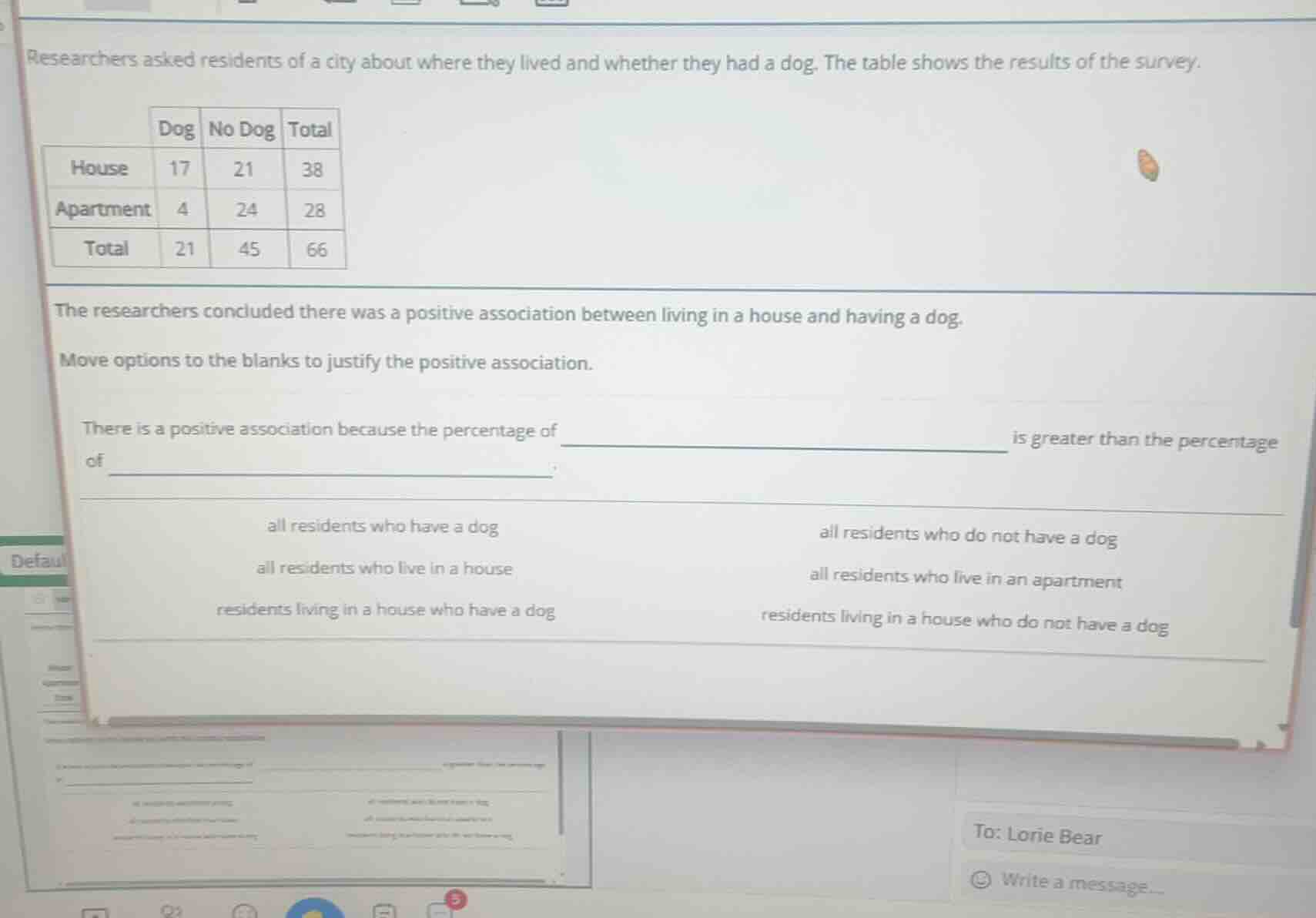
researchers asked residents of a city about where they lived and whether they had a dog. the table shows the results of the survey.
dog no dog total
house 17 21 38
apartment 4 24 28
total 21 45 66
the researchers concluded there was a positive association between living in a house and having a dog.
move options to the blanks to justify the positive association.
there is a positive association because the percentage of is greater than the percentage of .
all residents who have a dog
all residents who do not have a dog
all residents who live in a house
all residents who live in an apartment
residents living in a house who have a dog
residents living in a house who do not have a dog
Step1: Calculate percentage for house residents with dog
First, find the percentage of residents living in a house who have a dog. The number of house residents with a dog is 17, and the total number of house residents is 38. So the percentage is $\frac{17}{38} \times 100\% \approx 44.74\%$.
Step2: Calculate percentage for apartment residents with dog
Next, find the percentage of residents living in an apartment who have a dog. The number of apartment residents with a dog is 4, and the total number of apartment residents is 28. So the percentage is $\frac{4}{28} \times 100\% \approx 14.29\%$.
Step3: Compare the two percentages
We can see that the percentage of residents living in a house who have a dog ($\approx 44.74\%$) is greater than the percentage of residents living in an apartment who have a dog ($\approx 14.29\%$). Alternatively, we can also compare with other relevant groups, but this comparison shows the positive association between living in a house and having a dog.

Snap & solve any problem in the app
Get step-by-step solutions on Sovi AI
Photo-based solutions with guided steps
Explore more problems and detailed explanations
There is a positive association because the percentage of $\boldsymbol{\text{residents living in a house who have a dog}}$ is greater than the percentage of $\boldsymbol{\text{residents living in an apartment who have a dog}}$ (or other valid comparison like "residents living in a house who have a dog" vs "residents living in a house who do not have a dog" where percentage of having a dog in house: $\frac{17}{38}\approx44.74\%$, not having: $\frac{21}{38}\approx55.26\%$ – wait, no, that's not greater. So the correct comparison is with apartment residents with dog or other appropriate. The most appropriate is comparing the proportion of dog - owners among house residents and among apartment residents. So the first blank: residents living in a house who have a dog; the second blank: residents living in an apartment who have a dog (or also can be compared with "residents living in a house who do not have a dog" but in that case, the percentage of having a dog in house is less than not having, so that's wrong. So the correct one is comparing house dog - owners percentage with apartment dog - owners percentage or house dog - owners with all dog - owners (percentage of house residents among dog - owners: $\frac{17}{21}\approx80.95\%$, percentage of apartment residents among dog - owners: $\frac{4}{21}\approx19.05\%$; or house dog - owners with house non - dog - owners: no, as above. So the best is "residents living in a house who have a dog" and "residents living in an apartment who have a dog" or "residents living in a house who have a dog" and "all residents who have a dog" (percentage of house residents among all dog - owners: $\frac{17}{21}\approx80.95\%$, percentage of apartment residents among all dog - owners: $\frac{4}{21}\approx19.05\%$; but the first comparison with apartment residents with dog is more direct for the association between living in house and having a dog).