QUESTION IMAGE
Question
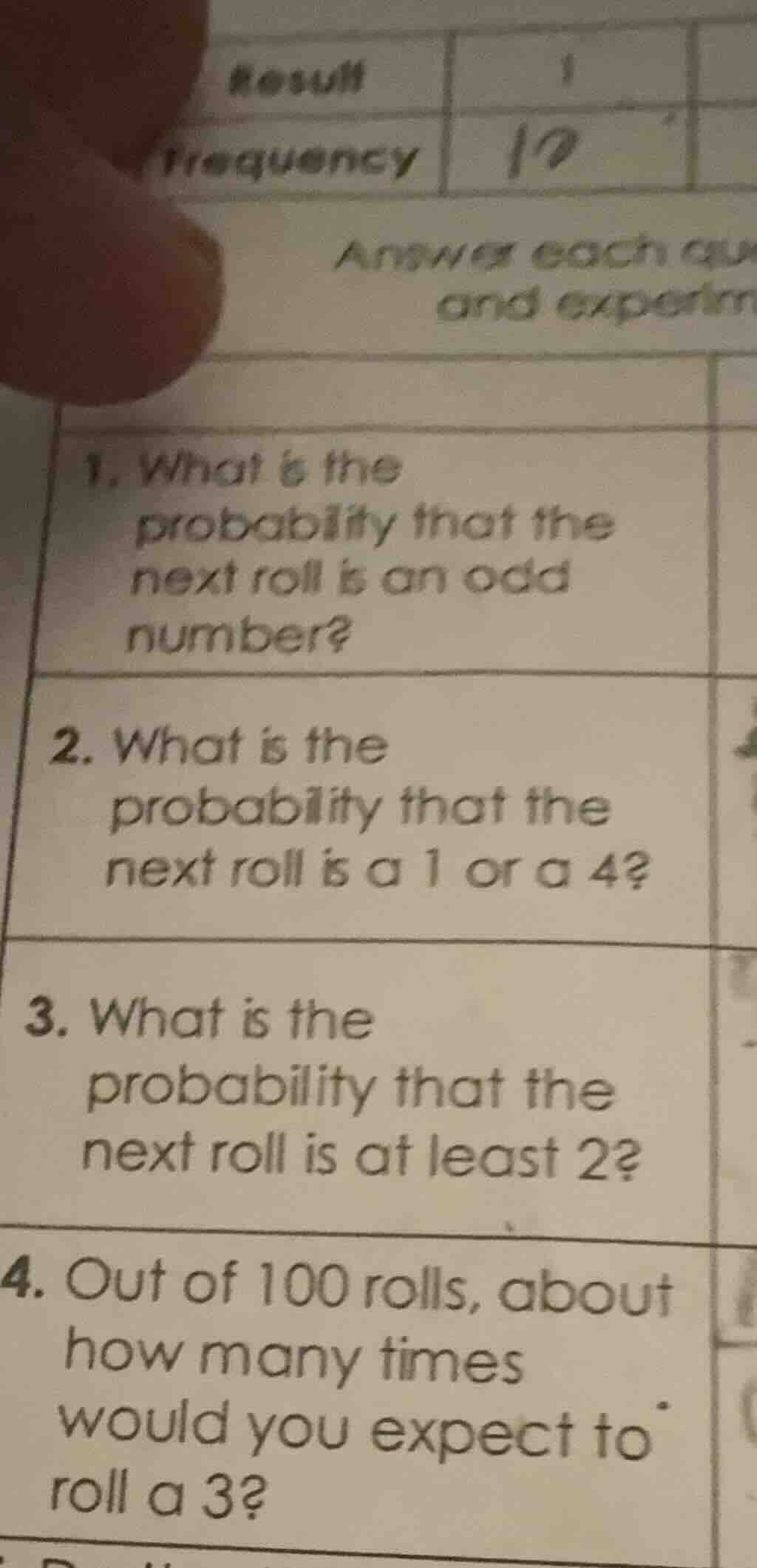
result 1
frequency 10
answer each qu and experim
- what is the probability that the next roll is an odd number?
- what is the probability that the next roll is a 1 or a 4?
- what is the probability that the next roll is at least 2?
- out of 100 rolls, about how many times would you expect to roll a 3?
To solve these probability questions, we assume we are dealing with a standard six - sided die (since the context of rolling a die is common for such probability problems). A standard die has outcomes: 1, 2, 3, 4, 5, 6.
Question 1: Probability of rolling an odd number
Step 1: Identify odd numbers on a die
The odd numbers on a die are 1, 3, 5. So there are 3 favorable outcomes.
Step 2: Calculate total number of possible outcomes
A standard die has 6 possible outcomes (1, 2, 3, 4, 5, 6).
Step 3: Use the probability formula
The probability \(P\) of an event is given by \(P=\frac{\text{Number of favorable outcomes}}{\text{Total number of possible outcomes}}\).
For rolling an odd number, \(P(\text{odd})=\frac{3}{6}=\frac{1}{2}\)
Question 2: Probability of rolling a 1 or a 4
Step 1: Identify favorable outcomes
The outcomes that are 1 or 4 are two distinct outcomes: 1 and 4. So the number of favorable outcomes is 2.
Step 2: Calculate total number of possible outcomes
As before, a die has 6 possible outcomes.
Step 3: Use the probability formula
\(P(1\text{ or }4)=\frac{\text{Number of favorable outcomes}}{\text{Total number of possible outcomes}}=\frac{2}{6}=\frac{1}{3}\)
Question 3: Probability of rolling at least 2
Step 1: Identify favorable outcomes
"At least 2" means 2, 3, 4, 5, 6. The number of favorable outcomes is 5 (since we exclude 1).
Step 2: Calculate total number of possible outcomes
A die has 6 possible outcomes.
Step 3: Use the probability formula
\(P(\text{at least }2)=\frac{5}{6}\)
Question 4: Expected number of times to roll a 3 in 100 rolls
Step 1: Find the probability of rolling a 3
The number of favorable outcomes (rolling a 3) is 1, and the total number of possible outcomes is 6. So \(P(3)=\frac{1}{6}\).
Step 2: Use the expected - value formula for repeated trials
The expected number of times an event occurs in \(n\) trials is given by \(E = n\times P\), where \(n = 100\) (number of rolls) and \(P\) is the probability of the event.
\(E=100\times\frac{1}{6}=\frac{100}{6}\approx16.67\) (we can say about 17 times, or if we keep it as a fraction, \(\frac{50}{3}\approx16.67\))
Final Answers
- \(\frac{1}{2}\)
- \(\frac{1}{3}\)
- \(\frac{5}{6}\)
- About 17 (or \(\frac{50}{3}\approx16.67\)) times

Snap & solve any problem in the app
Get step-by-step solutions on Sovi AI
Photo-based solutions with guided steps
Explore more problems and detailed explanations
To solve these probability questions, we assume we are dealing with a standard six - sided die (since the context of rolling a die is common for such probability problems). A standard die has outcomes: 1, 2, 3, 4, 5, 6.
Question 1: Probability of rolling an odd number
Step 1: Identify odd numbers on a die
The odd numbers on a die are 1, 3, 5. So there are 3 favorable outcomes.
Step 2: Calculate total number of possible outcomes
A standard die has 6 possible outcomes (1, 2, 3, 4, 5, 6).
Step 3: Use the probability formula
The probability \(P\) of an event is given by \(P=\frac{\text{Number of favorable outcomes}}{\text{Total number of possible outcomes}}\).
For rolling an odd number, \(P(\text{odd})=\frac{3}{6}=\frac{1}{2}\)
Question 2: Probability of rolling a 1 or a 4
Step 1: Identify favorable outcomes
The outcomes that are 1 or 4 are two distinct outcomes: 1 and 4. So the number of favorable outcomes is 2.
Step 2: Calculate total number of possible outcomes
As before, a die has 6 possible outcomes.
Step 3: Use the probability formula
\(P(1\text{ or }4)=\frac{\text{Number of favorable outcomes}}{\text{Total number of possible outcomes}}=\frac{2}{6}=\frac{1}{3}\)
Question 3: Probability of rolling at least 2
Step 1: Identify favorable outcomes
"At least 2" means 2, 3, 4, 5, 6. The number of favorable outcomes is 5 (since we exclude 1).
Step 2: Calculate total number of possible outcomes
A die has 6 possible outcomes.
Step 3: Use the probability formula
\(P(\text{at least }2)=\frac{5}{6}\)
Question 4: Expected number of times to roll a 3 in 100 rolls
Step 1: Find the probability of rolling a 3
The number of favorable outcomes (rolling a 3) is 1, and the total number of possible outcomes is 6. So \(P(3)=\frac{1}{6}\).
Step 2: Use the expected - value formula for repeated trials
The expected number of times an event occurs in \(n\) trials is given by \(E = n\times P\), where \(n = 100\) (number of rolls) and \(P\) is the probability of the event.
\(E=100\times\frac{1}{6}=\frac{100}{6}\approx16.67\) (we can say about 17 times, or if we keep it as a fraction, \(\frac{50}{3}\approx16.67\))
Final Answers
- \(\frac{1}{2}\)
- \(\frac{1}{3}\)
- \(\frac{5}{6}\)
- About 17 (or \(\frac{50}{3}\approx16.67\)) times