QUESTION IMAGE
Question
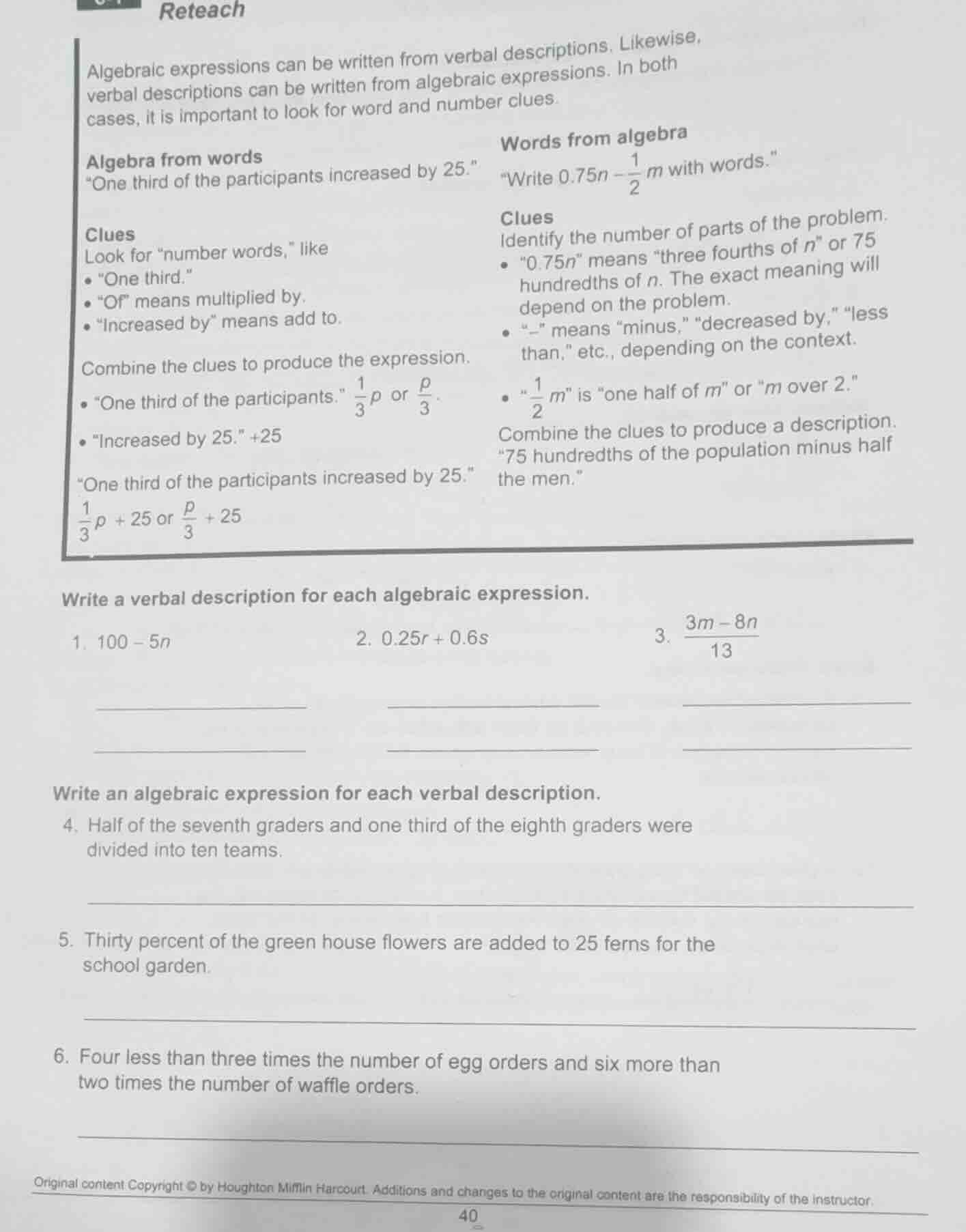
reteach
algebraic expressions can be written from verbal descriptions. likewise,
verbal descriptions can be written from algebraic expressions. in both
cases, it is important to look for word and number clues.
algebra from words
\one third of the participants increased by 25.\
clues
look for
umber words,\ like
- \one third.\
- \of\ means multiplied by.
- \increased by\ means add to.
combine the clues to produce the expression.
- \one third of the participants.\ \\(\frac{1}{3}p\\) or \\(\frac{p}{3}\\).
- \increased by 25.\ +25
\one third of the participants increased by 25.\
\\(\frac{1}{3}p + 25\\) or \\(\frac{p}{3} + 25\\)
words from algebra
\write \\(0.75n - \frac{1}{2}m\\) with words.\
clues
identify the number of parts of the problem.
- \0.75n\ means \three fourths of n\ or 75
hundredths of n. the exact meaning will
depend on the problem.
- \-\ means \minus,\ \decreased by,\ \less
than,\ etc., depending on the context.
- \\\(\frac{1}{2}m\\)\ is \one half of m\ or \m over 2.\
combine the clues to produce a description.
\75 hundredths of the population minus half
the men.\
write a verbal description for each algebraic expression.
- \\(100 - 5n\\)
- \\(0.25r + 0.6s\\)
- \\(\frac{3m - 8n}{13}\\)
write an algebraic expression for each verbal description.
- half of the seventh graders and one third of the eighth graders were
divided into ten teams.
- thirty percent of the green house flowers are added to 25 ferns for the
school garden.
- four less than three times the number of egg orders and six more than
two times the number of waffle orders.
original content copyright © by houghton mifflin harcourt. additions and changes to the original content are the responsibility of the instructor.
40
Problem 1: \(100 - 5n\)
Step1: Analyze each term
- \(100\) is a constant.
- \(5n\) means "5 times \(n\)" (since "of" or multiplication clue, here coefficient 5 with variable \(n\) implies 5 multiplied by \(n\)).
- The subtraction sign "\(-\)" means "minus" or "decreased by" or "less than" (in context, we can say "100 minus 5 times \(n\)" or "5 times \(n\) less than 100").
Step2: Combine the clues
Combine the descriptions of each part. So, "One hundred minus five times \(n\)" (or "Five times \(n\) less than one hundred").
Step1: Analyze each term
- \(0.25r\): \(0.25\) is "twenty - five hundredths" or "one fourth", and with \(r\) it means "0.25 times \(r\)" or "one fourth of \(r\)" or "twenty - five hundredths of \(r\)".
- \(0.6s\): \(0.6\) is "six tenths" or "sixty hundredths", and with \(s\) it means "0.6 times \(s\)" or "six tenths of \(s\)" or "sixty hundredths of \(s\)".
- The addition sign "\(+\)" means "plus" or "added to" or "and".
Step2: Combine the clues
Combine the descriptions of each part. So, "Twenty - five hundredths of \(r\) plus six tenths of \(s\)" (or "One fourth of \(r\) plus six tenths of \(s\)" or other equivalent descriptions).
Step1: Analyze the numerator and denominator
- Numerator: \(3m-8n\)
- \(3m\) means "3 times \(m\)" or "three times \(m\)".
- \(8n\) means "8 times \(n\)" or "eight times \(n\)".
- The subtraction sign "\(-\)" means "minus", so \(3m - 8n\) is "three times \(m\) minus eight times \(n\)".
- Denominator: \(13\) means "thirteen", and the fraction bar means "divided by" or "the quotient of... and...".
Step2: Combine the clues
The entire expression is "The quotient of (three times \(m\) minus eight times \(n\)) and thirteen" (or "Thirteen divided into (three times \(m\) minus eight times \(n\))" or "Three times \(m\) minus eight times \(n\) divided by thirteen").

Snap & solve any problem in the app
Get step-by-step solutions on Sovi AI
Photo-based solutions with guided steps
Explore more problems and detailed explanations
One hundred minus five times \(n\) (or equivalent verbal description like "Five times \(n\) less than one hundred")