QUESTION IMAGE
Question
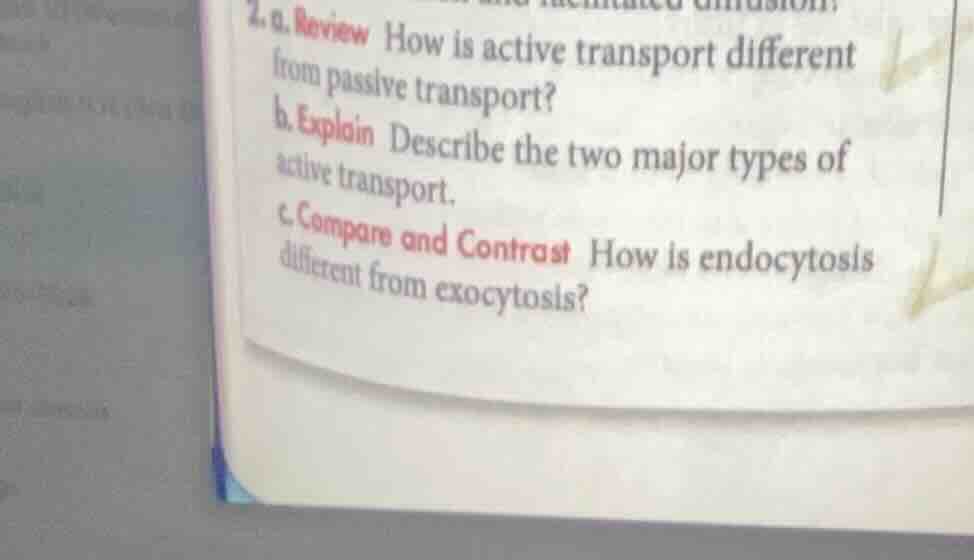
- a. review how is active transport different from passive transport?
b. explain describe the two major types of active transport.
c. compare and contrast how is endocytosis different from exocytosis?
a. Passive transport moves substances down their concentration gradient (from high to low concentration) without using cellular energy (ATP). Active transport moves substances against their concentration gradient (from low to high concentration) and requires ATP to power the movement.
b. The two main types of active transport are primary and secondary active transport. Primary active transport uses ATP directly to pump molecules against their gradient (e.g., sodium-potassium pump). Secondary active transport uses the concentration gradient of one substance (established by primary active transport) to drive the movement of another substance against its gradient (e.g., glucose transport linked to sodium movement).
c. Endocytosis is the process where a cell takes in large molecules or particles by engulfing them with its cell membrane, forming a vesicle inside the cell. Exocytosis is the process where a cell releases substances from inside the cell by fusing a vesicle with the cell membrane, expelling the contents outside the cell.

Snap & solve any problem in the app
Get step-by-step solutions on Sovi AI
Photo-based solutions with guided steps
Explore more problems and detailed explanations
a. Active transport requires ATP and moves substances against their concentration gradient, while passive transport uses no energy and moves substances down their concentration gradient.
b. 1. Primary active transport: Uses ATP directly to pump molecules against their concentration gradient (e.g., Na⁺/K⁺ pump).
- Secondary active transport: Uses the concentration gradient of one substance (created by primary active transport) to move another substance against its gradient (e.g., sodium-glucose cotransport).
c. Endocytosis brings substances into the cell via membrane vesicles, while exocytosis releases substances out of the cell via vesicle-membrane fusion.