QUESTION IMAGE
Question
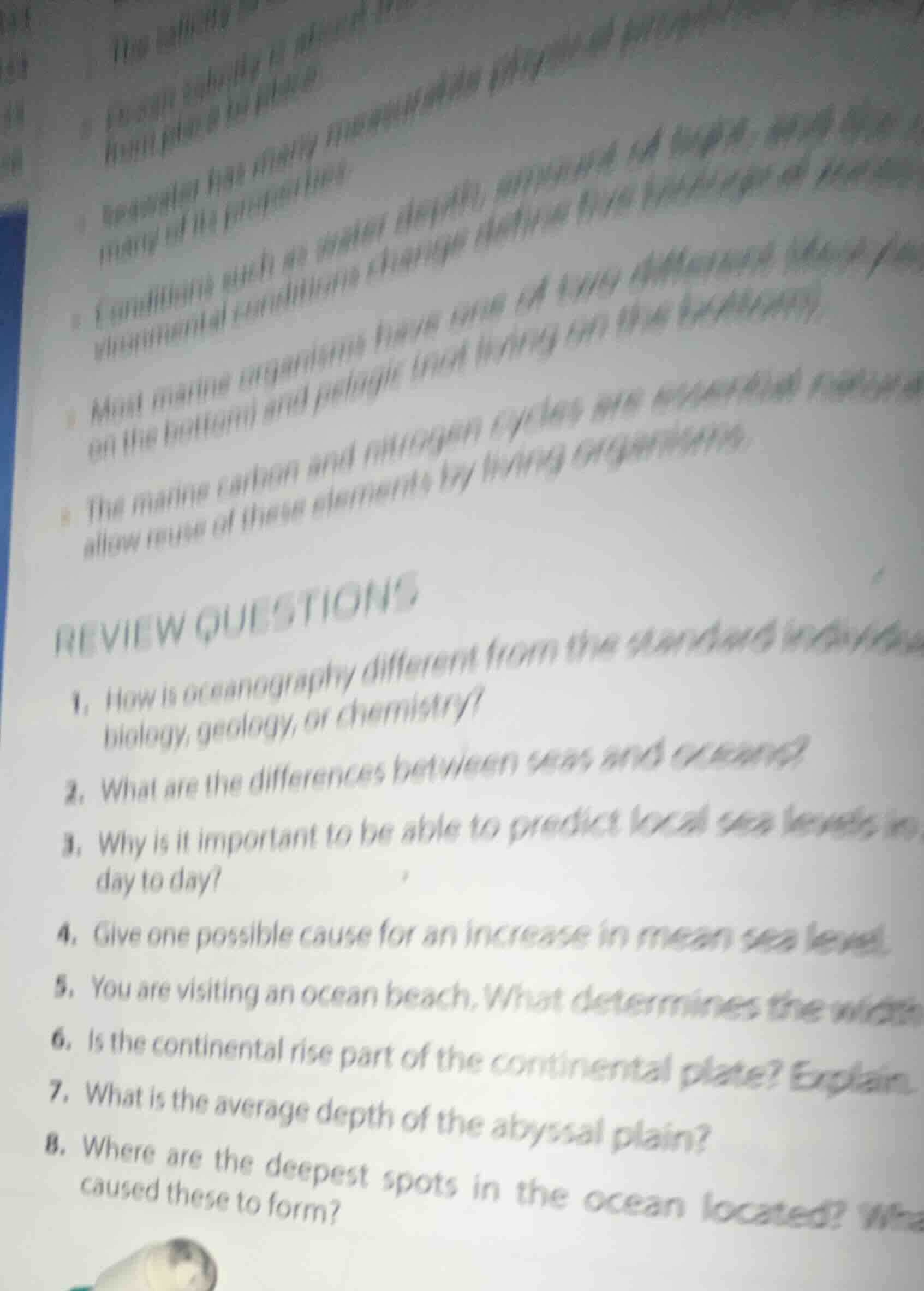
review questions
- how is oceanography different from the standard individual biology, geology, or chemistry?
- what are the differences between seas and oceans?
- why is it important to be able to predict local sea levels in day to day?
- give one possible cause for an increase in mean sea level.
- you are visiting an ocean beach. what determines the width
- is the continental rise part of the continental plate? explain.
- what is the average depth of the abyssal plain?
- where are the deepest spots in the ocean located? wha caused these to form?

Snap & solve any problem in the app
Get step-by-step solutions on Sovi AI
Photo-based solutions with guided steps
Explore more problems and detailed explanations
- Oceanography is an interdisciplinary science that integrates biology, geology, chemistry, and physics to study the ocean as a whole, rather than focusing on just one of these individual fields in isolation.
- Oceans are large, continuous bodies of saltwater that cover most of the Earth's surface, while seas are smaller, partially enclosed by land, and often connected to an ocean.
- Thermal expansion of seawater as ocean temperatures rise (or melting of land-based ice such as glaciers and ice sheets)
- The average depth of the abyssal plain is between 3,000 and 6,000 meters (typically ~4,000 meters).