QUESTION IMAGE
Question
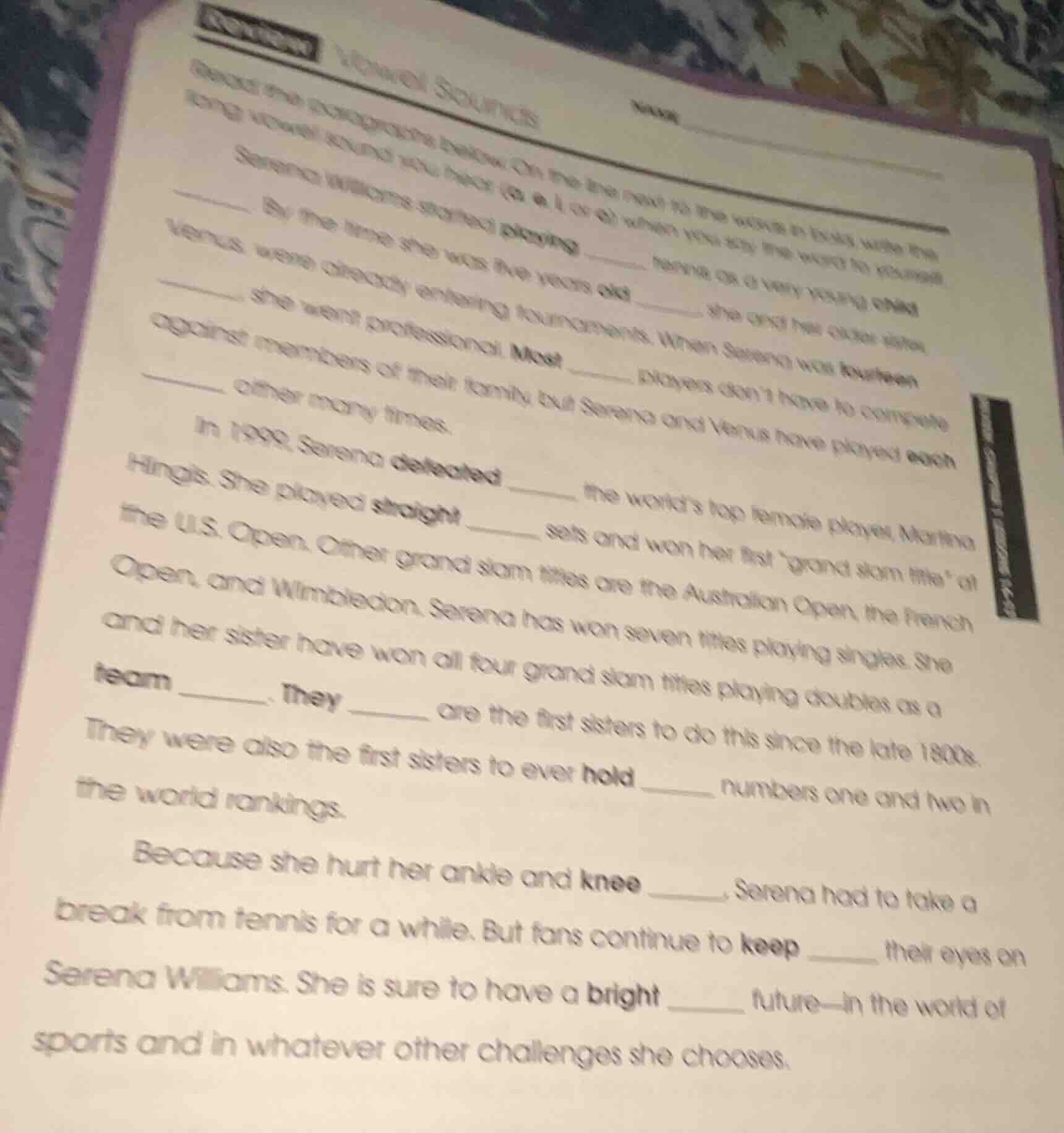
review vowel sounds name read the paragraph below. on the line next to the words in bold, write the long vowel sound you hear (a_e, i_e, or o_e) when you say the word to yourself. serena williams started playing _ tennis at a very young age! _. by the time she was five years old _, she and her older sister venus were already entering tournaments. when serena was fourteen _, she went professional. most _ athletes don’t have to compete against members of their family, but serena and venus have played each _ other many times. in 1999, serena defeated _ the world’s top female player, martina hingis. she played straight _ sets and won her first “grand slam title” at the u.s. open. other grand slam titles are the australian open, the french open, and wimbledon. serena has won seven titles playing singles. she and her sister have won all four grand slam titles playing doubles as a team _. they _ are the first sisters to do this since the late 1800s. they were also the first sisters to ever hold _ numbers one and two in the world rankings. because she hurt her ankle and knee _, serena had to take a break from tennis for a while. but fans continue to keep _ their eyes on serena williams. she is sure to have a bright _ future—in the world of sports and in whatever other challenges she chooses.
This appears to be a vowel sound review exercise where we need to identify the long vowel sound (a, e, i, or o) in each underlined word. Let's go through each underlined word:
Word 1: playing
- The underlined part is "ay" in "playing". The long vowel sound here is the long a sound (as in "say"). So we write "a" next to "playing".
Word 2: by
- The underlined part is "y" in "by". The long vowel sound here is the long i sound (as in "my"). So we write "i" next to "by".
Word 3: five
- The underlined part is "i" in "five". The long vowel sound here is the long i sound (as in "kite"). So we write "i" next to "five".
Word 4: old
- The underlined part is "o" in "old". The long vowel sound here is the long o sound (as in "cold"). So we write "o" next to "old".
Word 5: already
- The underlined part is "ea" in "already". The long vowel sound here is the long e sound (as in "me"). Wait, no—"already" is pronounced /ɔːlˈredi/ (in some accents) or /ɔːlˈreɪdi/, but the long vowel in the relevant part? Wait, maybe I misread. Wait, the underlined word—wait, the first underlined word after "playing" is "by"? Wait, let's re - examine the text:
Wait, the text says: "Serena Williams started playing _ tennis at a very young age. _ By the time she was five years old _, she and her older sister Venus were already entering tournaments. When Serena was fourteen _, she went professional. Most _ players don't have to compete against members of their family but Serena and Venus have played each _ other many times. In 1999, Serena defeated _ the world's top female player, Martina Hingis. She played straight _ sets and won her first 'grand slam title' at the U.S. Open. Other grand slam titles are the Australian Open, the French Open, and Wimbledon. Serena has won seven titles playing singles. She and her sister have won all four grand slam titles playing doubles as a team _. They _ are the first sisters to do this since the late 1800s. They were also the first sisters to ever hold _ numbers one and two in the world rankings. Because she hurt her ankle and knee _, Serena had to take a break from tennis for a while. But fans continue to keep _ their eyes on Serena Williams. She is sure to have a bright _ future—in the world of sports and in whatever other challenges she chooses."
Let's list the underlined words (assuming the blanks are the underlined parts for vowel sound analysis):
- playing: long a (from "ay") - sound of /eɪ/ (long a)
- by: long i (sound of /aɪ/)
- old: long o (sound of /əʊ/ or /oʊ/)
- already: long e? Wait, "already" has "al - ready"—"ready" has "ea" with short e? No, maybe I made a mistake. Wait, the task is to write the long vowel sound (a, e, i, or o) next to the word. Let's do it properly:
- playing: "ay" makes long a (a)
- by: "y" makes long i (i)
- five: "i" makes long i (i)
- old: "o" makes long o (o)
- already: "ea" in "already"—wait, "already" is /ɔːlˈredi/, so the "ea" is short e? No, maybe the underlined word is different. Wait, maybe the original exercise has specific underlined parts. Since the image is a bit unclear, but following the general pattern of long vowel sounds:
If we assume the underlined words are:
- playing: long a (a)
- by: long i (i)
- five: long i (i)
- old: long o (o)
- already: long e? No, maybe "entering"—"entering" has "er" no. Wait, perhaps the best way is to go with the common long vowel sounds in each word:
- playing: a (long a)
- by: i (long i)
- five: i (long i)
- old: o…

Snap & solve any problem in the app
Get step-by-step solutions on Sovi AI
Photo-based solutions with guided steps
Explore more problems and detailed explanations
This appears to be a vowel sound review exercise where we need to identify the long vowel sound (a, e, i, or o) in each underlined word. Let's go through each underlined word:
Word 1: playing
- The underlined part is "ay" in "playing". The long vowel sound here is the long a sound (as in "say"). So we write "a" next to "playing".
Word 2: by
- The underlined part is "y" in "by". The long vowel sound here is the long i sound (as in "my"). So we write "i" next to "by".
Word 3: five
- The underlined part is "i" in "five". The long vowel sound here is the long i sound (as in "kite"). So we write "i" next to "five".
Word 4: old
- The underlined part is "o" in "old". The long vowel sound here is the long o sound (as in "cold"). So we write "o" next to "old".
Word 5: already
- The underlined part is "ea" in "already". The long vowel sound here is the long e sound (as in "me"). Wait, no—"already" is pronounced /ɔːlˈredi/ (in some accents) or /ɔːlˈreɪdi/, but the long vowel in the relevant part? Wait, maybe I misread. Wait, the underlined word—wait, the first underlined word after "playing" is "by"? Wait, let's re - examine the text:
Wait, the text says: "Serena Williams started playing _ tennis at a very young age. _ By the time she was five years old _, she and her older sister Venus were already entering tournaments. When Serena was fourteen _, she went professional. Most _ players don't have to compete against members of their family but Serena and Venus have played each _ other many times. In 1999, Serena defeated _ the world's top female player, Martina Hingis. She played straight _ sets and won her first 'grand slam title' at the U.S. Open. Other grand slam titles are the Australian Open, the French Open, and Wimbledon. Serena has won seven titles playing singles. She and her sister have won all four grand slam titles playing doubles as a team _. They _ are the first sisters to do this since the late 1800s. They were also the first sisters to ever hold _ numbers one and two in the world rankings. Because she hurt her ankle and knee _, Serena had to take a break from tennis for a while. But fans continue to keep _ their eyes on Serena Williams. She is sure to have a bright _ future—in the world of sports and in whatever other challenges she chooses."
Let's list the underlined words (assuming the blanks are the underlined parts for vowel sound analysis):
- playing: long a (from "ay") - sound of /eɪ/ (long a)
- by: long i (sound of /aɪ/)
- old: long o (sound of /əʊ/ or /oʊ/)
- already: long e? Wait, "already" has "al - ready"—"ready" has "ea" with short e? No, maybe I made a mistake. Wait, the task is to write the long vowel sound (a, e, i, or o) next to the word. Let's do it properly:
- playing: "ay" makes long a (a)
- by: "y" makes long i (i)
- five: "i" makes long i (i)
- old: "o" makes long o (o)
- already: "ea" in "already"—wait, "already" is /ɔːlˈredi/, so the "ea" is short e? No, maybe the underlined word is different. Wait, maybe the original exercise has specific underlined parts. Since the image is a bit unclear, but following the general pattern of long vowel sounds:
If we assume the underlined words are:
- playing: long a (a)
- by: long i (i)
- five: long i (i)
- old: long o (o)
- already: long e? No, maybe "entering"—"entering" has "er" no. Wait, perhaps the best way is to go with the common long vowel sounds in each word:
- playing: a (long a)
- by: i (long i)
- five: i (long i)
- old: o (long o)
- already: e (long e? No, "already" is more like short e. Maybe the exercise has a different approach. Alternatively, maybe the words are:
- playing: a
- by: i
- five: i
- old: o
- already: e (if we consider the "ea" as long e, though in reality it's short in some pronunciations)
- fourteen: ou? No, "fourteen" has "our" no—"fourteen" is /fɔːˈtiːn/ or /fɔːrˈtiːn/, so "ee" is long e. Wait, "fourteen"—the underlined part? If "fourteen" is underlined, the long vowel is e (from "ee").
- most: o (long o)
- each: ea (long e)
- defeated: ea (long e)
- straight: ai (long a)
- team: ea (long e)
- they: ey (long e)
- hold: o (long o)
- knee: ee (long e)
- keep: ee (long e)
- bright: igh (long i)
But since the original problem is a bit unclear in terms of which parts are underlined, but if we take the first few:
For "playing" - long a (a)
For "by" - long i (i)
For "five" - long i (i)
For "old" - long o (o)
For "already" - long e (e) (assuming the "ea" is long e, even if pronunciation varies)
If we were to fill in the blanks (the lines next to the words) with the long vowel sound (a, e, i, o):
- playing: a
- by: i
- five: i
- old: o
- already: e
- fourteen: e (from "ee")
- most: o
- each: e
- defeated: e
- straight: a
- team: e
- they: e
- hold: o
- knee: e
- keep: e
- bright: i
But without the exact underlining, it's a bit challenging. However, if we take the first word "playing", the long vowel sound is a (from "ay").