QUESTION IMAGE
Question
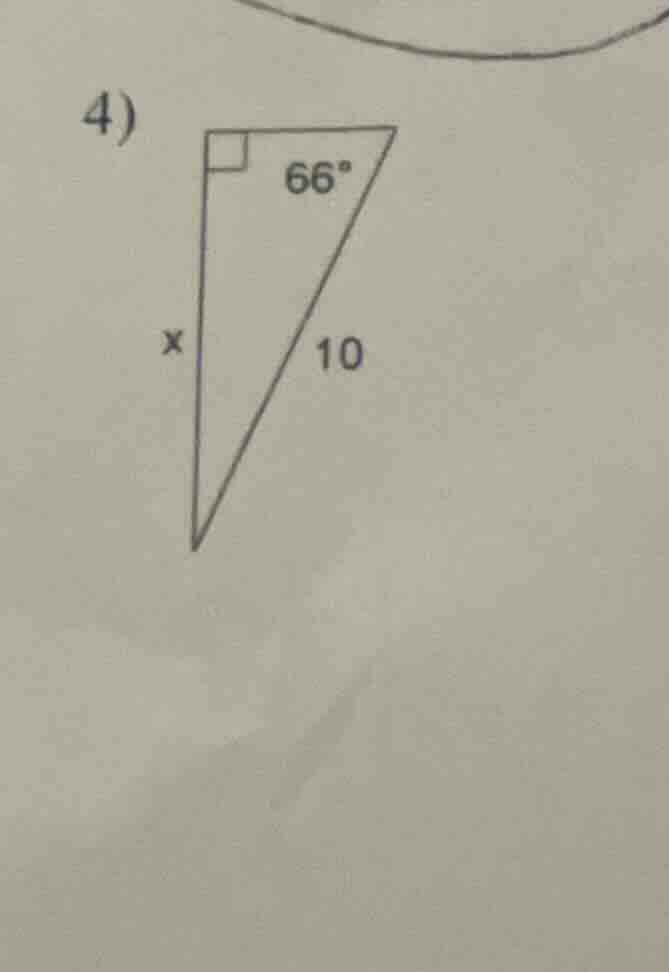
- a right triangle with one angle 66°, hypotenuse 10, and one leg x (the leg adjacent to the 66° angle? or opposite? wait, the right angle is at the top left, so the angle of 66° is at the top right, hypotenuse is 10, and the vertical leg is x. so we need to find x using trigonometry, maybe cosine or sine. lets see, the angle 66°, the adjacent side to 66° would be x? wait, no, the right angle is at the top, so the triangle has vertices: top left (right angle), top right (66°), bottom (the other angle). so the sides: top left to top right is one leg, top left to bottom is x (vertical leg), top right to bottom is hypotenuse 10. so the angle at top right is 66°, so the adjacent side to 66° is the horizontal leg (top left to top right), and the opposite side is x (vertical leg). wait, no, in a right triangle, for angle θ, cosθ = adjacent/hypotenuse, sinθ = opposite/hypotenuse. so if angle is 66°, hypotenuse 10, and x is the adjacent side? wait, maybe i got the sides wrong. lets reorient: right angle at top left, so the two legs are top left to top right (horizontal) and top left to bottom (vertical, length x), and hypotenuse is top right to bottom (length 10). so the angle at top right is 66°, so in that angle, the adjacent side is the horizontal leg (top left to top right), and the opposite side is the vertical leg (x). wait, no, the angle at top right: the sides forming the angle are the horizontal leg (top left to top right) and the hypotenuse (top right to bottom). wait, no, the angle at top right is between the horizontal leg (top left - top right) and the hypotenuse (top right - bottom). so the adjacent side to 66° is the horizontal leg, and the opposite side is the vertical leg (x). wait, but we need to find x, which is the vertical leg. so sin(66°) = opposite/hypotenuse = x/10? wait, no, opposite side to 66° would be the vertical leg (x), and hypotenuse is 10. wait, no, lets label the triangle: let’s call the right angle vertex a, the 66° vertex b, and the bottom vertex c. so a is top left, b is top right, c is bottom. so ab is horizontal leg, ac is vertical leg (length x), bc is hypotenuse (length 10). angle at b is 66°, so angle at b is between ab and bc. so in triangle abc, right-angled at a, angle at b is 66°, hypotenuse bc = 10, ac = x (opposite to angle b), ab is adjacent to angle b. so sin(angle b) = ac / bc => sin(66°) = x / 10? wait, no, sin(θ) = opposite/hypotenuse, so opposite to angle b (66°) is ac (x), hypotenuse is bc (10). so x = 10 sin(66°)? wait, but maybe its cosine. wait, no, angle at b is 66°, so angle at c is 90° - 66° = 24°. maybe using angle at c. lets check: angle at c is 24°, so for angle c, adjacent side is ac (x), hypotenuse is bc (10). so cos(24°) = adjacent/hypotenuse = x / 10 => x = 10 cos(24°). wait, but cos(24°) is equal to sin(66°), since cos(θ) = sin(90° - θ). so both ways, x = 10 sin(66°) or x = 10 cos(24°). lets calculate that. sin(66°) is approximately 0.9135, so x ≈ 10 0.9135 ≈ 9.135? wait, but maybe i mixed up adjacent and opposite. wait, no, in triangle abc, right-angled at a, so angle at b is 66°, so sides: ab (horizontal) is adjacent to angle b, ac (vertical) is opposite to angle b, bc (hypotenuse) is 10. so sin(angle b) = opposite/hypotenuse = ac / bc = x / 10 => x = 10 sin(66°). alternatively, cos(angle at c) = adjacent/hypotenuse, angle at c is 24°, adjacent side is ac (x), hypotenuse bc = 10, so cos(24°) = x / 10 => x = 10 * cos(24°). since sin(66°) = cos(24°), both are correct. so the problem is to find x in this right triangle with hypotenuse 10 and angle 66°, so we need to use trigonometric ratios (sine or cosine) to find the length of the leg x.
Step1: Identify the trigonometric ratio
In a right - triangle, we know that the cosine of an angle is defined as the adjacent side divided by the hypotenuse. Here, the angle is \(66^{\circ}\), the adjacent side to the angle \(66^{\circ}\) is \(x\) and the hypotenuse is \(10\). So we use the cosine function: \(\cos(\theta)=\frac{\text{adjacent}}{\text{hypotenuse}}\)
Step2: Substitute the values
We have \(\theta = 66^{\circ}\), adjacent \(=x\) and hypotenuse \( = 10\). So \(\cos(66^{\circ})=\frac{x}{10}\)
Step3: Solve for \(x\)
Multiply both sides of the equation by \(10\) to get \(x = 10\times\cos(66^{\circ})\). We know that \(\cos(66^{\circ})\approx0.4067\), so \(x = 10\times0.4067 = 4.067\) (rounded to three decimal places)

Snap & solve any problem in the app
Get step-by-step solutions on Sovi AI
Photo-based solutions with guided steps
Explore more problems and detailed explanations
\(x\approx4.07\) (or more precisely \(x = 10\cos(66^{\circ})\approx4.07\))