QUESTION IMAGE
Question
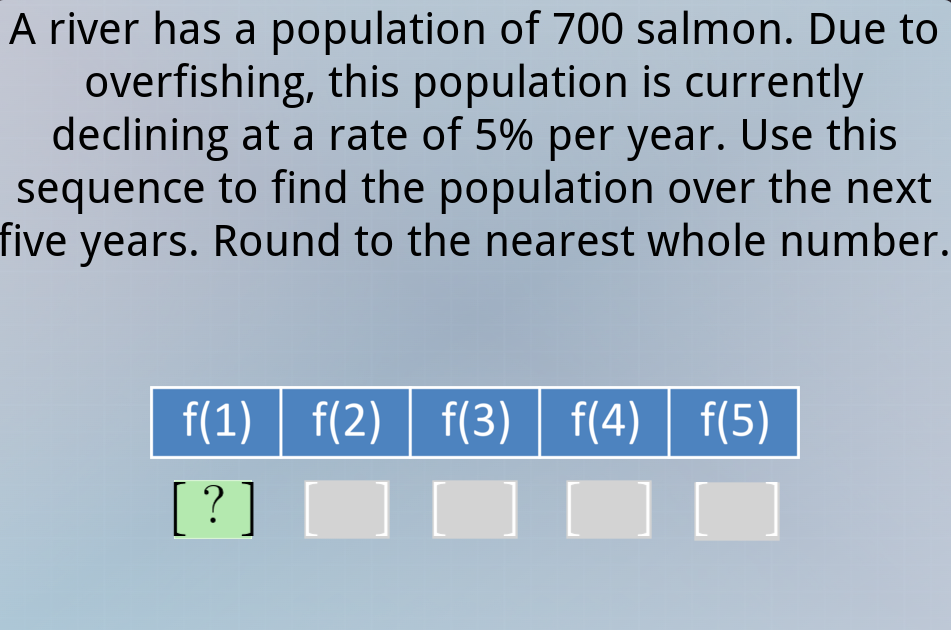
a river has a population of 700 salmon. due to overfishing, this population is currently declining at a rate of 5% per year. use this sequence to find the population over the next five years. round to the nearest whole number. f(1) f(2) f(3) f(4) f(5) ?
Step1: Identify the formula for exponential decay
The formula for exponential decay is \( f(n) = P(1 - r)^{n - 1} \), where \( P \) is the initial population, \( r \) is the rate of decay, and \( n \) is the number of years. Here, \( P = 700 \), \( r = 0.05 \).
Step2: Calculate \( f(1) \)
For \( n = 1 \), \( f(1)=700(1 - 0.05)^{1 - 1}=700(0.95)^{0}=700\times1 = 700 \)? Wait, no. Wait, the first year after the initial. Wait, actually, the initial population is at time \( n = 0 \), so for \( n = 1 \) (first year later), the formula is \( f(n)=700(1 - 0.05)^{n} \)? Wait, let's re - check. If the initial population (at year 0) is 700, then after 1 year (\( n = 1 \)), the population is \( 700\times(1 - 0.05)^{1} \).
So \( f(1)=700\times0.95=665 \)
Step3: Calculate \( f(2) \)
For \( n = 2 \), \( f(2)=700\times(0.95)^{2}=700\times0.9025 = 631.75\approx632 \)
Step4: Calculate \( f(3) \)
For \( n = 3 \), \( f(3)=700\times(0.95)^{3}=700\times0.857375 = 600.1625\approx600 \)
Step5: Calculate \( f(4) \)
For \( n = 4 \), \( f(4)=700\times(0.95)^{4}=700\times0.81450625 = 570.154375\approx570 \)
Step6: Calculate \( f(5) \)
For \( n = 5 \), \( f(5)=700\times(0.95)^{5}=700\times0.7737809375 = 541.64665625\approx542 \)
Wait, but let's start over with the correct interpretation. The problem says "the population is currently declining at a rate of 5% per year". So the current population (let's say year 0) is 700. Then \( f(1) \) is the population after 1 year, \( f(2) \) after 2 years, etc. So the formula is \( f(n)=700\times(1 - 0.05)^{n} \), where \( n = 1,2,3,4,5 \)
So:
- \( f(1)=700\times0.95 = 665 \)
- \( f(2)=700\times0.95^{2}=700\times0.9025 = 631.75\approx632 \)
- \( f(3)=700\times0.95^{3}=700\times0.857375 = 600.1625\approx600 \)
- \( f(4)=700\times0.95^{4}=700\times0.81450625 = 570.154375\approx570 \)
- \( f(5)=700\times0.95^{5}=700\times0.7737809375 = 541.64665625\approx542 \)

Snap & solve any problem in the app
Get step-by-step solutions on Sovi AI
Photo-based solutions with guided steps
Explore more problems and detailed explanations
\( f(1)=\boldsymbol{665} \), \( f(2)=\boldsymbol{632} \), \( f(3)=\boldsymbol{600} \), \( f(4)=\boldsymbol{570} \), \( f(5)=\boldsymbol{542} \)