QUESTION IMAGE
Question
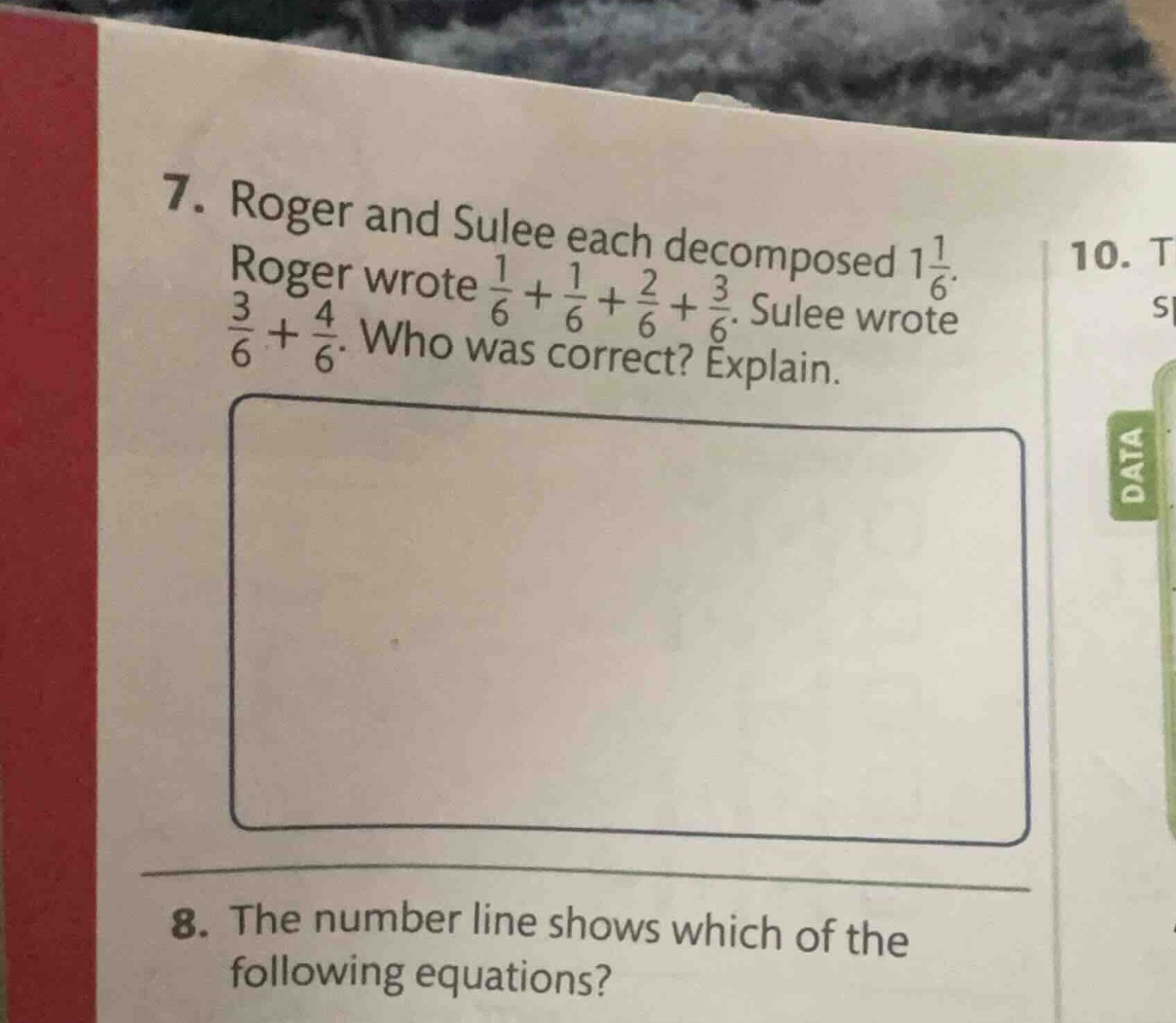
- roger and sulee each decomposed $1\frac{1}{6}$. roger wrote $\frac{1}{6} + \frac{1}{6} + \frac{2}{6} + \frac{3}{6}$. sulee wrote $\frac{3}{6} + \frac{4}{6}$. who was correct? explain. 8. the number line shows which of the following equations?
Step1: Calculate Roger's sum
To find the sum of Roger's fractions, we add the numerators since the denominators are the same. So, \(\frac{1}{6}+\frac{1}{6}+\frac{2}{6}+\frac{3}{6}=\frac{1 + 1+2 + 3}{6}\). Calculating the numerator: \(1+1 = 2\), \(2+2 = 4\), \(4 + 3=7\). So Roger's sum is \(\frac{7}{6}\), and \(1\frac{1}{6}=\frac{6 + 1}{6}=\frac{7}{6}\), so Roger's decomposition is correct in value. Wait, but let's check Sulee's.
Step2: Calculate Sulee's sum
Sulee wrote \(\frac{3}{6}+\frac{4}{6}\). Adding the numerators: \(3+4 = 7\), so \(\frac{3}{6}+\frac{4}{6}=\frac{7}{6}\), which is also equal to \(1\frac{1}{6}\) (since \(\frac{7}{6}=1\frac{1}{6}\)). Wait, but let's re - check the problem statement. Wait, the problem says "decomposed \(1\frac{1}{6}\)". Wait, maybe there is a typo? Wait, no, let's re - evaluate. Wait, \(1\frac{1}{6}=\frac{7}{6}\). Roger's sum: \(\frac{1}{6}+\frac{1}{6}+\frac{2}{6}+\frac{3}{6}=\frac{1 + 1+2 + 3}{6}=\frac{7}{6}\). Sulee's sum: \(\frac{3}{6}+\frac{4}{6}=\frac{7}{6}\). But wait, maybe the problem has a mistake? Wait, no, maybe I misread. Wait, the original problem: "Roger wrote \(\frac{1}{6}+\frac{1}{6}+\frac{2}{6}+\frac{3}{6}\). Sulee wrote \(\frac{3}{6}+\frac{4}{6}\). Who was correct? Explain." Wait, but both sums equal \(\frac{7}{6}\), which is \(1\frac{1}{6}\). But maybe the problem intended different? Wait, no, let's check the arithmetic again.
Wait, Roger's fractions: \(\frac{1}{6}+\frac{1}{6}= \frac{2}{6}\), \(\frac{2}{6}+\frac{2}{6}=\frac{4}{6}\), \(\frac{4}{6}+\frac{3}{6}=\frac{7}{6}\). Sulee's: \(\frac{3}{6}+\frac{4}{6}=\frac{7}{6}\). So both sums are equal to \(1\frac{1}{6}\). But maybe the problem has a typo, or maybe I misread. Wait, no, perhaps the problem meant to say "decompose" in a different way, like as a sum of fractions that are unit fractions or with different constraints? Wait, no, the problem just says "decomposed \(1\frac{1}{6}\)". Since both Roger and Sulee's sums equal \(1\frac{1}{6}\), both are correct? But that seems odd. Wait, maybe there is a mistake in the problem statement. Wait, no, let's re - check the numbers. Wait, Roger's fractions: \(\frac{1}{6}+\frac{1}{6}+\frac{2}{6}+\frac{3}{6}\): sum is \(\frac{1 + 1+2 + 3}{6}=\frac{7}{6}\). Sulee's: \(\frac{3}{6}+\frac{4}{6}=\frac{7}{6}\). So both are correct? But maybe the problem has a typo, like Sulee wrote \(\frac{3}{6}+\frac{4}{6}\) but maybe it's \(\frac{2}{6}+\frac{4}{6}\) or something else. Wait, no, according to the given problem, both Roger and Sulee's sums equal \(\frac{7}{6}\) (which is \(1\frac{1}{6}\)). But maybe the problem intended that Roger's sum is wrong? Wait, no, let's recalculate Roger's sum: \(1 + 1+2 + 3=7\), so \(\frac{7}{6}\). Sulee's sum: \(3 + 4 = 7\), so \(\frac{7}{6}\). So both are correct? But that seems unusual. Wait, maybe the problem was supposed to be \(1\frac{1}{6}\) decomposed into different parts, but as per the arithmetic, both sums are equal to \(1\frac{1}{6}\). So both Roger and Sulee are correct? But that might not be the case. Wait, maybe I made a mistake. Wait, \(1\frac{1}{6}\) is \(\frac{7}{6}\). Roger's sum: \(\frac{1}{6}+\frac{1}{6}+\frac{2}{6}+\frac{3}{6}=\frac{7}{6}\). Sulee's sum: \(\frac{3}{6}+\frac{4}{6}=\frac{7}{6}\). So both are correct. But maybe the problem has a typo, like Sulee wrote \(\frac{3}{6}+\frac{3}{6}\) or something else. But based on the given numbers, both are correct. Wait, but maybe the question is about the decomposition structure? Wait, no, the problem says "decomposed", which usually means expressing the number as a sum of other numbers. Since both…

Snap & solve any problem in the app
Get step-by-step solutions on Sovi AI
Photo-based solutions with guided steps
Explore more problems and detailed explanations
Both Roger and Sulee are correct because when we add the fractions in Roger's decomposition \(\frac{1}{6}+\frac{1}{6}+\frac{2}{6}+\frac{3}{6}=\frac{1 + 1+2 + 3}{6}=\frac{7}{6}=1\frac{1}{6}\), and when we add the fractions in Sulee's decomposition \(\frac{3}{6}+\frac{4}{6}=\frac{3 + 4}{6}=\frac{7}{6}=1\frac{1}{6}\). So both decompositions result in \(1\frac{1}{6}\).