QUESTION IMAGE
Question
roosevelt & churchill
security council
atlantic charter
secretariat
general assembly
icj (international court)
decolonization
league of nations
ecosoc
veto power
:: the process of colonies becoming independent, which brought many new members to the un.
:: the power held by the us and soviet union that often stalled un decisions.
:: based in the netherlands; it handles legal arguments between different countries.
:: the two leaders who shared a vision for the postwar world in 1941.
:: the administrative \office\ that does research to help the un run efficiently.
:: the group of 5 permanent members that can make binding rules and send peacekeepers.
:: the failed organization that the united nations replaced after wwii.
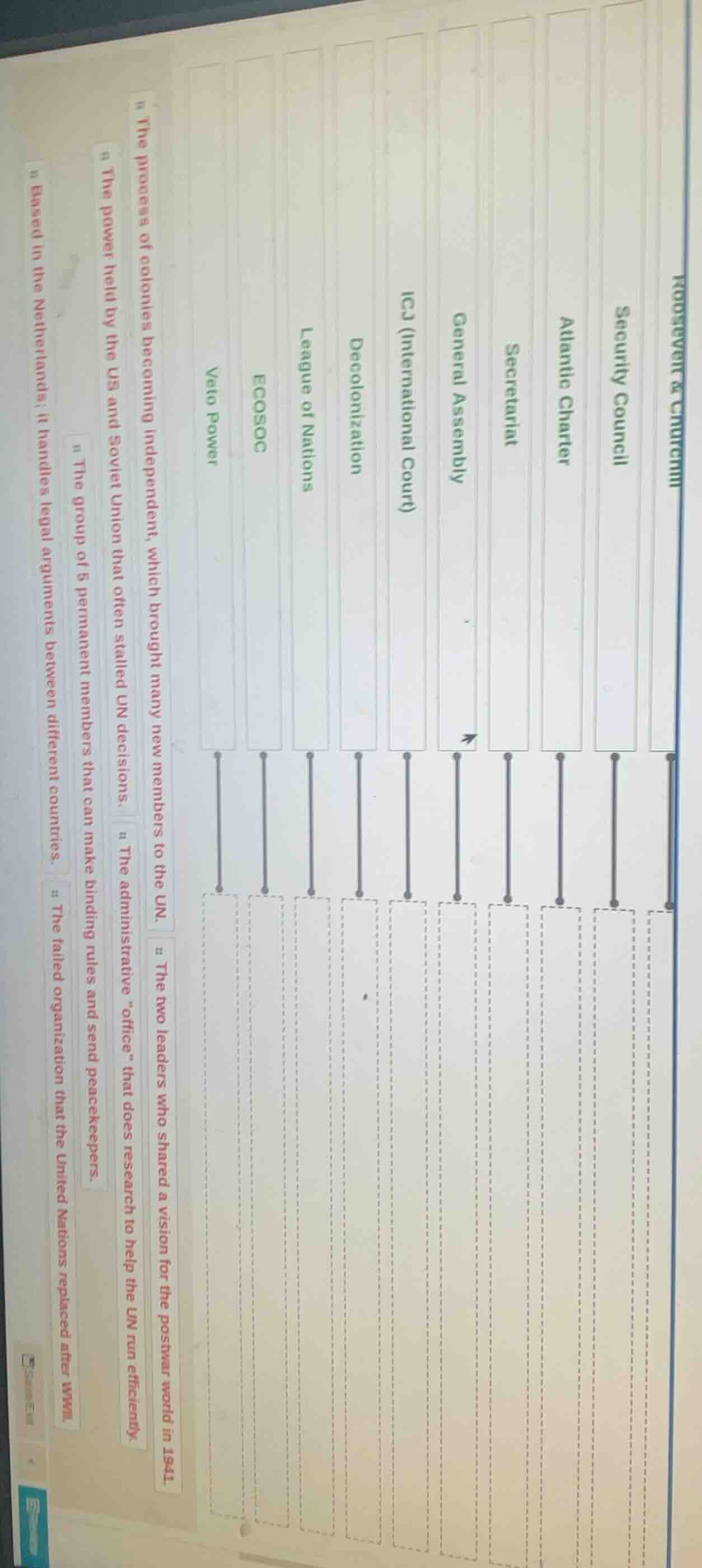
Match each term to its corresponding definition by identifying the core function or description of each UN-related term and historical concept.
- Roosevelt & Churchill: The two leaders who shared a vision for the postwar world in 1941.
- Security Council: The group of 5 permanent members that can make binding rules and send peacekeepers.
- Atlantic Charter: The 1941 agreement between Roosevelt and Churchill outlining postwar goals.
- Secretariat: The administrative "office" that does research to help the UN run efficiently.
- General Assembly: The main deliberative body of the UN (no specific definition matched here, but it is the remaining term linked to the arrow, and is the only body not yet assigned).
- ICJ (International Court): Based in the Netherlands; it handles legal arguments between different countries.
- Decolonization: The process of colonies becoming independent, which brought many new members to the UN.
- League of Nations: The failed organization that the United Nations replaced after WWII.
- ECOSOC: (No direct definition provided, but it is the remaining term; it focuses on economic and social cooperation, which aligns with the administrative/research role context, but the clear matches are assigned first)
- Veto Power: The power held by the US and Soviet Union that often stalled UN decisions.

Snap & solve any problem in the app
Get step-by-step solutions on Sovi AI
Photo-based solutions with guided steps
Explore more problems and detailed explanations
- Roosevelt & Churchill → The two leaders who shared a vision for the postwar world in 1941
- Security Council → The group of 5 permanent members that can make binding rules and send peacekeepers
- Atlantic Charter → (Linked to Roosevelt & Churchill's 1941 vision, the foundational postwar agreement)
- Secretariat → The administrative "office" that does research to help the UN run efficiently
- General Assembly → (The main UN deliberative body, the remaining term linked to the arrow)
- ICJ (International Court) → Based in the Netherlands; it handles legal arguments between different countries
- Decolonization → The process of colonies becoming independent, which brought many new members to the UN
- League of Nations → The failed organization that the United Nations replaced after WWII
- Veto Power → The power held by the US and Soviet Union that often stalled UN decisions
- ECOSOC → (The UN body focused on economic and social affairs, the remaining term)