QUESTION IMAGE
Question
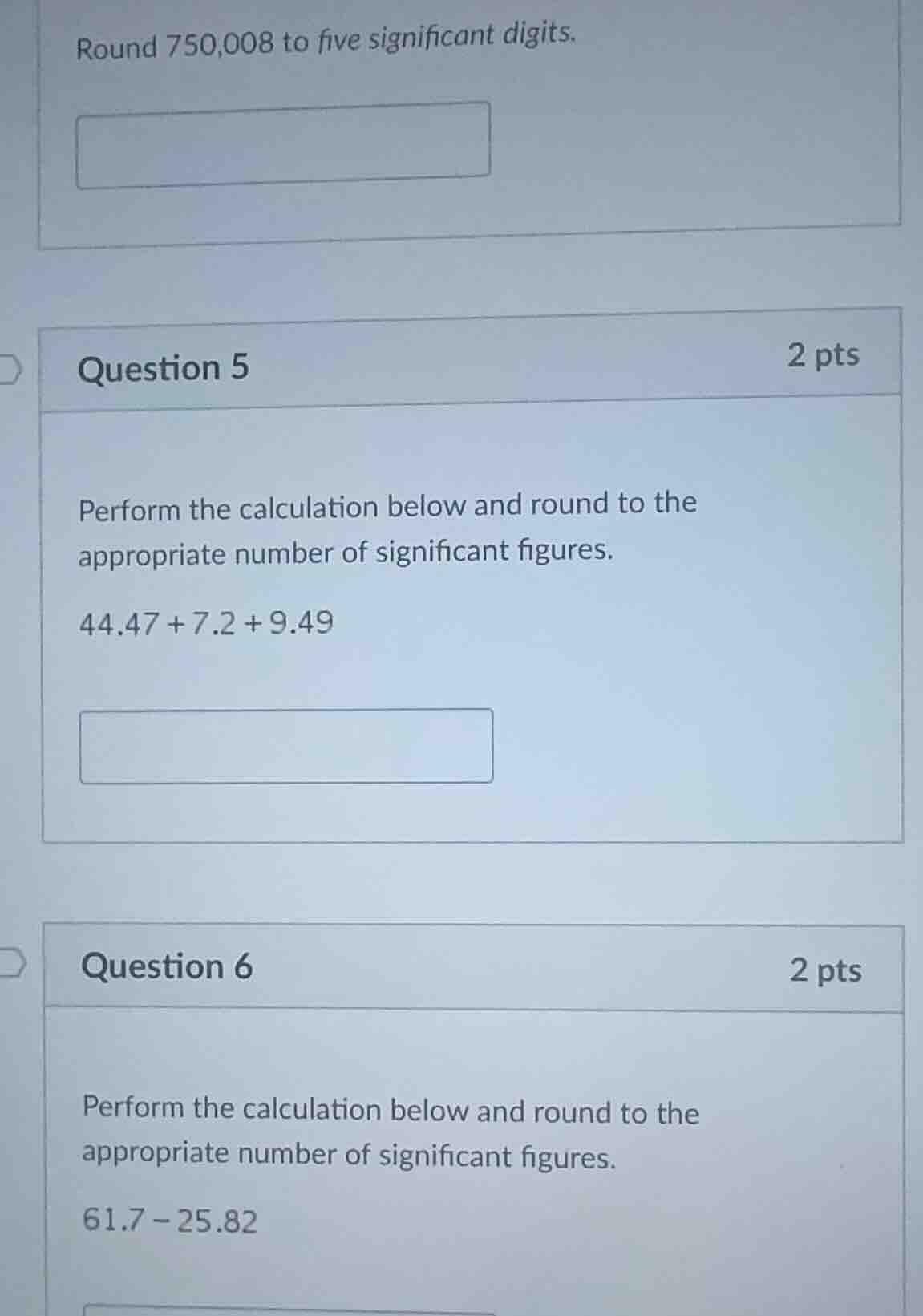
round 750,008 to five significant digits.
question 5
2 pts
perform the calculation below and round to the appropriate number of significant figures.
44.47 + 7.2 + 9.49
question 6
2 pts
perform the calculation below and round to the appropriate number of significant figures.
61.7 − 25.82
First Problem (Round 750,008 to five significant digits)
Step1: Identify significant digits
The number is 750008. The first five significant digits start from 7, 5, 0, 0, 0? Wait, no. Wait, significant digits: non - zero digits are significant, and zeros between non - zero digits are significant. But trailing zeros in a whole number without a decimal are ambiguous, but here we have 750008. Let's count: 7 (1st), 5 (2nd), 0 (3rd, between 7 and 8? Wait, no, 750008 is 7,5,0,0,0,8. Wait, to get five significant digits, we look at the first five digits. The first digit is 7, second 5, third 0, fourth 0, fifth 0? No, wait, maybe we need to express it in scientific notation. 750008 can be written as \(7.50008\times10^{5}\). To round to five significant digits, we look at the sixth digit, which is 8. Since 8 > 5, we round up the fifth digit. Wait, no, the first five significant digits are 7,5,0,0,0? Wait, no, 750008: let's count the significant digits properly. The number is 7 (1), 5 (2), 0 (3), 0 (4), 0 (5), 8 (6). Wait, maybe I made a mistake. Wait, 750008: the first non - zero digit is 7, then 5, then the zeros after 5: in a number like 750008, the zeros between 5 and 8 are not significant? No, wait, significant figures rules: all non - zero digits are significant. Zeros between non - zero digits are significant. Trailing zeros in a number without a decimal are not significant. But here, the number is 750008. So the digits are 7,5,0,0,0,8. So to get five significant digits, we take the first five digits: 7,5,0,0,0 and then the next digit is 8. Wait, no, maybe we should write it as 750010? Wait, no. Wait, 750008. Let's count the significant digits: 7 (1), 5 (2), 0 (3, because it's between 7 and 8? No, 750008 is 750,008. So the first five significant digits: 7,5,0,0,0? No, that can't be. Wait, maybe the number is 7.50008×10⁵. To round to five significant digits, we look at the sixth digit (8). Since 8 ≥ 5, we round the fifth digit (0) up by 1. So 7.5001×10⁵, which is 750010. Wait, but 750008 rounded to five significant digits: let's list the digits: position 1:7, 2:5, 3:0, 4:0, 5:0, 6:8. So we need to keep five digits. So we take the first five digits (7,5,0,0,0) and then round based on the sixth digit (8). So 0 (fifth digit) becomes 1, so 750010. Wait, but maybe I was wrong. Alternatively, 750008: the first five significant digits are 7,5,0,0,0? No, maybe the correct way is: 750008. Let's count the significant figures: 7,5,0,0,0,8. So to five significant figures, we have 750010 (since the sixth digit is 8, we round the fifth digit up).
Step2: Round the number
The number 750008. Let's write it as 7.50008×10⁵. The fifth significant digit is the fifth digit in 7.50008, which is 0 (the fifth digit after the decimal in scientific notation? Wait, no, in 7.50008×10⁵, the digits are 7 (1), 5 (2), 0 (3), 0 (4), 0 (5), 8 (6). So we want to keep five digits, so we look at the sixth digit (8). Since 8 > 5, we round the fifth digit (0) up to 1. So 7.5001×10⁵ = 750010.
Step1: Perform the addition
First, add 44.47 and 7.2: \(44.47+7.2 = 51.67\)
Step2: Add the result to 9.49
Then, add 9.49 to 51.67: \(51.67 + 9.49=61.16\)
Step3: Determine significant figures for addition
In addition, we round to the least number of decimal places. 44.47 has two decimal places, 7.2 has one decimal place, 9.49 has two decimal places. The least number of decimal places is 1. So we round 61.16 to one decimal place.
Step4: Round the number
61.16 rounded to one decimal place is 61.2 (since the digit in the hundredths place is 6, which is ≥ 5, we round up the tenths place digit 1 to 2).
Step1: Perform the subtraction
\(61.7−25.82 = 35.88\)
Step2: Determine significant figures for subtraction
In subtraction, we round to the least number of decimal places. 61.7 has one decimal place, 25.82 has two decimal places. The least number of decimal places is 1. So we round 35.88 to one decimal place.
Step3: Round the number
35.88 rounded to one decimal place is 35.9 (since the digit in the hundredths place is 8, which is ≥ 5, we round up the tenths place digit 8 to 9).

Snap & solve any problem in the app
Get step-by-step solutions on Sovi AI
Photo-based solutions with guided steps
Explore more problems and detailed explanations
750010