QUESTION IMAGE
Question
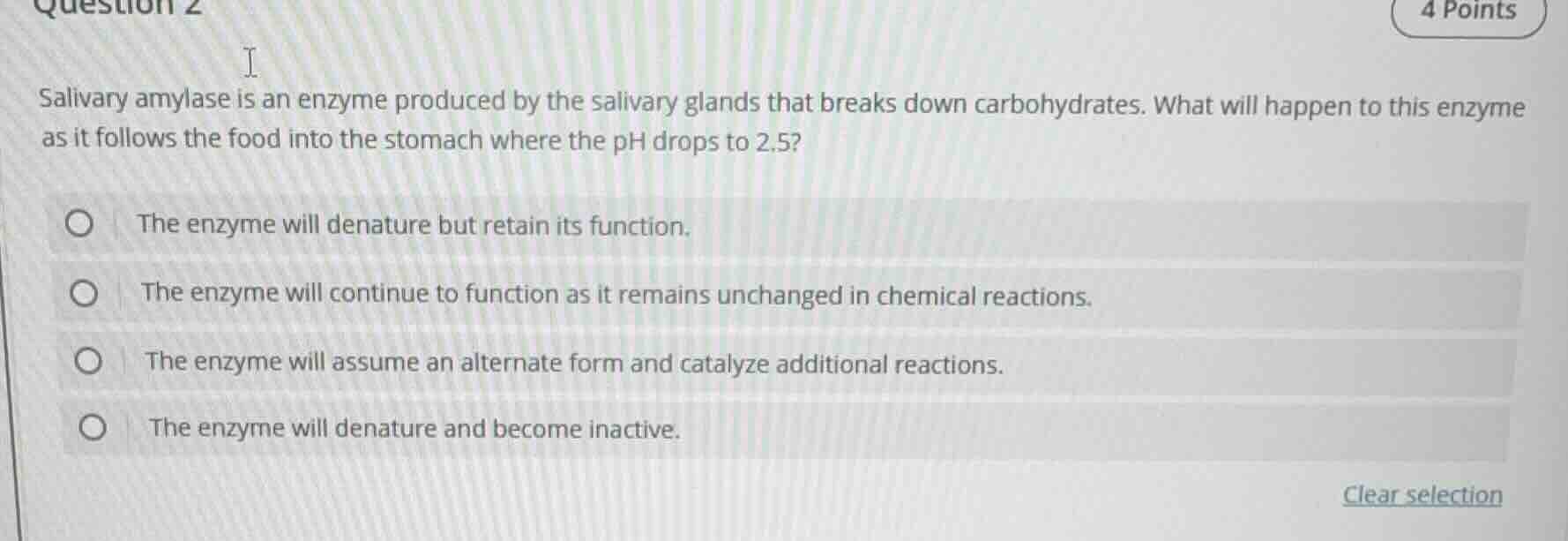
salivary amylase is an enzyme produced by the salivary glands that breaks down carbohydrates. what will happen to this enzyme as it follows the food into the stomach where the ph drops to 2.5?
the enzyme will denature but retain its function.
the enzyme will continue to function as it remains unchanged in chemical reactions.
the enzyme will assume an alternate form and catalyze additional reactions.
the enzyme will denature and become inactive.
Enzymes, like salivary amylase, have an optimal pH range (around neutral for salivary amylase). When the pH drops significantly (to 2.5 in the stomach), the enzyme's specific three - dimensional structure, especially the active site, is disrupted. This process is called denaturation. Once denatured, the enzyme loses its specific structure, including the active site's shape, which is necessary for it to bind to its substrate (carbohydrates) and carry out its function. So, salivary amylase will denature and become inactive in the acidic environment of the stomach.
- Option 1: If an enzyme denatures, it loses its function because the active site is altered, so this is incorrect.
- Option 2: The acidic environment of the stomach (low pH) will change the enzyme's structure, so it won't remain unchanged and will not continue to function as normal, so this is incorrect.
- Option 3: Denaturation due to pH change does not lead to the enzyme assuming an alternate form to catalyze additional reactions; instead, it loses its catalytic ability, so this is incorrect.
- Option 4: This option correctly states that the enzyme will denature (due to the low pH in the stomach) and as a result, become inactive.

Snap & solve any problem in the app
Get step-by-step solutions on Sovi AI
Photo-based solutions with guided steps
Explore more problems and detailed explanations
D. The enzyme will denature and become inactive.