QUESTION IMAGE
Question
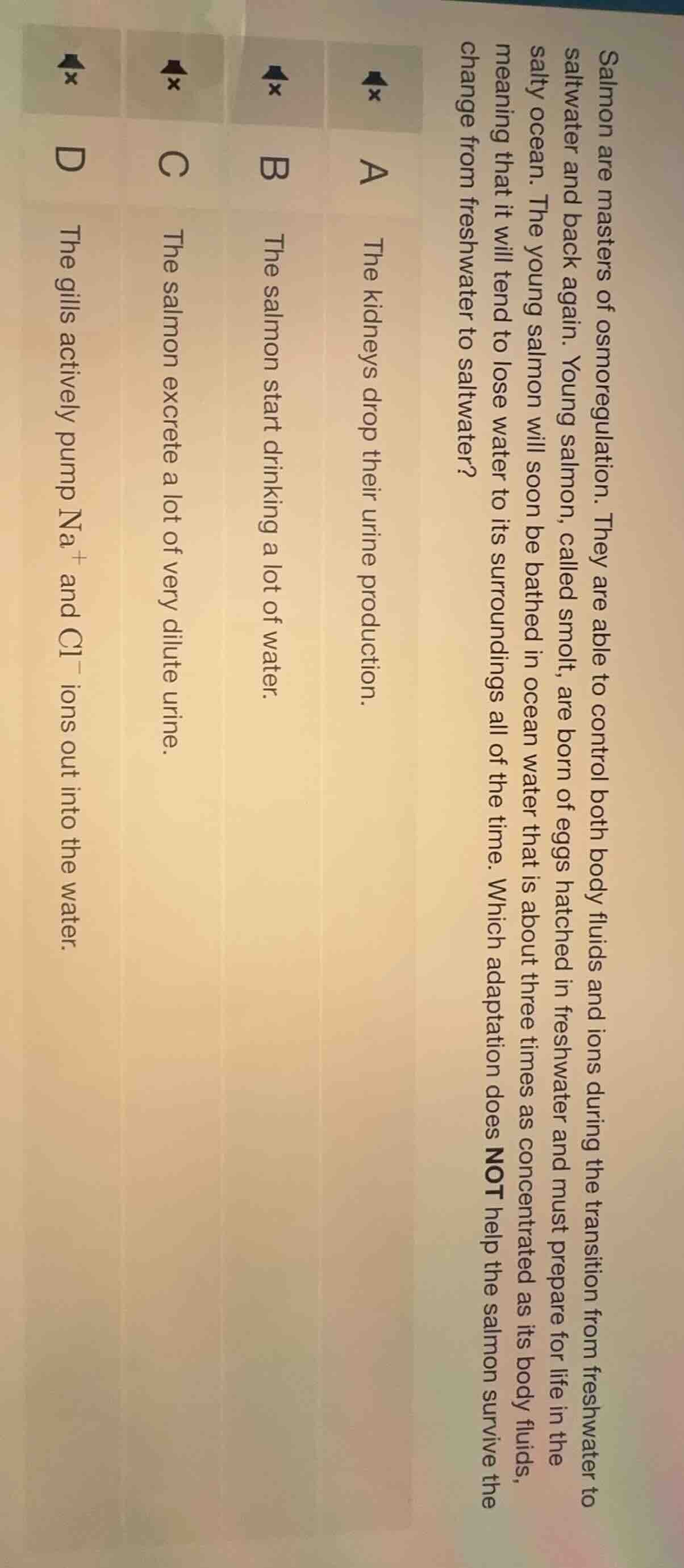
salmon are masters of osmoregulation. they are able to control both body fluids and ions during the transition from freshwater to saltwater and back again. young salmon, called smolt, are born of eggs hatched in freshwater and must prepare for life in the salty ocean. the young salmon will soon be bathed in ocean water that is about three times as concentrated as its body fluids, meaning that it will tend to lose water to its surroundings all of the time. which adaptation does not help the salmon survive the change from freshwater to saltwater?
a the kidneys drop their urine production.
b the salmon start drinking a lot of water.
c the salmon excrete a lot of very dilute urine.
d the gills actively pump $\text{na}^+$ and $\text{cl}^-$ ions out into the water.
When moving to saltwater (hypertonic relative to body fluids), salmon lose water passively. To compensate:
- They increase water intake by drinking more saltwater (B is adaptive).
- Kidneys reduce urine production to conserve water (A is adaptive).
- Gills actively pump excess salt ions (Na⁺, Cl⁻) out to maintain internal balance (D is adaptive).
Excreting dilute urine would waste water, which is harmful in saltwater, so this is not an adaptive change.

Snap & solve any problem in the app
Get step-by-step solutions on Sovi AI
Photo-based solutions with guided steps
Explore more problems and detailed explanations
C. The salmon excrete a lot of very dilute urine.