QUESTION IMAGE
Question
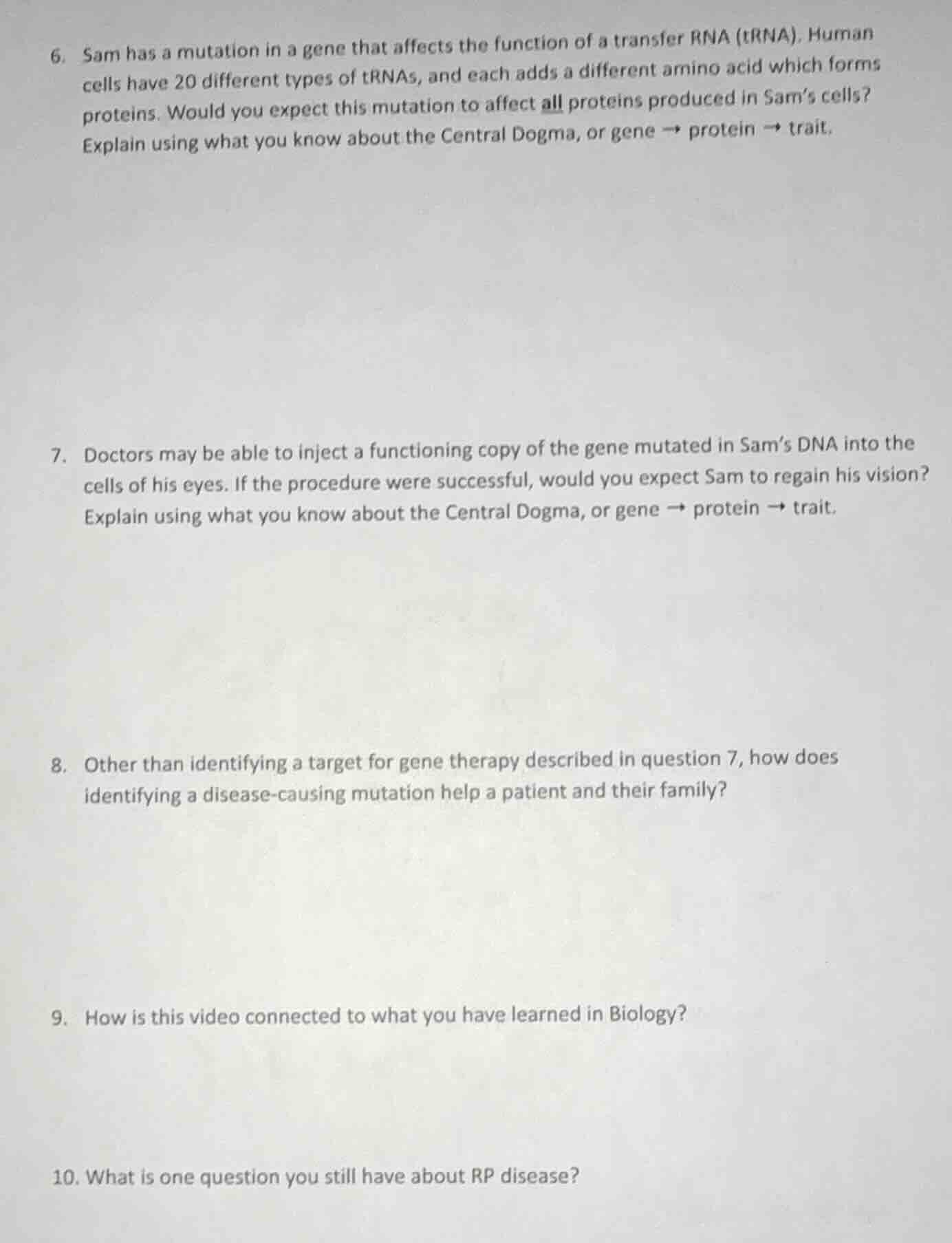
- sam has a mutation in a gene that affects the function of a transfer rna (trna). human cells have 20 different types of trnas, and each adds a different amino acid which forms proteins. would you expect this mutation to affect all proteins produced in sam’s cells? explain using what you know about the central dogma, or gene → protein → trait.
- doctors may be able to inject a functioning copy of the gene mutated in sam’s dna into the cells of his eyes. if the procedure were successful, would you expect sam to regain his vision? explain using what you know about the central dogma, or gene → protein → trait.
- other than identifying a target for gene therapy described in question 7, how does identifying a disease-causing mutation help a patient and their family?
- how is this video connected to what you have learned in biology?
- what is one question you still have about rp disease?
Response
Question 6
Brief Explanations
- Recall the Central Dogma: DNA (gene) → RNA → protein. tRNA's role is to bring amino acids during translation (RNA→protein).
- There are 20 tRNAs (one for each amino acid). A mutation in one tRNA gene would affect only the amino acid that this specific tRNA carries.
- Since not all proteins use every amino acid, and only the amino acid associated with the mutated tRNA would be affected in its incorporation, not all proteins will be affected. For example, if the mutated tRNA is for amino acid X, only proteins that require X will have their synthesis potentially disrupted, while others won't.
Brief Explanations
- Central Dogma: gene (DNA) → RNA → protein → trait. Vision is a trait dependent on eye - specific proteins (e.g., photoreceptor proteins).
- Injecting a functional gene into eye cells: if successful, the eye cells can transcribe (gene→RNA) and translate (RNA→protein) the gene into the needed functional protein.
- If the protein is involved in vision (e.g., restoring photoreceptor function), then with the functional protein, the trait (vision) could be restored as the gene→protein→trait pathway is repaired for the eye - related protein.
Brief Explanations
- Diagnosis/Prognosis: Knowing the mutation helps confirm the disease (diagnosis) and predict its progression (prognosis).
- Family Planning/Genetic Counseling: Family members can be tested for the mutation to assess their risk of developing the disease or passing it to offspring, aiding in family planning (e.g., prenatal testing).
- Personalized Medicine: It can guide treatment choices (e.g., avoiding drugs that interact negatively with the mutated pathway) and help in developing targeted therapies beyond gene therapy.

Snap & solve any problem in the app
Get step-by-step solutions on Sovi AI
Photo-based solutions with guided steps
Explore more problems and detailed explanations
No, the mutation would not affect all proteins. A tRNA mutation impacts only the amino acid it carries; since cells have 20 tRNAs (each for a different amino acid) and not all proteins use every amino acid, only proteins requiring the affected amino acid would be impacted, not all.