QUESTION IMAGE
Question
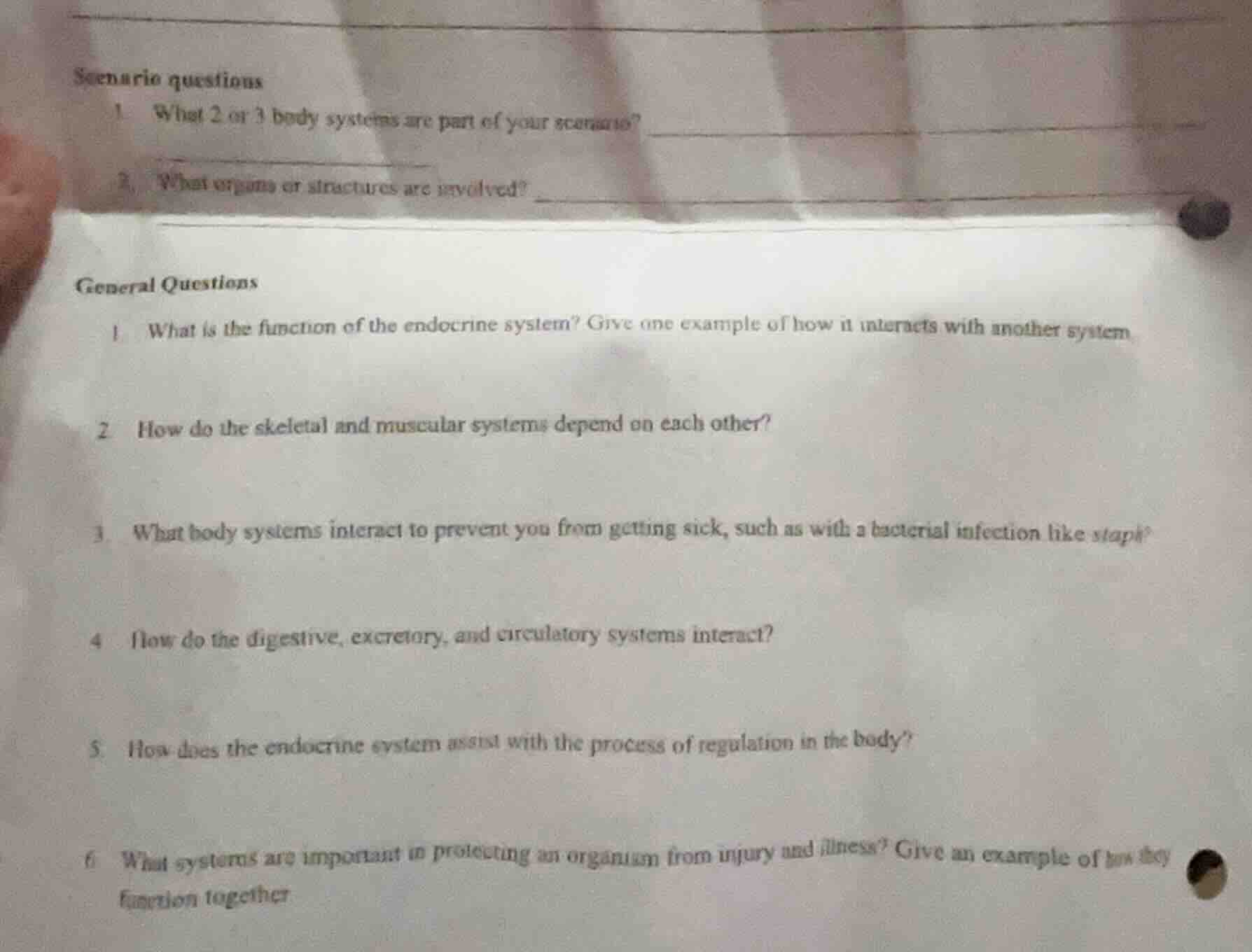
scenario questions
- what 2 or 3 body systems are part of your scenario?
- what organs or structures are involved?
general questions
- what is the function of the endocrine system? give one example of how it interacts with another system.
- how do the skeletal and muscular systems depend on each other?
- what body systems interact to prevent you from getting sick, such as with a bacterial infection like staph?
- how do the digestive, excretory, and circulatory systems interact?
- how does the endocrine system assist with the process of regulation in the body?
- what systems are important in protecting an organism from injury and illness? give an example of how they function together
To answer these questions, we'll address each one using knowledge of human body systems (from the Natural Science discipline, subfield Biology):
General Question 1: Function of the Endocrine System & Interaction
The endocrine system’s function is to secrete hormones (chemical messengers) that regulate growth, metabolism, reproduction, and other bodily processes. For interaction, the endocrine system works with the nervous system: the hypothalamus (part of the brain, nervous system) controls the pituitary gland (endocrine gland), which then releases hormones to regulate other glands (e.g., thyroid, adrenal). Another example: the endocrine system interacts with the reproductive system—hormones like estrogen/progesterone (endocrine) regulate menstrual cycles and pregnancy (reproductive).
The skeletal system provides structure, protection, and attachment points for muscles. The muscular system (skeletal muscles) attaches to bones via tendons. Muscles contract to pull on bones, enabling movement (e.g., biceps contracting to bend the elbow, using the radius/ulna bones). Without bones, muscles would lack leverage; without muscles, bones can’t move.
The immune system (fights pathogens), integumentary system (skin/barrier), and circulatory system (transports immune cells) interact. Skin (integumentary) acts as a physical barrier; if breached, immune cells (e.g., white blood cells) from the circulatory system travel to the site, and the immune system (lymphocytes, antibodies) targets the bacteria.

Snap & solve any problem in the app
Get step-by-step solutions on Sovi AI
Photo-based solutions with guided steps
Explore more problems and detailed explanations
Function: Secretes hormones to regulate growth, metabolism, reproduction, and homeostasis. Example interaction: The endocrine system (via the pituitary gland) releases hormones that regulate the reproductive system (e.g., estrogen production for menstrual cycles).