QUESTION IMAGE
Question
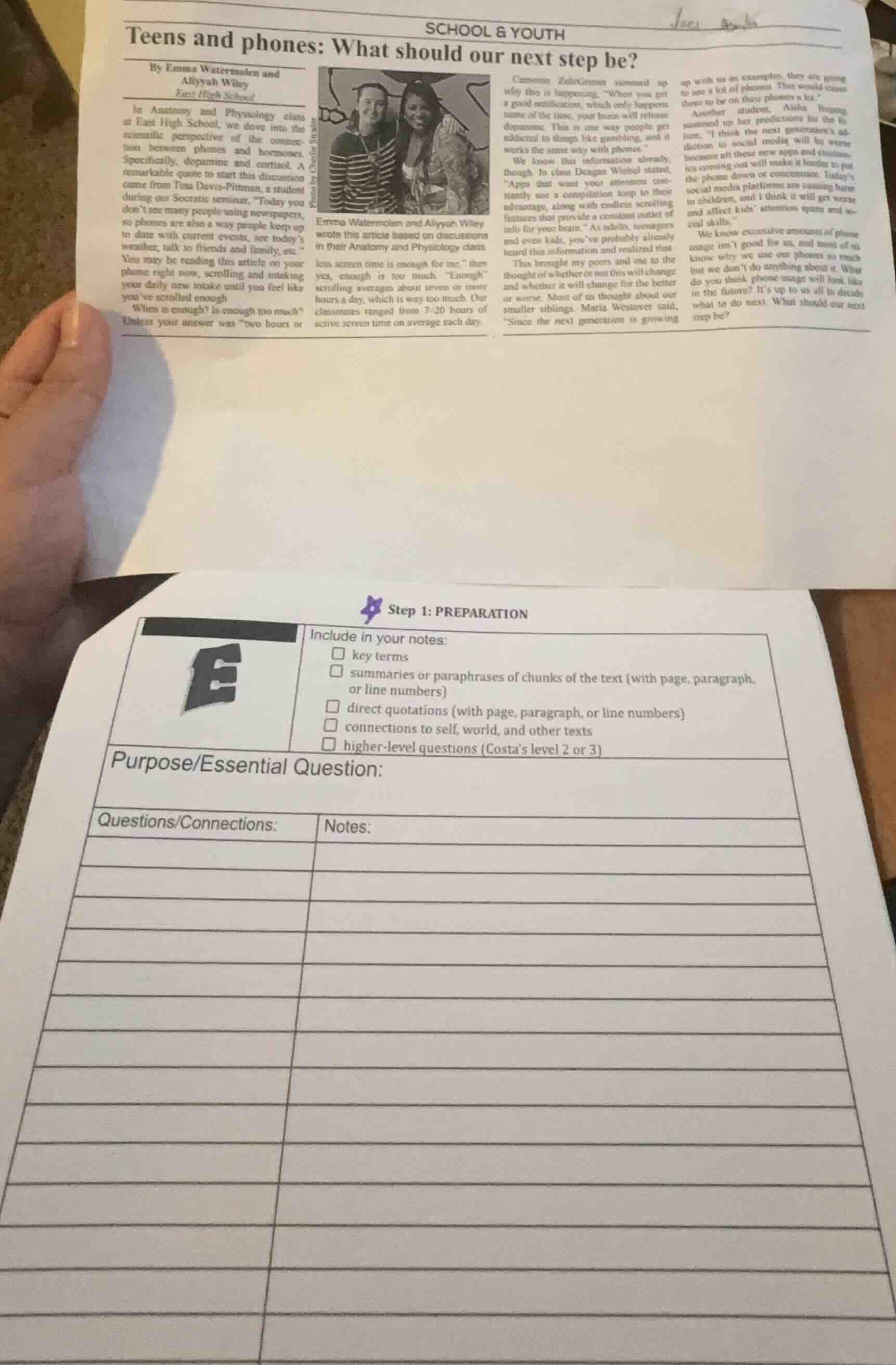
school & youth
teens and phones: what should our next step be?
by emma watermolen and
allyyah wiley
east high school
in anatomy and physiology class
at east high school, we dove into the
scientific perspective of the connec-
tion between phones and hormones.
specifically, dopamine and cortisol. a
remarkable quote to start this discussion
came from tina davis - pinman, a student
during our socratic seminar, “today you
don’t see many people using newspapers,
so phones are also a way people keep up
to date with current events, see today’s
weather, talk to friends and family, etc.”
you may be reading this article on your
phone right now, scrolling and intaking
your daily news intake until you feel like
you’ve scrolled enough
when is enough? is enough too much?
unless your answer was “two hours or
emma watermolen and allyyah wiley
wrote this article based on discussions
in their anatomy and physiology class
less screen time is enough for me,” then
yes, enough is too much. “enough”
scrolling averages about seven or more
hours a day, which is way too much. our
classmates ranged from 7 - 20 hours of
active screen time on average each day.
cameron zahn - ostman summed up
why they is happening, “when you get
a good notification, which only happens
some of the time, your brain will release
dopamine. this is one way people get
addicted to things like gambling, and it
works the same way with phones.”
we know this information already,
though. in class deagan wiebel stated,
“apps that want your attention con-
stantly use a compilation loop to their
advantage, along with endless scrolling
features that provide a constant outlet of
tools for your brain.” as adults, teenagers
and even kids, you’ve probably already
learned this information and realized that
this brought my peers and me to the
thought of whether or not this will change
and whether it will change for the better
or worse. most of us thought about our
smaller siblings. marta weslover said,
“since the next generation is growing
up with us as examples, they are going
to see a lot of phones. this would cause
them to be on their phones a lot.”
another student, aisha, hojung
summed up her predictions for the fu-
ture, “i think the next generation’s ad-
diction to social media will be worse
because all these new apps and enthusi-
as coming out will make it harder to put
the phone down or concentrate. today’s
social media platforms are causing harm
to children, and i think it will get worse
and affect kids’ attention spans and so-
cial skills.”
we know excessive amounts of phone
usage isn’t good for us, and most of us
know why we use our phones so much
but we don’t do anything about it. what
do you think phone usage will look like
in the future? it’s up to us all to decide
what to do next. what should our next
step be?
step 1: preparation
include in your notes:
□ key terms
□ summaries or paraphrases of chunks of the text (with page, paragraph,
or line numbers)
□ direct quotations (with page, paragraph, or line numbers)
□ connections to self, world, and other texts
□ higher - level questions (costa’s level 2 or 3)
purpose/essential question:
questions/connections: notes:
To complete the preparation for analyzing the article "Teens and phones: What should our next step be?", we can follow these steps to fill in the notes:
Key Terms:
- Dopamine and Cortisol: Hormones related to the connection between phones and teens' behavior (mentioned in the article as part of the scientific perspective).
- Socratic Seminar: A discussion method used during the article's creation (from Tina Davis - Pinman's quote).
- Screen Time: The amount of time spent on phones (e.g., "enough scrolling averages about seven or more hours a day").
- Social Media Platforms: Platforms affecting children's attention and social skills (as per Aisha's prediction).
Summaries or Paraphrases:
- Paragraph 1 (approximate): In Anatomy and Physiology class at East High School, the connection between phones and hormones (dopamine, cortisol) is explored. A student's quote from a Socratic seminar highlights phones as a way to stay updated, and the article addresses phone use while reading it.
- Paragraph about Screen Time: Students' screen time ranges from 7 - 20 hours daily. "Enough" scrolling is about 7+ hours, which is considered too much. Apps are designed to capture attention with features that stimulate the brain.
- Future Predictions (Aisha's): The next generation's addiction to social media will worsen with new apps, making it hard to put phones down, harming children's attention and social skills.
Direct Quotations:
- "Today you don’t see many people using newspapers, so phones are also a way people keep up to date with current events, see today’s weather, talk to friends and family, etc." (Tina Davis - Pinman, Socratic seminar)
- "When you get a good notification, which only happens some of the time, your brain will release dopamine. This is one way people get addicted to things like gambling, and it works the same way with phones." (Cameron ZelinOttman)
- "I think the next generation’s addiction to social media will be worse because all these new apps and extensions coming out will make it harder to put the phone down or concentrate. Today’s social media platforms are causing harm to children, and I think it will get worse and affect kids’ attention spans and social skills." (Aisha)
Connections to Self, World, and Other Texts:
- Self: Many of us use phones while reading this article, showing how ingrained phone use is. Personally, I might spend hours scrolling, similar to the students in the article.
- World: The article reflects a global issue of increasing phone use among teens, with social media's impact on mental health and social skills being a widespread concern (similar to discussions about screen time in other countries).
- Other Texts: This article relates to articles about digital addiction, where dopamine's role in addiction (like in gambling) is also discussed, showing a common theme in behavioral science.
Higher - level Questions (Costa’s level 2 or 3):
- Level 2 (Analysis): How do the design features of apps contribute to increased phone addiction?
- Level 3 (Evaluation): What policies could be implemented to reduce the negative impact of phone use on teens, and how effective would they be?
- Level 3 (Synthesis): How can we balance the benefits of phone use (staying informed, connecting with others) with reducing its negative effects?
Purpose/Essential Question:
The purpose of the article is to explore the connection between teen phone use, hormones, and its future impact, and to prompt readers to consider what the next step should be regardi…

Snap & solve any problem in the app
Get step-by-step solutions on Sovi AI
Photo-based solutions with guided steps
Explore more problems and detailed explanations
To complete the preparation for analyzing the article "Teens and phones: What should our next step be?", we can follow these steps to fill in the notes:
Key Terms:
- Dopamine and Cortisol: Hormones related to the connection between phones and teens' behavior (mentioned in the article as part of the scientific perspective).
- Socratic Seminar: A discussion method used during the article's creation (from Tina Davis - Pinman's quote).
- Screen Time: The amount of time spent on phones (e.g., "enough scrolling averages about seven or more hours a day").
- Social Media Platforms: Platforms affecting children's attention and social skills (as per Aisha's prediction).
Summaries or Paraphrases:
- Paragraph 1 (approximate): In Anatomy and Physiology class at East High School, the connection between phones and hormones (dopamine, cortisol) is explored. A student's quote from a Socratic seminar highlights phones as a way to stay updated, and the article addresses phone use while reading it.
- Paragraph about Screen Time: Students' screen time ranges from 7 - 20 hours daily. "Enough" scrolling is about 7+ hours, which is considered too much. Apps are designed to capture attention with features that stimulate the brain.
- Future Predictions (Aisha's): The next generation's addiction to social media will worsen with new apps, making it hard to put phones down, harming children's attention and social skills.
Direct Quotations:
- "Today you don’t see many people using newspapers, so phones are also a way people keep up to date with current events, see today’s weather, talk to friends and family, etc." (Tina Davis - Pinman, Socratic seminar)
- "When you get a good notification, which only happens some of the time, your brain will release dopamine. This is one way people get addicted to things like gambling, and it works the same way with phones." (Cameron ZelinOttman)
- "I think the next generation’s addiction to social media will be worse because all these new apps and extensions coming out will make it harder to put the phone down or concentrate. Today’s social media platforms are causing harm to children, and I think it will get worse and affect kids’ attention spans and social skills." (Aisha)
Connections to Self, World, and Other Texts:
- Self: Many of us use phones while reading this article, showing how ingrained phone use is. Personally, I might spend hours scrolling, similar to the students in the article.
- World: The article reflects a global issue of increasing phone use among teens, with social media's impact on mental health and social skills being a widespread concern (similar to discussions about screen time in other countries).
- Other Texts: This article relates to articles about digital addiction, where dopamine's role in addiction (like in gambling) is also discussed, showing a common theme in behavioral science.
Higher - level Questions (Costa’s level 2 or 3):
- Level 2 (Analysis): How do the design features of apps contribute to increased phone addiction?
- Level 3 (Evaluation): What policies could be implemented to reduce the negative impact of phone use on teens, and how effective would they be?
- Level 3 (Synthesis): How can we balance the benefits of phone use (staying informed, connecting with others) with reducing its negative effects?
Purpose/Essential Question:
The purpose of the article is to explore the connection between teen phone use, hormones, and its future impact, and to prompt readers to consider what the next step should be regarding phone use. The essential question is: "What should our next step be to address teen phone use, considering its psychological, social, and scientific aspects?"
Questions/Connections and Notes Table:
| Questions/Connections | Notes |
|---|---|
| What is the range of students' daily screen time? | 7 - 20 hours on average. |
| How do apps attract attention? | Use features to stimulate the brain, constant outlet for the brain. |
| How does this article connect to my phone use? | I use my phone while reading, spend hours scrolling. |
| What global issues does this reflect? | Global teen phone use, social media impact on mental health. |
| What other texts relate to this? | Texts on digital addiction, dopamine in addiction. |
| What policies can reduce phone harm? | (Open - ended, need to brainstorm) |
| How to balance phone benefits and harms? | (Open - ended, need to brainstorm) |
If you want to focus on a particular section (e.g., only key terms, or only questions), you can further refine these notes.