QUESTION IMAGE
Question
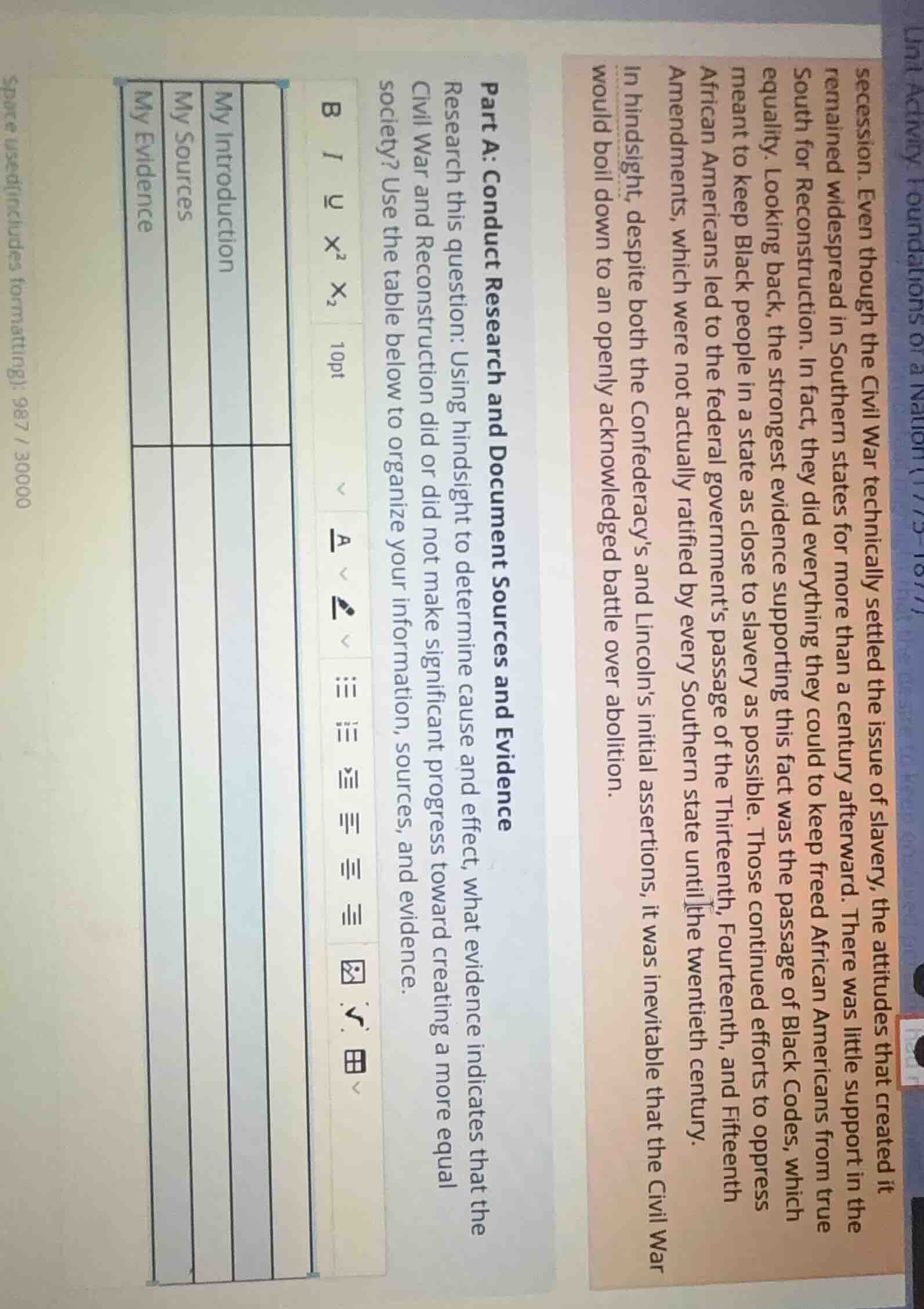
secession. even though the civil war technically settled the issue of slavery, the attitudes that created it remained widespread in southern states for more than a century afterward. there was little support in the south for reconstruction. in fact, they did everything they could to keep freed african americans from true equality. looking back, the strongest evidence supporting this fact was the passage of black codes, which meant to keep black people in a state as close to slavery as possible. those continued efforts to oppress african americans led to the federal government’s passage of the thirteenth, fourteenth, and fifteenth amendments, which were not actually ratified by every southern state until the twentieth century. in hindsight, despite both the confederacy’s and lincoln’s initial assertions, it was inevitable that the civil war would boil down to an openly acknowledged battle over abolition. part a: conduct research and document sources and evidence research this question: using hindsight to determine cause and effect, what evidence indicates that the civil war and reconstruction did or did not make significant progress toward creating a more equal society? use the table below to organize your information, sources, and evidence. my introduction my sources my evidence
To answer this, we analyze the Civil War and Reconstruction's impact on equality:
My Introduction:
The Civil War and Reconstruction era was a pivotal attempt to reshape American society toward racial equality, though progress was fraught with challenges. The war ended slavery, but Reconstruction’s efforts (like Black Codes, amendments) revealed a complex battle between advancing and resisting equality.
My Sources:
- Primary Sources: The Thirteenth, Fourteenth, Fifteenth Amendments (legal documents), Black Codes from Southern states (e.g., Mississippi’s 1865 Black Code restricting Black labor), and letters/diaries of formerly enslaved people (e.g., narratives of sharecropping struggles).
- Secondary Sources: Books like Reconstruction: America's Unfinished Revolution, 1863 - 1877 by Eric Foner (analyzes political/social changes) and scholarly articles on Jim Crow’s origins (showing post - Reconstruction rollback of rights).
My Evidence:
- Cause of Inequality Persistence: Southern elites’ resistance (e.g., Black Codes enforced racial hierarchy, limiting Black voting, employment, and landownership). The federal government’s waning commitment (end of Reconstruction in 1877) let white supremacist groups (e.g., Ku Klux Klan) terrorize Black communities.
- Effect on Equality Progress: The Thirteenth Amendment (1865) abolished slavery, Fourteenth (1868) granted citizenship and equal protection, Fifteenth (1870) gave Black men the vote—legal steps toward equality. However, Southern states evaded these via literacy tests, poll taxes, and segregation laws, showing progress was incomplete and temporary.

Snap & solve any problem in the app
Get step-by-step solutions on Sovi AI
Photo-based solutions with guided steps
Explore more problems and detailed explanations
My Introduction:
The Civil War and Reconstruction aimed to create a more equal society by ending slavery and granting legal rights to Black Americans, yet deep - rooted white supremacy and political compromises limited true progress, leading to a century of continued struggle for racial equality.
My Sources:
- Primary: Thirteenth, Fourteenth, Fifteenth Amendments; Mississippi 1865 Black Code; Narratives of formerly enslaved people (e.g., Narrative of the Life of Frederick Douglass).
- Secondary: Reconstruction: America's Unfinished Revolution, 1863 - 1877 (Eric Foner); “The Origins of Jim Crow” (scholarly article on post - Reconstruction segregation).
My Evidence:
- Cause of Inequality: Southern states’ Black Codes (enforcing racial subordination) and the federal government’s withdrawal of Reconstruction support (1877) empowered white supremacist backlash.
- Effect on Progress: Constitutional amendments (13th - 15th) provided legal equality on paper, but Southern states’ evasion (e.g., literacy tests) and violence (e.g., KKK) created a “separate but unequal” reality, delaying true equality until the 20th - century civil rights movement.