QUESTION IMAGE
Question
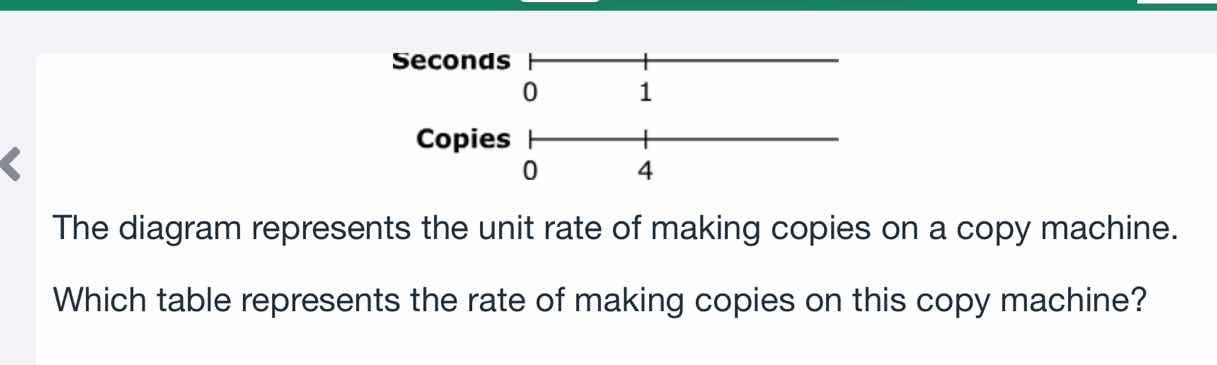
seconds 0 1
copies 0 4
the diagram represents the unit rate of making copies on a copy machine.
which table represents the rate of making copies on this copy machine?
To solve this, we first determine the unit rate from the diagram. The diagram shows that in 1 second, 4 copies are made. So the rate is 4 copies per second.
A table representing this rate should have a relationship where the number of copies (let's call it \( C \)) is equal to 4 times the number of seconds (let's call it \( t \)), so \( C = 4t \).
Let's check possible tables:
- For \( t = 0 \) seconds, \( C = 4(0) = 0 \) copies.
- For \( t = 1 \) second, \( C = 4(1) = 4 \) copies.
- For \( t = 2 \) seconds, \( C = 4(2) = 8 \) copies.
- For \( t = 3 \) seconds, \( C = 4(3) = 12 \) copies. And so on.
So a correct table would have rows like:
| Seconds (\( t \)) | Copies (\( C \)) |
|---|---|
| 1 | 4 |
| 2 | 8 |
| 3 | 12 |
(Note: Since the actual tables to choose from are not provided here, but the key is to identify the table where the number of copies is 4 times the number of seconds. For example, if there are options, we check which one follows \( C = 4t \).)
If we assume typical options (even though not shown), the table with seconds and copies in the ratio 1:4 (and proportional for other times) is the correct one. For instance, if an option has (2, 8), (3, 12), etc., that's the one.
Since the problem is about rates and proportional relationships, the key is recognizing the unit rate (4 copies per second) and finding the table that reflects \( \text{Copies} = 4 \times \text{Seconds} \).

Snap & solve any problem in the app
Get step-by-step solutions on Sovi AI
Photo-based solutions with guided steps
Explore more problems and detailed explanations
To solve this, we first determine the unit rate from the diagram. The diagram shows that in 1 second, 4 copies are made. So the rate is 4 copies per second.
A table representing this rate should have a relationship where the number of copies (let's call it \( C \)) is equal to 4 times the number of seconds (let's call it \( t \)), so \( C = 4t \).
Let's check possible tables:
- For \( t = 0 \) seconds, \( C = 4(0) = 0 \) copies.
- For \( t = 1 \) second, \( C = 4(1) = 4 \) copies.
- For \( t = 2 \) seconds, \( C = 4(2) = 8 \) copies.
- For \( t = 3 \) seconds, \( C = 4(3) = 12 \) copies. And so on.
So a correct table would have rows like:
| Seconds (\( t \)) | Copies (\( C \)) |
|---|---|
| 1 | 4 |
| 2 | 8 |
| 3 | 12 |
(Note: Since the actual tables to choose from are not provided here, but the key is to identify the table where the number of copies is 4 times the number of seconds. For example, if there are options, we check which one follows \( C = 4t \).)
If we assume typical options (even though not shown), the table with seconds and copies in the ratio 1:4 (and proportional for other times) is the correct one. For instance, if an option has (2, 8), (3, 12), etc., that's the one.
Since the problem is about rates and proportional relationships, the key is recognizing the unit rate (4 copies per second) and finding the table that reflects \( \text{Copies} = 4 \times \text{Seconds} \).