QUESTION IMAGE
Question
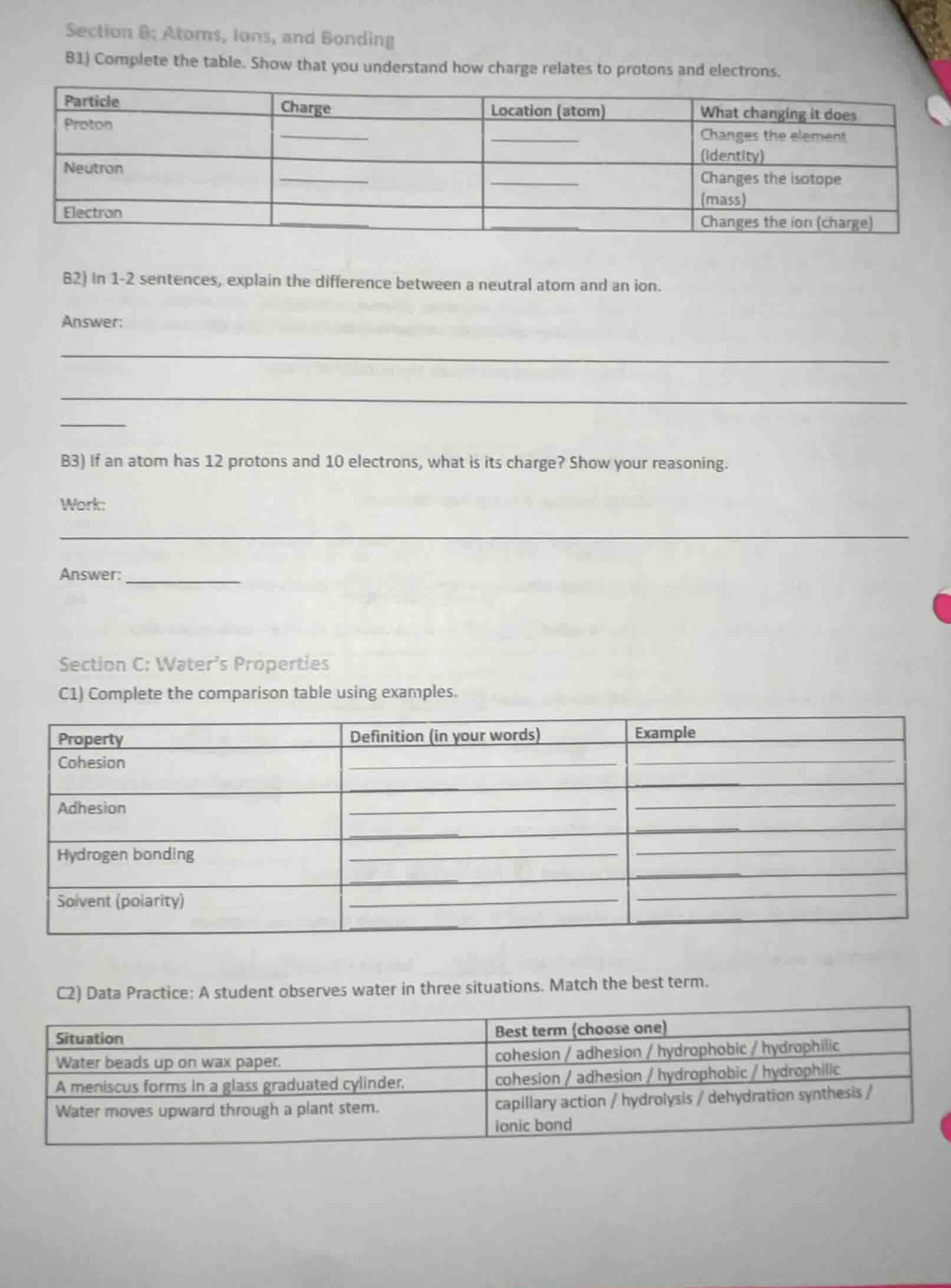
section b: atoms, ions, and bonding
b1) complete the table. show that you understand how charge relates to protons and electrons.
| particle | charge | location (atom) | what changing it does |
|---|---|---|---|
| neutron | ______ | ______ | changes the isotope (mass) |
| electron | ______ | ______ | changes the ion (charge) |
b2) in 1 - 2 sentences, explain the difference between a neutral atom and an ion.
answer:
_____________________________________________________________________
_____________________________________________________________________
______
b3) if an atom has 12 protons and 10 electrons, what is its charge? show your reasoning.
work:
_____________________________________________________________________
answer: __________
section c: water’s properties
c1) complete the comparison table using examples.
| property | definition (in your words) | example |
|---|---|---|
| adhesion | ______ | ______ |
| hydrogen bonding | ______ | ______ |
| solvent (polarity) | ______ | ______ |
c2) data practice: a student observes water in three situations. match the best term.
| situation | best term (choose one) |
|---|---|
| a meniscus forms in a glass graduated cylinder. | cohesion / adhesion / hydrophobic / hydrophilic |
| water moves upward through a plant stem. | capillary action / hydrolysis / dehydration synthesis / ionic bond |
B1)
| Particle | Charge | Location (atom) | What changing it does |
|---|---|---|---|
| Neutron | \(0\) (or neutral) | Nucleus | Changes the isotope (mass) |
| Electron | \(-1\) (or negative) | Electron cloud (outside nucleus) | Changes the ion (charge) |
B2)
A neutral atom has an equal number of protons (positive charge) and electrons (negative charge, so their charges cancel out, resulting in a net charge of zero. An ion is an atom (or group of atoms) that has gained or lost electrons, so the number of protons and electrons is unequal, giving it a net positive or negative charge.
Step1: Recall charge of particles
Protons have a charge of \(+1\), electrons have a charge of \(-1\). Neutrons have no charge, so we ignore them here.
Step2: Calculate total positive charge
Number of protons = 12, so total positive charge = \(12\times(+1)= +12\)
Step3: Calculate total negative charge
Number of electrons = 10, so total negative charge = \(10\times(-1)= -10\)
Step4: Find net charge
Net charge = total positive charge + total negative charge = \(+12 + (-10)= +2\)

Snap & solve any problem in the app
Get step-by-step solutions on Sovi AI
Photo-based solutions with guided steps
Explore more problems and detailed explanations
A neutral atom has equal protons and electrons (net charge 0), while an ion has unequal protons and electrons (net positive/negative charge) due to electron gain/loss.