QUESTION IMAGE
Question
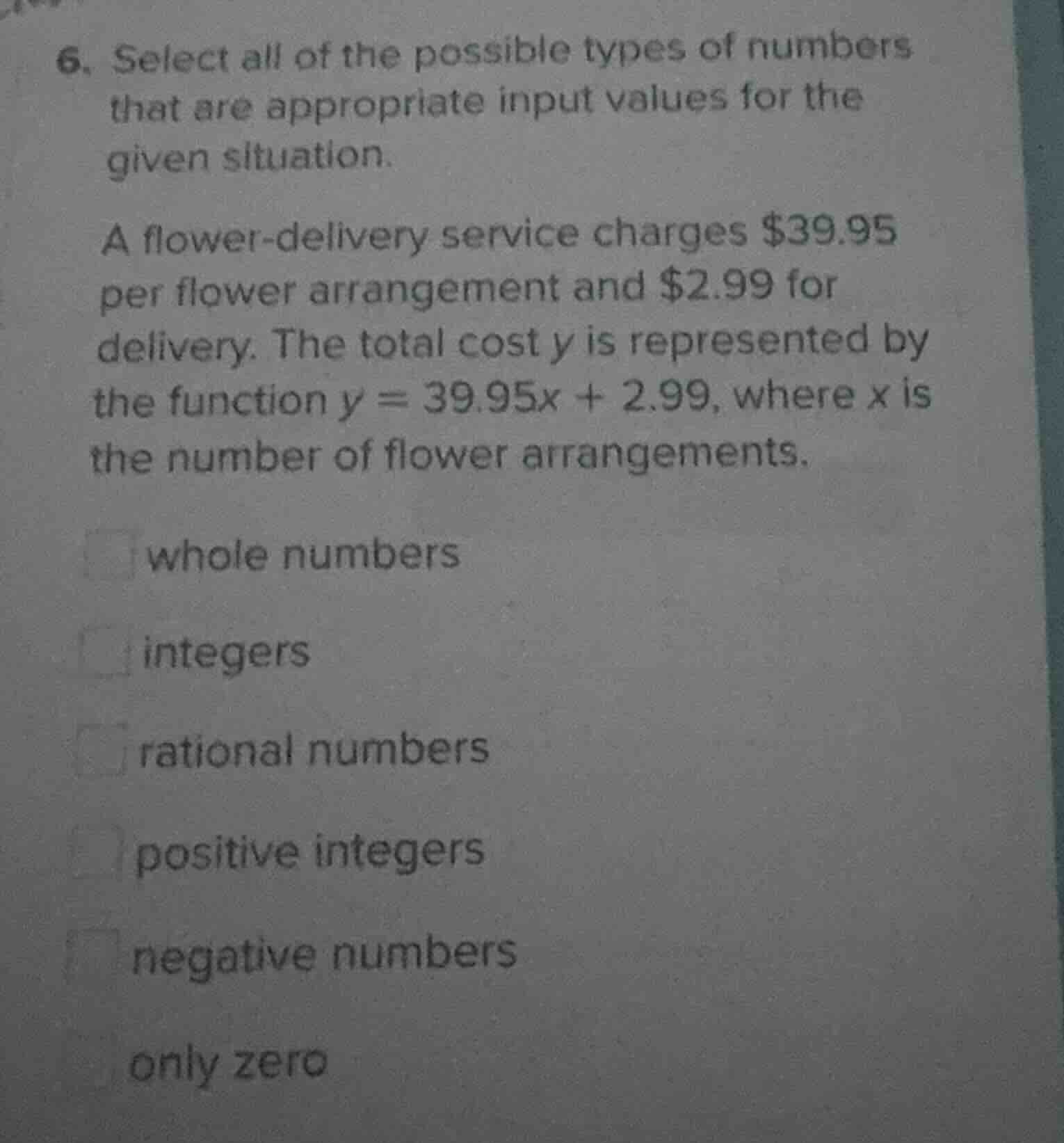
- select all of the possible types of numbers that are appropriate input values for the given situation. a flower - delivery service charges $39.95 per flower arrangement and $2.99 for delivery. the total cost y is represented by the function $y = 39.95x + 2.99$, where x is the number of flower arrangements. whole numbers integers rational numbers positive integers negative numbers only zero
Brief Explanations
- Whole numbers: The number of flower arrangements can be 0, 1, 2, ..., so whole numbers (non - negative integers) are appropriate. Since \(x\) represents the number of flower arrangements, it can be 0 (no arrangements) or positive whole numbers.
- Integers: But integers include negative numbers, and we can't have a negative number of flower arrangements. However, the set of whole numbers is a subset of integers, and the valid integer values here are non - negative integers (whole numbers). But when considering the broader set, since the valid integer values (non - negative) are included, and the function can take \(x = 0,1,2,\cdots\) (which are integers), we can say integers in the sense of non - negative integers. But more precisely, the valid integers are non - negative.
- Rational numbers: The number of flower arrangements \(x\) is a non - negative integer, and all integers are rational numbers (since any integer \(n\) can be written as \(\frac{n}{1}\)). Also, if we consider the context, even though \(x\) is an integer, it is a rational number.
- Positive integers: The number of flower arrangements can be 1, 2, 3, ... (positive integers) as well as 0. But positive integers are part of the valid values (when \(x\gt0\)).
- Negative numbers: We can't have a negative number of flower arrangements, so negative numbers are not appropriate.
- Only zero: We can have more than zero flower arrangements (e.g., 1, 2, ...), so this is not correct.

Snap & solve any problem in the app
Get step-by-step solutions on Sovi AI
Photo-based solutions with guided steps
Explore more problems and detailed explanations
whole numbers, integers, rational numbers, positive integers